India Namibia Joint Trade Committee and Critical Minerals Partnership
Source:PIB ↗
આ શા માટે મહત્વનું છે
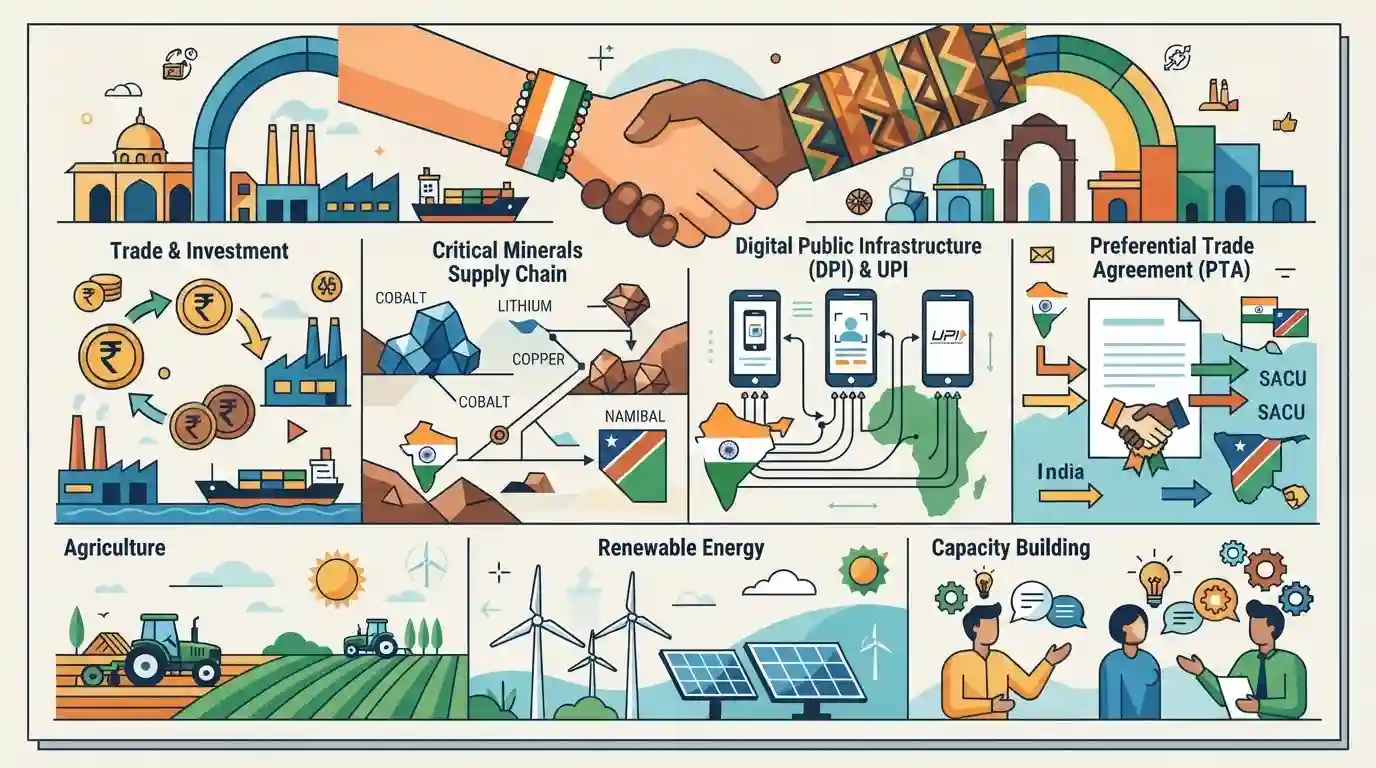
Namibia is a crucial partner for India's engagement with the resource-rich African continent. Cooperation in critical minerals secures India's supply chains for energy transitions, while sharing DPIs like UPI expands India's soft power and digital diplomacy. Additionally, progress on the India-SACU PTA is vital for enhancing broader economic integration with Southern Africa.
સારાંશ
The 4th Session of the India-Namibia Joint Trade Committee (JTC) convened in New Delhi to deepen bilateral economic and commercial ties. The dialogue comprehensively reviewed the current state of trade, highlighting avenues for expansion in strategic areas such as critical minerals, generic pharmaceuticals, and the export of India's Digital Public Infrastructure (DPI), including UPI. A focal point of the discussions was accelerating the conclusion of the India-SACU (Southern African Customs Union) Preferential Trade Agreement (PTA) to eliminate non-tariff barriers and facilitate smoother market access. The session reaffirmed a mutual commitment to leveraging synergies in agriculture, renewable energy, and capacity building for sustained, co-developed economic growth.
મુખ્ય મુદ્દા
- The 4th Session of the India-Namibia Joint Trade Committee (JTC) was held in New Delhi to review and enhance bilateral trade and investment relations.
- Discussions focused on strategic sectors such as critical minerals, health and pharmaceuticals, and the implementation of Digital Public Infrastructure (DPI) like UPI.
- Both nations emphasized the importance of expediting negotiations for the India-SACU Preferential Trade Agreement (PTA) to boost economic cooperation.
- Collaborations were also explored in agriculture, renewable energy, capacity building, and B2B engagements.
મહત્વપૂર્ણ શબ્દો
Southern African Customs Union (SACU)

A regional trade bloc established in 1910, consisting of South Africa, Botswana, Namibia, Lesotho, and Eswatini. It is the world's oldest existing customs union, maintaining a common external tariff.
UPSC context
GS Paper II (Bilateral/Regional Groupings) & GS Paper III (Economy). Tests understanding of regional trade blocs and India's economic diplomacy with Africa.
India-SACU Preferential Trade Agreement (PTA)
A proposed trade agreement between India and the Southern African Customs Union (SACU) aimed at reducing tariffs on select goods, eliminating non-tariff barriers, and boosting bilateral economic engagement.
UPSC context
GS Paper II (Bilateral Agreements) & GS Paper III (Trade). Tests knowledge of India's trade policy and preferential versus free trade agreements.
Digital Public Infrastructure (DPI)
Interoperable digital platforms—such as digital identity, fast payment systems, and data exchange networks—that enable the delivery of public and private services at a societal scale.
UPSC context
GS Paper III (Science & Technology/Economy). Tests understanding of India's digital governance model (India Stack) and its deployment in global partnerships.
Unified Payments Interface (UPI)
An instant real-time payment system developed by the National Payments Corporation of India (NPCI) facilitating inter-bank peer-to-peer and person-to-merchant transactions through mobile devices.
UPSC context
GS Paper III (Economy/S&T). Tests understanding of digital financial inclusion, fintech innovations, and India's external economic outreach.
India-Namibia Joint Trade Committee
The primary bilateral institutional mechanism established to review, expand, and guide trade, investment, and economic cooperation, including critical minerals and pharmaceuticals, between India and Namibia.
UPSC context
GS Paper II (Bilateral Relations). Tests knowledge of institutional frameworks driving India-Africa economic ties and strategic mineral partnerships.
પ્રિલિમ્સ ટ્રેપ
All member states of the Southern African Customs Union (SACU) share a common currency framework and peg their national currencies to the South African Rand.
Botswana is a member of SACU but opted out of the Common Monetary Area (CMA) and does not peg its currency (the Pula) to the South African Rand. All other SACU members do.
સંલગ્ન સ્થિર ખ્યાલો
What is the Southern African Customs Union (SACU) and the Common Monetary Area (CMA)?
- Historical Status: Established in 1910 and headquartered in Windhoek, Namibia, SACU is the world's oldest operating customs union.
- Membership: Comprises five countries: South Africa, Botswana, Namibia, Lesotho, and Eswatini, maintaining a common external tariff.
- CMA Distinction: An allied monetary union where South Africa, Namibia, Lesotho, and Eswatini peg currencies to the Rand; Botswana is NOT a member.
How do Preferential Trade Agreements (PTAs) differ from Free Trade Agreements (FTAs) under WTO?
- Scope of Tariffs: PTAs operate on a 'positive list' where tariff concessions are given only to listed items. FTAs use a 'negative list' of excluded items.
- WTO Legal Basis: PTAs among developing countries are authorized under the 1979 WTO Enabling Clause, bypasssing stricter GATT Article XXIV requirements for FTAs.
- Reciprocity: PTAs can be non-reciprocal (unilateral concessions), whereas FTAs require mutual, reciprocal elimination of duties on substantially all trade.
આંતર-વિષય પેટર્ન
DPI export as strategic soft power
India's export of NPCI's UPI architecture (via Namibia's WayaMe) shifts economic diplomacy from physical infrastructure to digital public goods, countering China's Belt and Road dominance in Africa.
Critical mineral security and EV goals
Joint exploration of lithium and cobalt in Namibia highlights India's shift toward direct domestic value addition to counter Chinese monopoly over critical mineral processing.

SACU's membership nuances and India's UPI-based 'WayaMe' in Namibia are prime targets for multi-statement Prelims questions in 2026.
સંલગ્ન PYQ · 4
સંલગ્ન PYQ · 4
- 2025MainsGS2
India-Africa digital partnership is achieving mutual respect, co-development and long-term institutional partnerships. Elaborate.
- 2021MainsGS2
If the last few decades were of Asia's growth story, the next few are expected to be of Africa's.” In the light of this statement, examine India's influence in Africa in recent years.
- 2025MainsGS3
Mineral resources are fundamental to the country's economy and these are exploited by mining. Why is mining considered an environmental hazard? Explain the remedial measures required to reduce the environmental hazard due to mining.
- 2023MainsGS3
What is the status of digitalization in the Indian economy? Examine the problems faced in this regard and suggest improvements.
