TB Mukt Bharat Abhiyaan and Parliamentarian Community Mobilization
Source:PIB ↗
ఇది ఎందుకు ముఖ్యం
Achieving the ambitious target of eliminating TB in India by 2025—five years ahead of the global SDG target—demonstrates India's commitment to public health. The campaign exemplifies the "whole of society" approach by integrating technological innovation with grassroots community mobilization (Jan Andolan) and active parliamentary participation, presenting an important model for healthcare governance and disease eradication.
సారాంశం
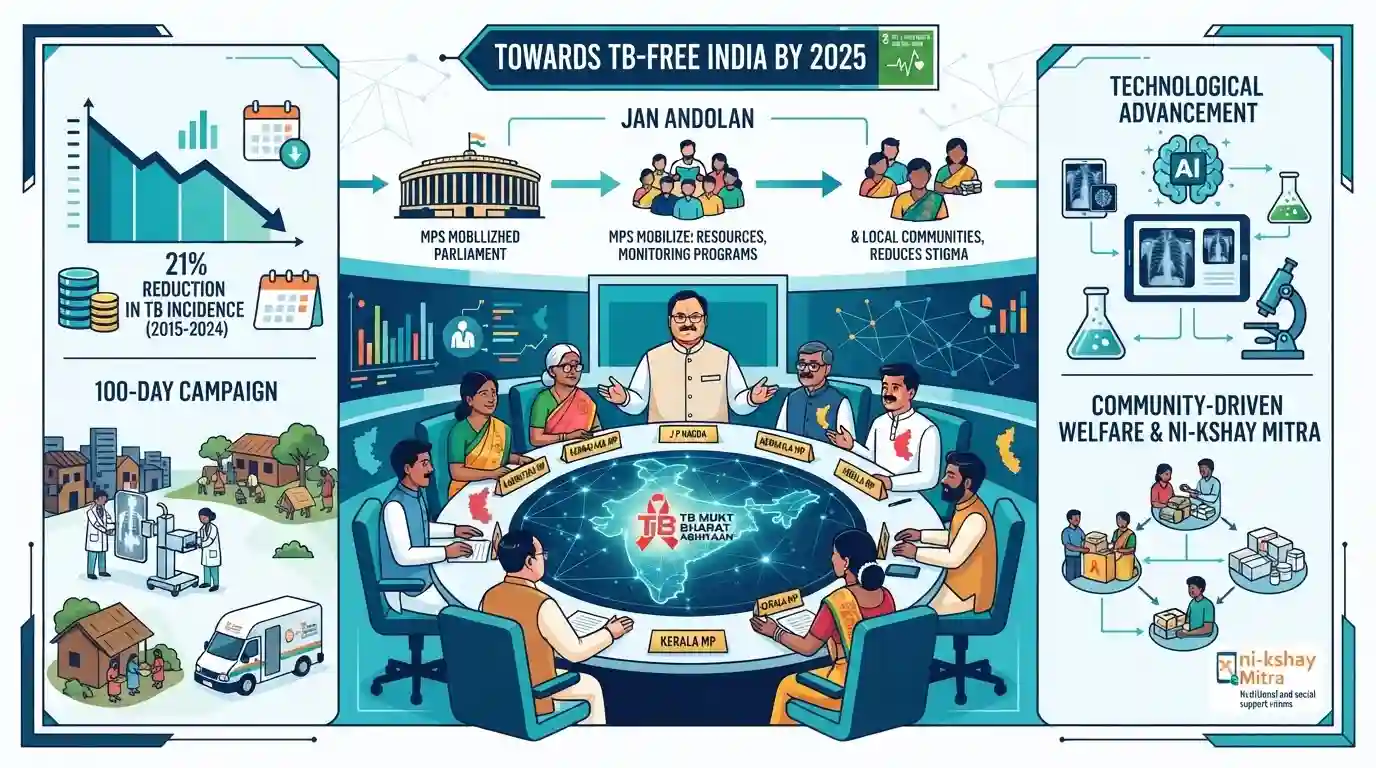
Union Health Minister J P Nadda engaged with Members of Parliament from Karnataka and Keralam to provide further impetus to the TB Mukt Bharat Abhiyaan. By prioritizing a 'Jan Andolan' approach, the government aims to leverage the influence of elected representatives to monitor TB programs, reduce stigma, and mobilize resources at the constituency level. India has made notable progress, recording a 21% reduction in TB incidence between 2015 and 2024, supported by the 100-Day TB campaign which extensively screened vulnerable populations. The overarching strategy integrates technological advancements such as AI-assisted diagnostics with community-driven welfare efforts, notably through the Ni-kshay Mitra initiative, providing holistic support to patients to realize the goal of a TB-free India by 2025.
ముఖ్య అంశాలు
- Union Health Minister J P Nadda chaired an interaction with MPs from Karnataka and Keralam to accelerate the TB Mukt Bharat Abhiyaan by leveraging their leadership for community mobilization.
- India reported a 21% decline in TB incidence from 2015 to 2024, nearly double the global rate, achieving a 92% treatment coverage.
- The 100-Day TB Mukt Bharat Abhiyaan significantly boosted active case finding, screening over 2.02 crore vulnerable individuals in areas like urban slums and migrant clusters.
- Technological interventions, including AI-enabled handheld X-ray units and expanded molecular testing (NAAT), are being utilized alongside grassroots initiatives like Ni-kshay Shivirs.
- The strategy emphasizes a 'Jan Andolan' (people's movement), encouraging the adoption of TB patients by 'Ni-kshay Mitras' who provide nutritional, psychosocial, and livelihood support.
ముఖ్యమైన పదాలు
TB Mukt Bharat Abhiyaan

A flagship national health initiative launched by the Ministry of Health and Family Welfare to eliminate Tuberculosis in India by 2025, five years ahead of the global SDG target.
UPSC context
GS Paper II (Social Justice/Health); tests awareness of national health missions and disease-elimination strategies.
Ni-kshay Mitra
An initiative under the PM TB Mukt Bharat Abhiyaan enabling individuals, corporates, and NGOs to "adopt" TB patients to provide nutritional, diagnostic, or vocational support.
UPSC context
GS Paper II (Social Justice/Governance); tests knowledge of community-driven health programs and public-private partnerships.
Ni-kshay Poshan Yojana
A centrally sponsored direct benefit transfer (DBT) scheme that provides financial assistance (recently increased to ₹1,000 monthly) to TB patients for their nutritional requirements.
UPSC context
GS Paper II (Welfare Schemes); tests knowledge of DBT mechanisms and nutritional safety nets for critical healthcare.
Ayushman Bharat
A flagship health umbrella initiative aiming to achieve Universal Health Coverage through primary-level Ayushman Arogya Mandirs and tertiary/secondary-level PM Jan Arogya Yojana.
UPSC context
GS Paper II (Health Policy); tests understanding of universal healthcare, health insurance, and structured welfare systems.
ప్రిలిమ్స్ ఉచ్చు
India’s TB Mukt Bharat Abhiyaan aims to completely eliminate Tuberculosis by 2030, in exact alignment with the UN Sustainable Development Goals.
India's National TB Elimination target is 2025, which is exactly five years ahead of the global SDG 3.3 target of 2030. UPSC frequently tests these timeline discrepancies.
అనుసంధానమైన స్థిర భావనలు
What are the biological characteristics and primary variants of Tuberculosis?
- Bacterial Pathogen: Caused by the bacterium Mycobacterium tuberculosis, it primarily affects the lungs (pulmonary) but can attack any body part (extrapulmonary).
- Drug Resistance: MDR-TB is resistant to isoniazid and rifampicin. XDR-TB is additionally resistant to fluoroquinolones and second-line injectable drugs.
- BCG Vaccine: The Bacille Calmette-Guérin (BCG) vaccine is administered at birth to provide basic immunity, though its efficacy in adults varies.
What are the key components of the government's Ni-kshay ecosystem?
- Ni-kshay Portal: A centralized IT platform by the Ministry of Health and Family Welfare to track TB patients, manage treatment, and monitor disease incidence globally.
- Ni-kshay Poshan Yojana: Provides ₹500/month via Direct Benefit Transfer (DBT) to notified TB patients for essential nutritional support during their treatment phase.
- Ni-kshay Mitra: A community engagement scheme where donors (individuals, corporates, NGOs) adopt patients to provide nutritional, diagnostic, and vocational aid.
అంతర-అంశ నమూనాలు
AI diagnostics in Public Health
The use of AI-enabled handheld X-rays for TB screening reflects a broader UPSC trend of testing deep-tech applications in tackling endemic public health challenges.
Community-led health and Jan Andolan
Leveraging MPs and citizen volunteers (Ni-kshay Mitras) illustrates the shift from top-down delivery to community mobilization ('Jan Andolan'), mirroring the success of Swachh Bharat.

Expect a multi-statement Prelims question contrasting MDR/XDR-TB mechanisms with India's 2025 elimination timeline and Ni-kshay schemes.
అనుసంధాన PYQలు · 4
అనుసంధాన PYQలు · 4
- 2024MainsGS2
In a crucial domain like the public healthcare system the Indian State should play a vital role to contain the adverse impact of marketisation of the system. Suggest some measures through which the State can enhance the reach of public healthcare at the grassroots level.
- 2021MainsGS2
“Besides being a moral imperative of a Welfare State, primary health structure is a necessary precondition for sustainable development.” Analyze.
- 2019PrelimsGS1
Which of the following are the reasons for the occurrence of multi-drug resistance in microbial pathogens in India? 1. Genetic predisposition of some people 2. Taking incorrect doses of antibiotics to cure diseases 3. Using antibiotics in livestock farming 4. Multiple chronic diseases in some people Select the correct answer using the code given below.
- 2023PrelimsGS1
Consider the following statements in the context of interventions being undertaken under Anaemia Mukt Bharat Strategy: 1. It provides prophylactic calcium supplementation for pre-school children, adolescents and pregnant women. 2. It runs a campaign for delayed cord clamping at the time of child-birth. 3. It provides for periodic deworming to children and adolescents. 4. It addresses non-nutritional causes of anaemia in endemic pockets with special focus on malaria, hemoglobinopathies and fluorosis. How many of the statements given above are correct?
