Parliamentary Committee Report on Bus Transport Modernization
Source:PIB ↗
Why It Matters
A robust public transport network is the backbone of sustainable urban growth. This parliamentary report provides a blueprint for integrating digital technologies, electric mobility, and private capital into the bus transport sector, directly aligning with India's climate commitments, smart city initiatives, and urbanization challenges.
Summary
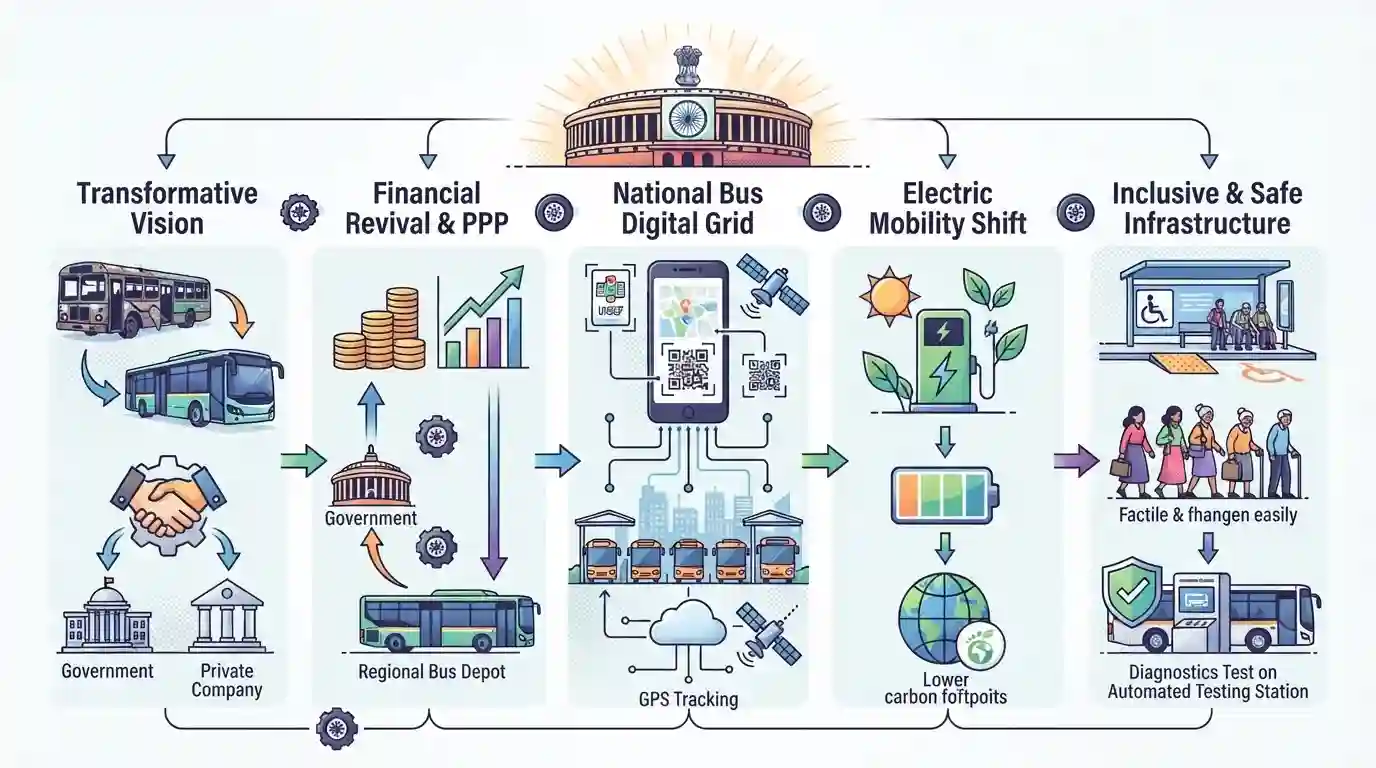
The 392nd Report of the Department-related Parliamentary Standing Committee on Transport, Tourism, and Culture outlines a transformative vision for India's bus transport network. Titled 'Enabling Inclusive, Digital and Sustainable Bus Transport,' the report highlights the critical need to revive financially distressed State Road Transport Undertakings (SRTUs) through Public-Private Partnerships (PPP) and structural reforms. Key recommendations include establishing a National Bus Digital Grid for unified ticketing and tracking, accelerating the shift to electric buses to meet climate goals, and enforcing stringent safety standards via Automated Testing Stations. Furthermore, the committee strongly advocates for gender-inclusive and accessible infrastructure, ensuring public transport serves as a safe and reliable backbone for next-generation urban mobility.
Key Points
- The 392nd Parliamentary Standing Committee report emphasizes modernizing India's bus transport through comprehensive policy, regulation, and Public-Private Partnerships (PPP).
- Advocates for the creation of a 'National Bus Digital Grid' to enable seamless interoperability, live-tracking, and universal digital ticketing across states.
- Pushes for a rapid transition to sustainable mobility by accelerating Electric Vehicle (EV) adoption, introducing scrap-and-lease models, and expanding charging infrastructure at bus terminals.
- Highlights the need for inclusive and safe transit systems, recommending enhanced accessibility for Divyangjan, recruitment of women drivers, and deployment of safety features like CCTVs and panic buttons.
Important Terms
State Road Transport Undertakings (SRTUs)

Government-owned entities operating public bus fleets across Indian states. Many face severe financial distress and operational inefficiencies, requiring urgent structural reforms and Public-Private Partnership (PPP) models for sustainable service delivery.
UPSC context
GS-III (Infrastructure). Highlights the financial health of state utilities, PPP models, and urban mobility challenges.
PM-eBus Sewa
A central government scheme deploying 10,000 electric buses in 100 tier-2 and tier-3 cities on a Public-Private Partnership (PPP) model, aiming to improve urban bus operations and promote clean mobility.
UPSC context
GS-III (Infrastructure & Environment). Tests policies on green mobility, EV adoption, and sustainable urban transport solutions.
National Common Mobility Card (NCMC)
An interoperable, RuPay-based transport card allowing passengers to seamlessly pay for buses, metros, suburban railways, and retail. It operates under the 'One Nation, One Card' vision for unified digital ticketing.
UPSC context
GS-III (Digital Infrastructure). Important for topics on integrated urban mobility, digital payments, and smart city ecosystems.
Parliamentary Standing Committee on Transport, Tourism and Culture
A department-related parliamentary panel overseeing associated ministries. Its 392nd report recommended comprehensive structural, safety, and digital reforms—such as a National Bus Digital Grid—for India's bus transport sector.
UPSC context
GS-II (Polity). Tests the role of parliamentary committees in policy formulation, executive oversight, and legislative accountability.
National Urban Transport Policy
An overarching policy framework emphasizing moving people rather than vehicles. It focuses on systematic urban transport planning, promoting public transport, and non-motorized mobility to address complex urbanization challenges.
UPSC context
GS-III (Urban Development). Foundational to understanding structural gaps in urban transport planning and multi-modal integration.
FAME Scheme
Faster Adoption and Manufacturing of Hybrid and Electric Vehicles (FAME) is India's flagship incentive scheme designed to accelerate domestic EV manufacturing and support the transition of public transport fleets.
UPSC context
GS-III (Environment & Economy). Tests knowledge of India’s climate commitments, EV market stimulation, and green subsidies.
Prelims Trap
The National Bus Terminals Authority is a statutory body established under MoRTH to standardise all state-run terminals.
It is a proposed entity recommended by the 392nd Parliamentary Standing Committee report to separate terminal operations from bus operations, not an active statutory body.
Static Concepts Connected
How is road transport governance split under the Seventh Schedule?
- Union List Entry 23: Covers National Highways, establishing central jurisdiction over major national transit corridors.
- State List Entry 13: Covers municipal tramways, roads, and bridges, giving states primary control over local transport networks.
- Concurrent List Entry 35: Covers mechanically propelled vehicles, allowing both Union and States to legislate on vehicular regulation and motor acts.
What is the mandate and composition of Parliamentary Standing Committees?
- Composition: Consists of 31 members (21 from Lok Sabha, 10 from Rajya Sabha) nominated by the Speaker or Chairman.
- Key Mandate: Examines department bills, budget demands, and policy implementations, submitting advisory reports to Parliament.
- Advisory Power: Recommendations are non-binding on the government, but ministries must submit an Action Taken Report.
Cross-Topic Patterns
Cooperative Federalism in Transport
Modernizing SRTUs via central frameworks tests federal cooperation, as road transport regulation spans concurrent and state lists, requiring consensus on revenue sharing and digitisation.
DPI and Urban Mobility
Integrating FASTag and VAHAN for national permits establishes transport infrastructure as Digital Public Infrastructure (DPI), optimizing cross-border logistics and public transit interoperability.

Mains 2026 may ask how PPP models in terminal management and digital integrations (FASTag/VAHAN) can revive financially distressed SRTUs.
Linked PYQs · 5
Linked PYQs · 5
- 2019PrelimsGS1
In India, which of the following review the independent regulators in sectors like telecommunications, insurance, electricity, etc.? 1. Ad Hoc Committees set up by the Parliament 2. Parliamentary Department Related Standing Committees 3. Finance Commission 4. Financial Sector Legislative Reforms Commission 5. NITI Aayog Select the correct answer using the code given below.
- 2014MainsGS3
National Urban Transport Policy emphasises on 'moving people' instead of 'moving vehicles'. Discuss critically the success of the various strategies of the Government in this regard.
- 2022MainsGS3
Why is Public Private Partnership (PPP) required in infrastructural projects ? Examine the role of PPP model in the redevelopment of Railway Stations in India.
- 2023MainsGS3
The adoption of electric vehicles is rapidly growing worldwide. How do electric vehicles contribute to reducing carbon emissions and what are the key benefits they offer compared to traditional combustion engine vehicles?
- 2025PrelimsGS1
Consider the following types of vehicles : I. Full battery electric vehicles II. Hydrogen fuel cell vehicles III. Fuel cell-electric hybrid vehicles How many of the above are considered as alternative powertrain vehicles?
