National Overseas Scholarship Scheme Reforms for SC Students
Source:PIB ↗
हे का महत्त्वाचे आहे
This article illustrates an important case study in public policy implementation, showcasing how administrative reforms—such as digital onboarding via the SAMAVESH portal and advance financial letters to foreign missions (LoAs)—can tackle chronic implementation issues like funding delays and lack of transparency. This is highly relevant for GS Paper 2 questions on affirmative action, social welfare schemes, and e-governance models.
सारांश
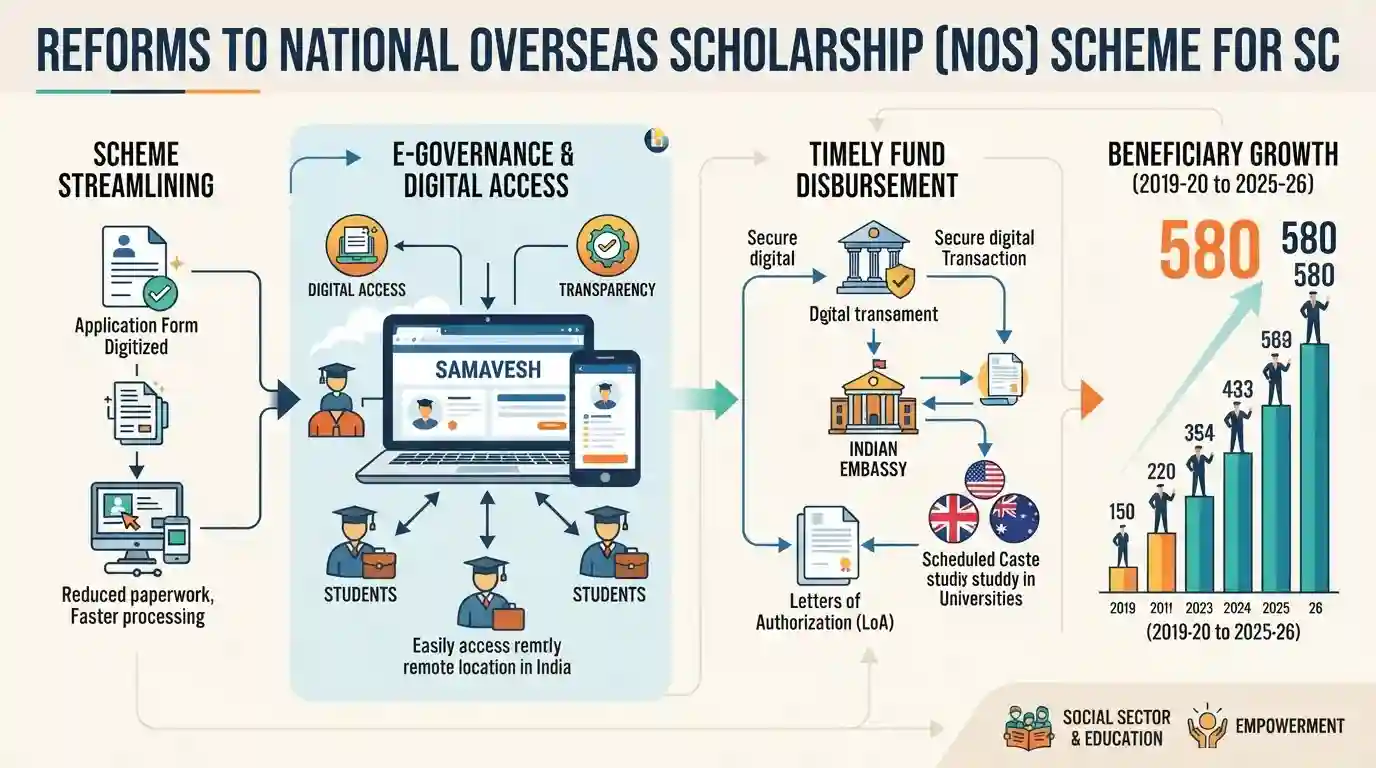
The Central Government has introduced key reforms to the National Overseas Scholarship (NOS) Scheme for Scheduled Castes (SC) to streamline applications and improve fund disbursement. By onboarding the scheme onto the new unified SAMAVESH portal, the government aims to enhance digital access and transparency. Furthermore, utilizing Letters of Authorization (LoA) in advance to Indian Embassies ensures timely financial disbursement for students studying abroad. A total of 580 students have benefited from the scheme between 2019-20 and 2025-26.
मुख्य मुद्दे
- The National Overseas Scholarship (NOS) Scheme for Scheduled Castes is a flaghip scheme run by the Ministry of Social Justice & Empowerment to facilitate overseas higher education (Master's and Ph.D.) for SC students.
- A total of 580 students have been awarded scholarships and enrolled abroad under the NOS scheme from the academic years 2019-20 to 2025-26 (as of August 6, 2026).
- To streamline administrative bottlenecks, the application, scrutiny, data management, and selection processes have been onboarded to the newly launched unified SAMAVESH (Single Access Mechanism for All Verticals of Empowerment & Social Harmony) Portal.
- Funds are disbursed efficiently using Letters of Authorization (LoA) released in advance to concerned Indian Missions and Embassies abroad, directing them to pay universities and students immediately upon receipt of claims.
- To resolve issues of low awareness and poor penetration, the government uses departmental websites, newspaper advertisements, and close coordination with state-level Social Welfare Departments to publicize the scheme.
महत्त्वाच्या संज्ञा
National Overseas Scholarship (NOS) Scheme for Scheduled Castes

A Central Sector Scheme providing full financial assistance to low-income students from Scheduled Castes, Denotified/Nomadic Tribes, and landless agricultural categories to pursue Master's or Ph.D. degrees abroad.
UPSC context
GS Paper II (Welfare Schemes); tests knowledge of affirmative action, educational empowerment, and social inclusion policies.
SAMAVESH Portal
A unified digital gateway launched by the Ministry of Social Justice and Empowerment to streamline applications, data management, scrutiny, and fund disbursements across multiple social welfare and empowerment schemes.
UPSC context
GS Paper II (E-governance); tests understanding of digital initiatives improving transparency and delivery of welfare benefits.
Ministry of Social Justice & Empowerment
The nodal ministry of the Government of India responsible for welfare, social justice, and empowerment of marginalized sections, including Scheduled Castes, OBCs, persons with disabilities, and senior citizens.
UPSC context
GS Paper II (Executive Structure); tests knowledge of ministerial mandates and administrative frameworks for social welfare.
Indian Missions/Embassies
Official diplomatic representations of India in foreign countries, which facilitate the overseas implementation of domestic schemes like NOS by handling local financial disbursements to foreign universities.
UPSC context
GS Paper II (International Relations); tests understanding of diplomatic bodies in facilitating citizen welfare and foreign educational support.
पूर्वपरीक्षा सापळा
The National Overseas Scholarship (NOS) scheme covers undergraduate, postgraduate, and doctoral studies abroad for Scheduled Caste students.
The NOS scheme is strictly restricted to Master's and Ph.D. level courses; it does not fund undergraduate education.
संबंधित स्थिर संकल्पना
Which Constitutional provisions promote the educational advancement of Scheduled Castes?
- Article 15(4): Enables the State to make special provisions, including educational reservations, for the advancement of Scheduled Castes and Scheduled Tribes.
- Article 46: Directs the State to promote with special care the educational and economic interests of the weaker sections, particularly SCs and STs.
How do Central Sector and Centrally Sponsored schemes differ?
- Funding pattern: Central Sector Schemes are 100% funded by the Union, while Centrally Sponsored Schemes feature cost-sharing between the Center and States.
- Implementation agency: Central Sector Schemes are implemented directly by Central Union ministries; Centrally Sponsored schemes are executed by State governments.
आंतर-विषय नमुने
E-Governance in Welfare Administration
Integrating welfare schemes with unified portals like SAMAVESH reflects how digital public infrastructure (GS2 E-Gov) reduces administrative bottlenecks in direct benefit delivery.
Diplomatic Channels and Social Justice
Using Letters of Authorization via Indian Missions abroad showcases how foreign policy apparatus (GS2 IR) is structurally leveraged to execute domestic affirmative action mandates.

2026 Prelims may target the NOS scheme's core design, specifically its restriction to PG/PhD levels and its 100% central funding model.
संबंधित PYQ · 3
संबंधित PYQ · 3
- 2019MainsGS2
Performance of welfare schemes that are implemented for vulnerable sections is not so effective due to absence of their awareness and active involvement at all stages of policy process. Discuss.
- 2023MainsGS2
e-governance, as a critical tool of governance, has ushered in effectiveness, transparency and accountability in governments. What inadequacies hamper the enhancement of these features ?
- 2020PrelimsGS1
Which part of the Constitution of India declares the ideal of Welfare State?
