SMILE Beggary Scheme Rehabilitation Framework and Judicial Guidelines
Source:PIB ↗
কেন এটি গুরুত্বপূর্ণ
Highlights the intersection of executive action and judicial oversight in protecting the marginalized. It serves as a concrete example of a 'rights-based approach' to welfare, transitioning policy responses to begging from criminalization to comprehensive rehabilitation. Crucial for GS2 answers on social justice, vulnerable sections, and human rights.
সারসংক্ষেপ
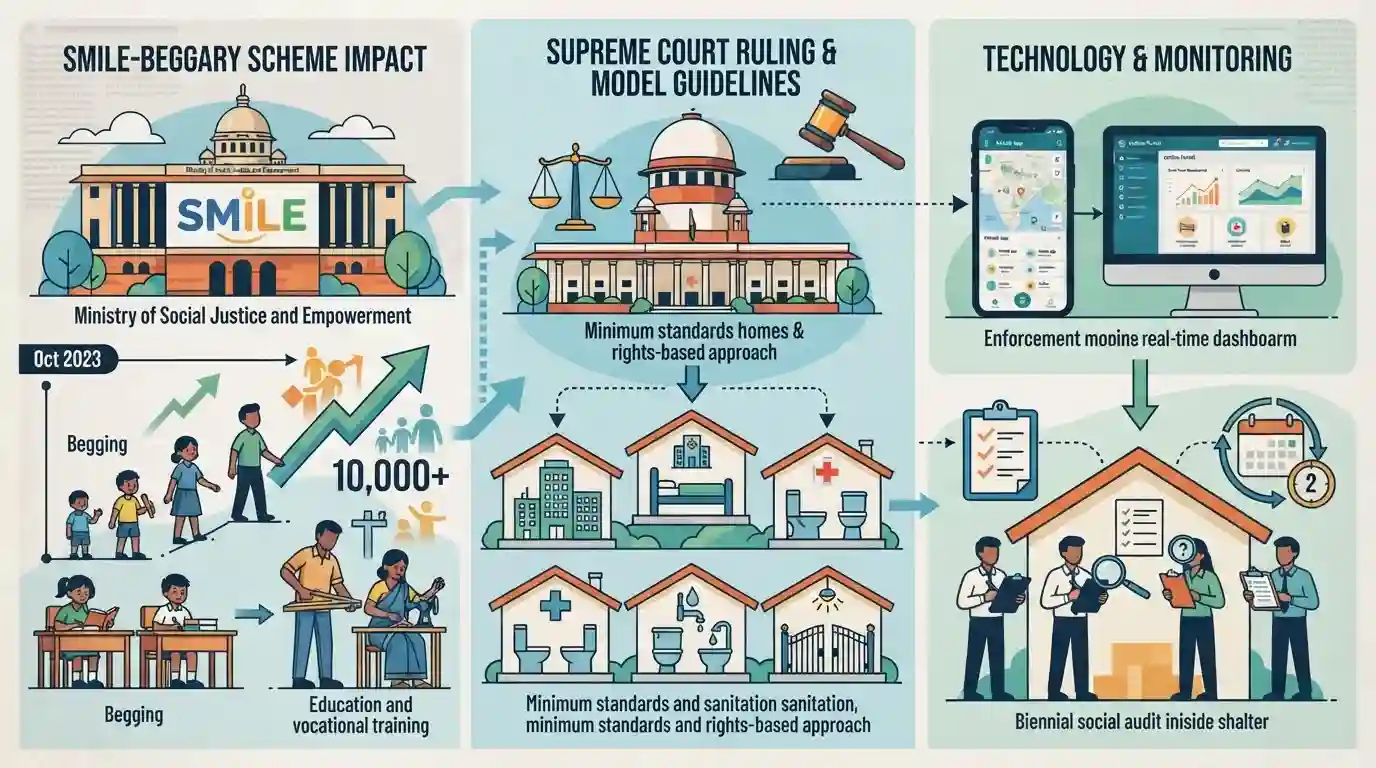
The Government of India has fortified the rehabilitation framework for individuals engaged in begging under the SMILE-Beggary Scheme. Managed by the Ministry of Social Justice and Empowerment (MoSJE), the initiative has successfully rehabilitated over 10,000 individuals since October 2023 through age-appropriate education for children and vocational training for adults. In response to a landmark 2025 Supreme Court ruling, MoSJE introduced Model Guidelines for Beggars'/Shelter Homes, establishing minimum standards for infrastructure, healthcare, sanitation, and safety to guarantee a rights-based rehabilitation approach. The enforcement of these guidelines is backed by technological tools like mobile apps and online portals for real-time monitoring, as well as mandatory biennial third-party social audits.
মূল বিষয়
- MoSJE has released ₹45.59 crore since October 2023 under the SMILE-Beggary Scheme, rehabilitating 10,446 individuals (including 2,824 children) nationwide.
- Rehabilitation components are tailored: rescued children receive education, counseling, and family reintegration, while adults receive vocational training based on aptitude and local livelihood opportunities.
- Tamil Nadu, Madhya Pradesh, and Uttar Pradesh recorded the highest numbers of rehabilitated adult beneficiaries under the scheme.
- In compliance with the Supreme Court judgement in 'M.S. Patter vs. State of NCT of Delhi (2025)', MoSJE formulated and circulated Model Guidelines for Beggars'/Shelter Homes to ensure humane, dignified, and rights-based rehabilitation.
- The scheme leverages technology with a dedicated mobile application for profiling and surveys, alongside a National Online Portal for real-time monitoring of shelter homes and beneficiary progress.
- Mandatory third-party infrastructure and social audits of all Beggar/Shelter Homes are required at least once every two years to ensure compliance with minimum living standards.
গুরুত্বপূর্ণ শব্দ
Support for Marginalized Individuals for Livelihood and Enterprise (SMILE) Scheme

An umbrella Central Sector scheme launched in 2022 to provide comprehensive welfare, housing, healthcare, and skill development to transgender persons and individuals engaged in begging.
UPSC context
GS Paper II: Welfare schemes for vulnerable sections of the population and their performance.
SMILE-Beggary Scheme
A dedicated sub-scheme under SMILE focusing on a rehabilitative, non-punitive approach to identify, rescue, counsel, educate, and provide vocational training to individuals engaged in begging.
UPSC context
GS Paper II: Poverty, developmental issues, and social welfare programs.
Model Guidelines for Beggars’/Shelter Homes
National guidelines formulated in 2026 to standardize care, infrastructure, sanitation, and safety in rehabilitation homes, ensuring a humane, dignity-first environment.
UPSC context
GS Paper II: Mechanisms, laws, institutions, and bodies for protecting vulnerable sections.
Ministry of Social Justice and Empowerment (MoSJE)
The Union Ministry of India responsible for welfare, social justice, and empowerment of marginalized groups, including Scheduled Castes, OBCs, transgender persons, and destitute populations.
UPSC context
GS Paper II: Executive and ministries implementing welfare and social safety measures.
National Consultative Committee
An expert advisory body mandated by the Supreme Court of India responsible for drafting standard guidelines on the care, rehabilitation, and management of beggars' and shelter homes.
UPSC context
GS Paper II: Role of judiciary and court-mandated bodies in social justice.
National Human Rights Commission (NHRC)
A statutory public body established under the Protection of Human Rights Act, 1993, to promote and protect human rights across India through monitoring and advisory interventions.
UPSC context
GS Paper II: Statutory, regulatory, and various quasi-judicial bodies protecting rights.
প্রিলিমস ফাঁদ
Begging is criminalized under a uniform Central Act, with the SMILE scheme serving as the statutory punitive-cum-rehabilitation framework.
India has no central anti-begging law; it is regulated by diverse state-level acts. SMILE is a voluntary, central sector welfare scheme, not a statutory penal framework.
সংযুক্ত স্থির ধারণা
What is the legal status of begging in India and its constitutional intersection?
- Concurrent List: Vagrancy is under Entry 15 of the Concurrent List, but India lacks a uniform central law, leaving regulation to diverse state-level acts.
- Penal State Laws: Most states rely on the Bombay Prevention of Begging Act, 1959, which criminalizes begging and allows detention, contrasting with voluntary central models.
- Judicial Decriminalization: In 2018, the Delhi HC decriminalized begging, ruling that penalizing destitution violates Article 21, a stance reinforced by the SC in 2025.
What is the distinction between begging and begar under the Indian Constitution?
- Article 23 Mandate: Article 23 prohibits 'begar' (forced labor without pay) and human trafficking, classifying them as fundamental rights violations against exploitation.
- Distinct Meanings: While begar denotes structural coercion to work, begging is seeking alms due to economic destitution; thus, begging does not fall under Article 23's definition.
আন্তঃবিষয় প্যাটার্ন
Criminalization of poverty vs Social Justice
Analyses how punitive vagrancy laws conflict with India's directive principles and the judiciary's expansion of Article 21 rights to guarantee a dignified existence for the destitute.
Digital accountability in welfare delivery
Examines how deploying real-time tracking portals and geo-tagged surveys under SMILE addresses historical leakages and systemic neglect in state-run shelter homes.

SMILE scheme's voluntary model vs. penal state begging laws post-M.S. Patter (2025) likely to be tested on Article 21 dimensions in 2026.
সংযুক্ত PYQ · 4
সংযুক্ত PYQ · 4
- 2019MainsGS2
Performance of welfare schemes that are implemented for vulnerable sections is not so effective due to absence of their awareness and active involvement at all stages of policy process. Discuss.
- 2023MainsGS2
“Development and welfare schemes for the vulnerable, by its nature, are discriminatory in approach.” Do you agree? Give reasons for your answer.
- 2021MainsGS2
Though the Human Rights Commissions have contributed immensely to the protection of human rights in India, yet they have failed to assert themselves against the mighty and powerful. Analyzing their structural and practical limitations, suggest remedial measures.
- 2016PrelimsGS1
'Rashtriya Garima Abhiyaan' is a national campaign to
