Government e Marketplace Inclusive Public Procurement and AI Analytics
Source:PIB ↗
ఇది ఎందుకు ముఖ్యం
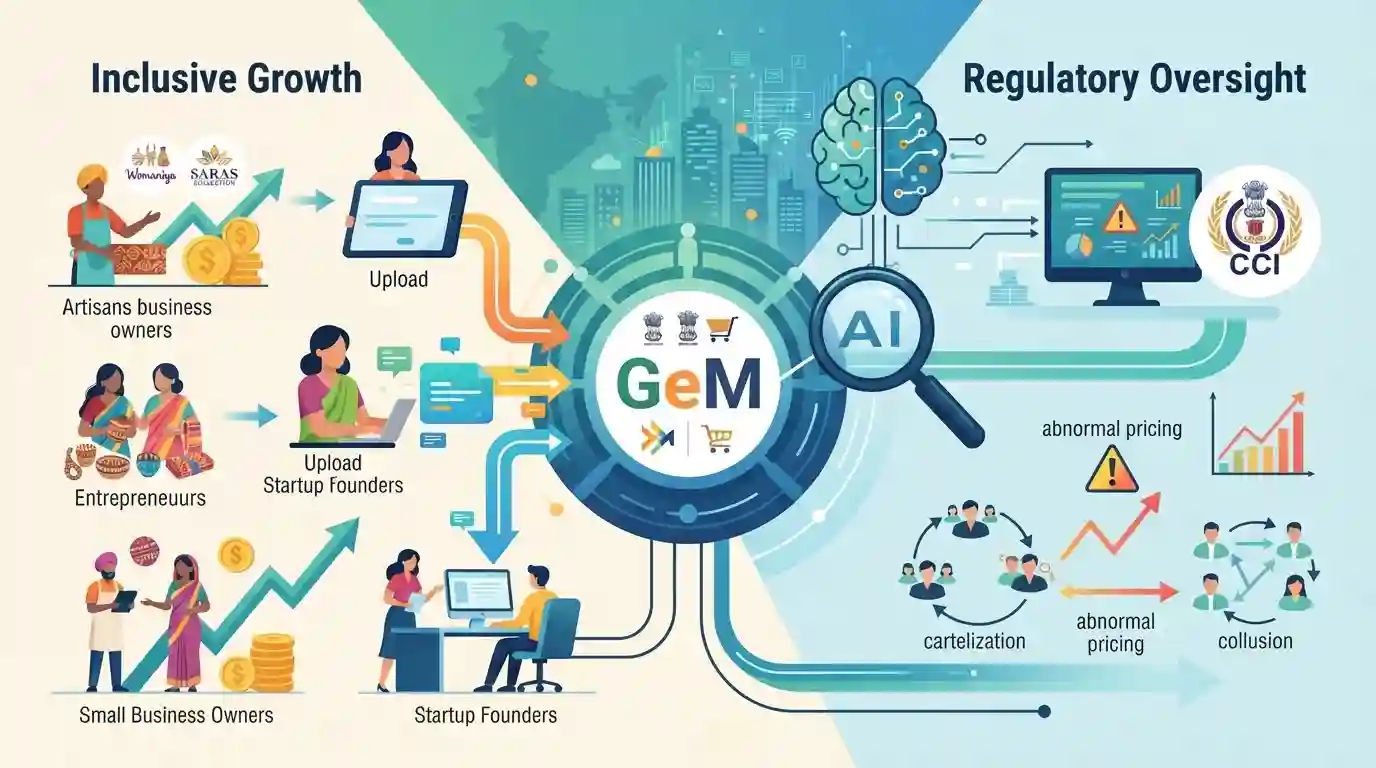
GeM exemplifies the application of technology (AI/ML) in enhancing public accountability, reducing administrative corruption, and promoting inclusive growth. It serves as an excellent case study for mains answers on how digital governance tools can simultaneously solve administrative leakages (cartelization, collusion) and drive socio-economic empowerment (MSMEs, rural women SHGs).
సారాంశం
The Government e-Marketplace (GeM) continues to strengthen inclusive public procurement by expanding market access for MSMEs, startups, women entrepreneurs, and Self-Help Groups (SHGs). By utilizing dedicated windows like 'Womaniya' and 'Saras Collection', GeM drives socio-economic empowerment and breaks traditional market barriers. Crucially, the platform has adopted AI/ML-driven analytical tools and partnered with the Competition Commission of India (CCI) to deploy automated detection toolkits. These advanced technical measures help monitor buyer-seller behavior, flagging anti-competitive activities such as cartelization, abnormal pricing, and collusion. This dual approach of promoting grassroots inclusivity while strictly enforcing transparency highlights GeM as a benchmark of modern e-governance.
ముఖ్య అంశాలు
- Government e-Marketplace (GeM) has emerged as a critical digital public infrastructure, significantly boosting the participation of MSMEs, startups, women entrepreneurs, and Self-Help Groups (SHGs) in public procurement.
- Specific focus initiatives like 'Womaniya' (promoting women-led enterprises) and 'Saras Collection' (integrating products from rural SHGs under DAY-NRLM) have bypassed traditional intermediaries, providing direct Business-to-Government (B2G) market access.
- The 'Startup Runway' initiative enables registered startups to showcase innovative products and services directly to government buyers, easing barriers to entry in public sector contracts.
- GeM incorporates advanced digital technologies, utilizing Artificial Intelligence (AI) and Machine Learning (ML) analytical models to detect suspicious procurement patterns.
- In partnership with the Competition Commission of India (CCI), GeM employs a specialized toolkit to identify and flag anti-competitive behavior such as cartelization, buyer-seller collusion, abnormal pricing, repeated participation, and order splitting.
- The platform ensures seamless MSME vendor registration through integration with the Udyam Registration Portal, allowing automatic verification and reducing compliance burdens.
ముఖ్యమైన పదాలు
Government e-Marketplace (GeM)

A paperless, cashless, and contactless digital procurement platform launched by the Ministry of Commerce and Industry to facilitate transparent purchasing of goods and services by government departments and PSUs.
UPSC context
Important for GS Paper 2 & 3 (e-Governance, Economy). Tests knowledge of digital public infrastructure and anti-corruption measures.
Womaniya on GeM
A dedicated inclusion-focused initiative on the GeM portal that enables women entrepreneurs and women-led Self-Help Groups (SHGs) to sell products directly to government ministries and public sector buyers.
UPSC context
Relevant to GS Paper 1 & 2 (Women Empowerment, Social Justice). Highlights gender budgeting, inclusive economic growth, and structural empowerment.
Saras Collection
A specialized marketplace on the GeM portal that showcases daily utility products and handicrafts made by rural Self-Help Groups, providing them direct market access to government buyers without intermediaries.
UPSC context
Vital for GS Paper 2 & 3 (Poverty Alleviation, Rural Development). Tests understanding of SHG empowerment and micro-enterprise support mechanisms.
Competition Commission of India (CCI)
A statutory body established under the Competition Act, 2002, responsible for enforcing competition laws, curbing anti-competitive practices like cartelization, and ensuring a fair, market-driven economy in India.
UPSC context
Crucial for GS Paper 2 (Statutory Bodies) and GS Paper 3 (Indian Economy). Tests regulatory frameworks and market oversight.
Deendayal Antyodaya Yojana-National Rural Livelihoods Mission (DAY-NRLM)
A flagship poverty alleviation program by the Ministry of Rural Development that promotes self-employment and rural livelihood enhancements, primarily by organizing the rural poor into robust Self-Help Groups (SHGs).
UPSC context
Central to GS Paper 2 (Welfare Schemes) & GS Paper 3 (Inclusive Growth). Evaluates rural development strategies and community mobilization.
ప్రిలిమ్స్ ఉచ్చు
"The Womaniya initiative enforces a mandatory 33% reservation for women-led enterprises in all government procurement on GeM."
The Public Procurement Policy mandates an overall 25% target for Micro and Small Enterprises (MSEs), with a specific sub-target of only 3% for women-owned MSEs, not 33%.
అనుసంధానమైన స్థిర భావనలు
What are the key mandates of the Public Procurement Policy for MSEs Order?
- Overall Target: Central ministries and Central Public Sector Enterprises (CPSEs) must procure at least 25% of their total annual value of goods and services from MSEs.
- Special Quotas: Within the 25% overall target, 4% is specifically earmarked for SC/ST-owned MSEs and 3% is reserved for women-owned MSEs.
- Price Preference: MSEs quoting within a price band of L1+15% can supply a portion of the requirement if they agree to match the lowest bidder's (L1) price.
How does the Competition Commission of India (CCI) regulate bid-rigging in public procurement?
- Statutory Mandate: Established under the Competition Act, 2002, CCI investigates and penalizes anti-competitive agreements, including bid-rigging and collusive bidding in government tenders.
- Bid-Rigging Definition: Bid-rigging is an agreement among competitors to manipulate prices, divide markets, or artificially reduce competition, heavily scrutinized on platforms like GeM.
- Penal Powers: CCI can impose penalties of up to 10% of the enterprise's average turnover for the preceding three financial years for cartel-like behavior.
అంతర-అంశ నమూనాలు
DPI + Regulatory Tech (RegTech)
Utilizing AI/ML for automated cartel detection transforms GeM from a mere marketplace into an active regulatory tool, marrying Digital Public Infrastructure with CCI's enforcement mandate.
Rural SHGs + B2G Market Access
The 'Saras Collection' bridges rural livelihood schemes (DAY-NRLM) with digital commerce. This reflects a shift from traditional micro-credit to direct Business-to-Government market linkages for SHGs.

Expect a 2026 Prelims question mixing GeM's nodal ministry (Commerce), its sub-portals (Saras/Womaniya), and the 3% women MSME quota.
అనుసంధాన PYQలు · 5
అనుసంధాన PYQలు · 5
- 2023MainsGS3
Faster economic growth requires increased share of the manufacturing sector in GDP, particularly of MSMEs. Comment on the present policies of the Government in this regard.
- 2017MainsGS2
The emergence of the Self-Help Groups (SHGs) in contemporary times points to the slow but steady withdrawal of the State from developmental activities." Examine the role of the SHGs in developmental activities and the measures taken by the Government of India to promote the SHGs.
- 2021MainsGS2
Can the vicious cycle of gender inequality, poverty and malnutrition be broken through microfinancing of women SHGs? Explain with examples.
- 2024MainsGS2
e-governance is not just about the routine application of digital technology in service delivery process. It is as much about multifarious interactions for ensuring transparency and accountability. In this context evaluate the role of the 'Interactive Service Model' of e-governance.
- 2023MainsGS2
e-governance, as a critical tool of governance, has ushered in effectiveness, transparency and accountability in governments. What inadequacies hamper the enhancement of these features ?
