MSME Development Amendment Bill and Dispute Resolution Reforms
Source:PIB ↗
हे का महत्त्वाचे आहे
The MSME sector is a cornerstone of India's economy, accounting for over 31% of GDP and employing over 40 crore people. This legislation addresses structural bottlenecks like delayed payments and compliance overregulation. It is highly relevant to UPSC GS3 (Economy & Manufacturing) and GS2 (Arbitration, Ease of Doing Business, and Judicial Reforms).
सारांश
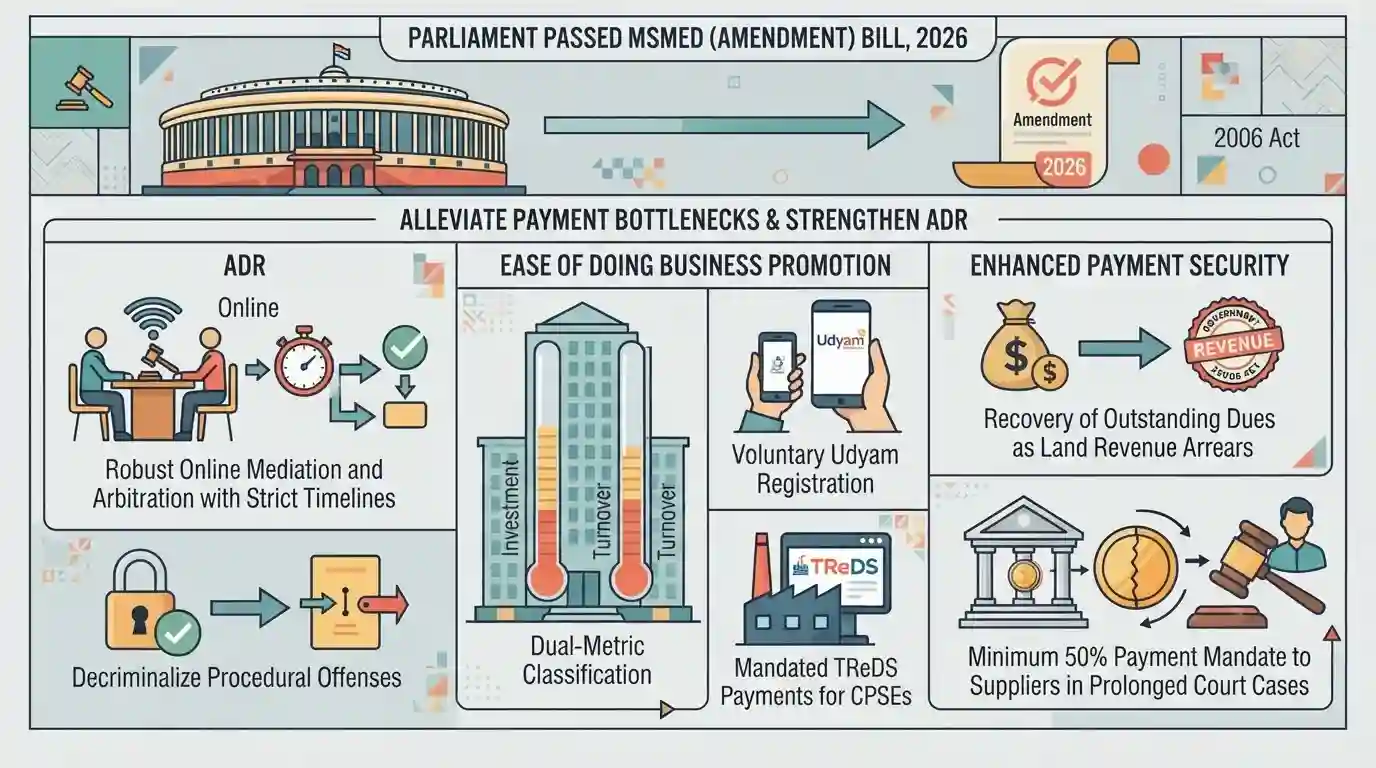
The Parliament passed the Micro, Small and Medium Enterprises Development (Amendment) Bill, 2026, which substantially modifies the MSMED Act, 2006. The amendment aims to alleviate payment-related bottlenecks, establish a robust online mediation and arbitration structure with strict timelines, decriminalise procedural offenses, and promote the Ease of Doing Business. Key provisions include a dual-metric classification (investment and turnover), voluntary Udyam registration, mandated TReDS payments for CPSEs, recovery of outstanding dues as land revenue arrears, and a minimum 50% payment mandate to suppliers in prolonged court cases.
मुख्य मुद्दे
- Reforms MSME classification by formally using both investment and turnover criteria instead of only investment thresholds.
- Makes filing of registration memorandum free and voluntary for all MSMEs via a notified national digital platform (Udyam).
- Mandates all Central Public Sector Enterprises (CPSEs) to settle invoices through the Trade Receivables Discounting System (TReDS) platform to tackle delayed payments.
- Allows state governments to set up multiple MSE Facilitation Councils (MSEFCs) and equip them with physical and digital infrastructure for faster dispute resolution.
- Establishes strict statutory timelines for online mediation (90 days) and arbitration awards (within 90 days of completed pleadings, with a 30-day window to refer unresolved mediation to arbitration).
- Introduces a key financial relief measure where courts must direct payment of at least 50% of the disputed/awarded amount to the supplier if a set-aside application remains pending for more than 6 months.
- Enables recovery of unpaid dues from mediated settlements or arbitral awards as 'arrears of land revenue' through the District Collector or Deputy Commissioner.
- Decriminalises minor procedural offenses (e.g., non-filing of registration details or non-disclosure of unpaid dues), replacing criminal convictions with warnings and tiered administrative penalties.
- Highlights the sector's immense economic footprint: MSMEs contribute 31.1% of India's GDP, 35.4% of manufacturing output, and 48.58% of exports, employing over 40 crore people.
महत्त्वाच्या संज्ञा
The Micro, Small and Medium Enterprises Development (Amendment) Bill, 2026

A 2026 legislative amendment to the MSMED Act, 2006, aimed at easing payment bottlenecks, creating online mediation and arbitration structures, decriminalizing procedural offenses, and promoting ease of doing business for MSMEs.
UPSC context
GS Paper 2 and 3. Tests awareness of recent legislative reforms addressing the operational, financial, and regulatory challenges faced by India's MSME sector.
Micro, Small and Medium Enterprises Development Act, 2006
The principal parliamentary act governing the classification, promotion, and development of MSMEs in India. It provides a legal framework to address issues like delayed payments, credit access, and sectoral competitiveness.
UPSC context
GS Paper 2 and 3. Fundamental for understanding the statutory framework, industrial policy, and regulatory support mechanisms for India's MSMEs.
Trade Receivables Discounting System (TReDS)
An RBI-regulated electronic platform enabling MSMEs to unlock working capital by auctioning and discounting their trade receivables (invoices) from large corporate buyers, government departments, and CPSEs through multiple financiers.
UPSC context
GS Paper 3. Essential for topics on economic growth, MSME financial inclusion, banking mechanisms, and resolving working capital constraints.
Udyam Registration Portal
A fully online, paperless government portal launched in 2020 for registering and certifying MSMEs based on composite criteria of investment and turnover, replacing the earlier Udyog Aadhaar system.
UPSC context
GS Paper 3. Important for evaluating digital governance, formalization of the economy, and the execution of targeted government policies.
Micro and Small Enterprises Facilitation Councils (MSEFCs)
Quasi-judicial, statutory bodies established by state governments under the MSMED Act, 2006 to resolve delayed payment disputes between buyers and micro or small enterprise suppliers through conciliation and arbitration.
UPSC context
GS Paper 2 and 3. Crucial for understanding Alternative Dispute Resolution (ADR) mechanisms and statutory protection for vulnerable economic units.
Central Public Sector Enterprises (CPSEs)
Companies in which the direct holding of the Central Government or other CPSEs is 51% or more. They play a strategic role in the economy and are significant institutional buyers.
UPSC context
GS Paper 3. Important for understanding public sector undertakings, resource mobilization, and their integration with industrial supply chains.
पूर्वपरीक्षा सापळा
The MSMED (Amendment) Bill, 2026 mandates all registered private and public companies to settle invoices through the TReDS platform.
The 2026 amendment specifically mandates all Central Public Sector Enterprises (CPSEs) to settle invoices via TReDS, not all registered private companies.
संबंधित स्थिर संकल्पना
What is the Trade Receivables Discounting System (TReDS)?
- Regulatory authority: Established by the Reserve Bank of India (RBI) under the Payment and Settlement Systems Act, 2007.
- Key participants: Facilitates discounting of invoices for MSME sellers, corporate buyers (including CPSEs), and institutional financiers.
- Core purpose: Ensures quick cash flows to MSMEs by converting trade receivables into liquid funds through competitive bidding.
What is the composite MSME classification criteria in India?
- Dual metric: Combines both investment in plant/machinery and annual turnover; both criteria must be met for a category.
- Micro threshold: Investment up to ₹1 crore and annual turnover up to ₹5 crore.
- Small threshold: Investment up to ₹10 crore and annual turnover up to ₹50 crore.
- Medium threshold: Investment up to ₹50 crore and annual turnover up to ₹250 crore.
आंतर-विषय नमुने
ADR Reforms + Judicial Pendency
Alternate Dispute Resolution (ADR) statutory timelines in MSME disputes directly influence contract enforcement, bridging commercial law with judicial administration reforms.
Decriminalization & Corporate Governance
Transitioning procedural lapses from criminal courts to administrative penalties mirrors the Jan Vishwas framework, improving ease of doing business while reducing judicial burden.

The unique recovery of MSME dues as 'arrears of land revenue' and the 90-day statutory ADR timelines are highly probable 2026 Prelims targets.
संबंधित PYQ · 3
संबंधित PYQ · 3
- 2023MainsGS3
Faster economic growth requires increased share of the manufacturing sector in GDP, particularly of MSMEs. Comment on the present policies of the Government in this regard.
- 2015MainsGS2
What are the major changes brought in the Arbitration and Conciliation Act, 1996 through the recent Ordinance promulgated by the President? How far will it improve India's dispute resolution mechanism? Discuss.
- 2026PrelimsGS1
Which of the following statements about M1xchange's role in Micro, Small & Medium Enterprises (MSMEs) financing is/are correct ? 1. M1xchange provides collateral based loans to MSMEs. 2. M1xchange facilitates discounting of invoices and Bills of Exchange for MSMEs. 3. M1xchange functions as a credit rating agency for MSMEs. Select the answer using the code given below :
