Deen Dayal Upadhyaya Grameen Kaushalya Yojana Skill Development
Source:PIB ↗
কেন এটি গুরুত্বপূর্ণ
The transition to DDU-GKY 2.0 reflects a critical structural shift in India's skill development strategy—moving from basic skill certification to high-retention, industry-led, and future-ready employment in green energy and the care economy. This is highly relevant for GS-2 and GS-3 mains answers regarding demographic dividend, poverty alleviation, and rural employment reforms.
সারসংক্ষেপ
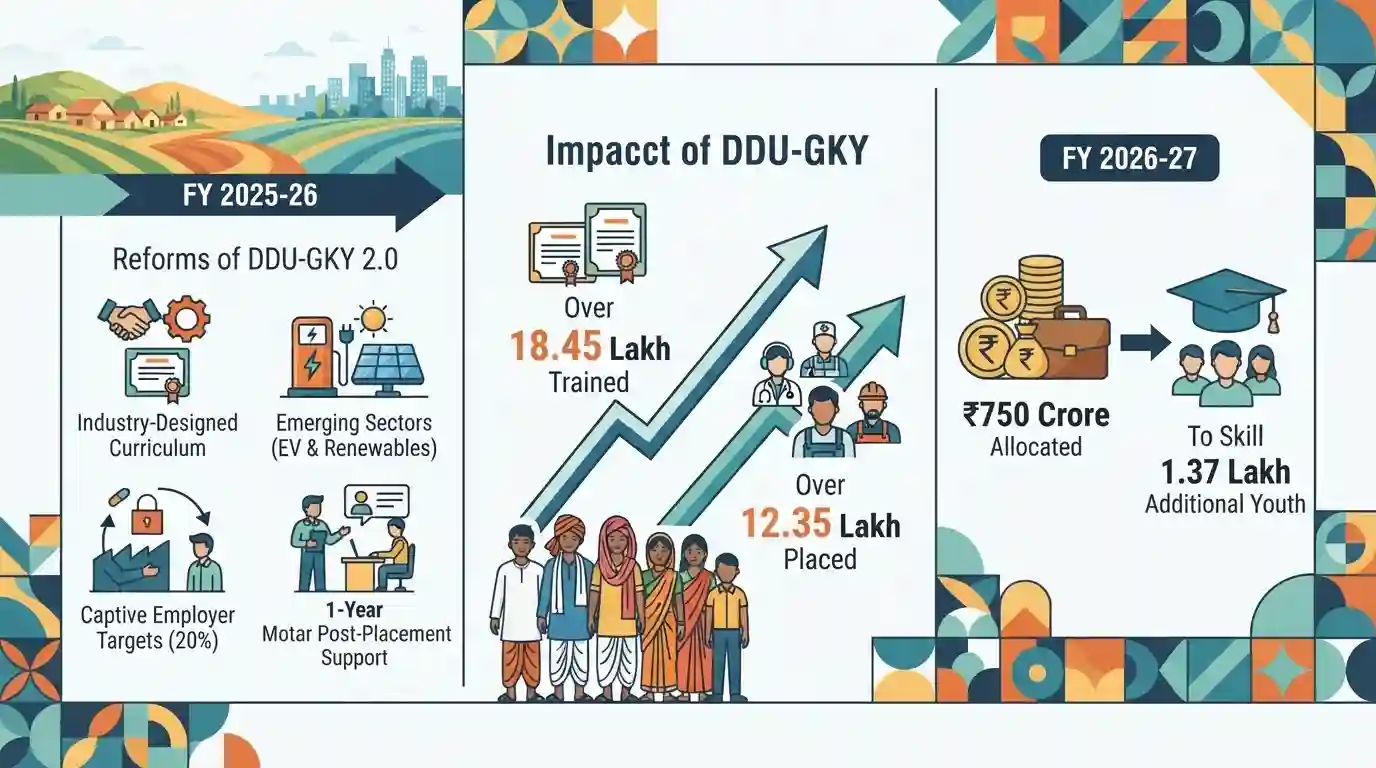
The Ministry of Rural Development has introduced DDU-GKY 2.0 (under DAY-NRLM) beginning in FY 2025-26 to reform rural skill development. By emphasizing industry-designed curriculum, emerging technology sectors (such as Electric Vehicles and renewable energy), captive employer targets (20%), and 1-year post-placement support, the revised scheme aims to transition rural youth into sustainable, long-term employment. To date, DDU-GKY has successfully trained over 18.45 lakh rural youth and placed over 12.35 lakh. For the financial year 2026-27, ₹750 crore has been allocated to skill 1.37 lakh additional rural youth.
মূল বিষয়
- Deen Dayal Upadhyaya Grameen Kaushalya Yojana (DDU-GKY) is a major placement-linked skill training initiative under the DAY-NRLM, aimed at diversifying rural livelihoods and reducing poverty.
- The government has rolled out DDU-GKY 2.0 starting FY 2025-26, shifting focus toward industry-led training, sustainable long-term employment, enhanced post-placement support, and reskilling/upskilling.
- DDU-GKY 2.0 prioritizes training in modern and emerging sectors, including Electric Vehicle (EV) maintenance, renewable energy, logistics, healthcare, the care economy, retail, hospitality, and media & entertainment.
- To align training with market demand, 20% of training targets in each State/UT are allocated to captive employers (industries that train candidates for their own workforce).
- Project Implementing Agencies (PIAs) receive batch-mode payments linked strictly to the successful mandatory placement of candidates for a minimum of 6 months.
- DDU-GKY 2.0 mandates a minimum 70% placement rate (which can include up to 20% self or gig employment) for at least 6 months, supported by 1-year post-placement tracking, counseling, migration support, and alumni engagement to improve retention.
- Since its inception, DDU-GKY has trained approximately 18.45 lakh rural youth and successfully placed 12.35 lakh candidates. For FY 2026-27, a budget estimate of ₹750 crore is allocated to train around 1.37 lakh rural youth.
গুরুত্বপূর্ণ শব্দ
Deen Dayal Upadhyaya Grameen Kaushalya Yojana (DDU-GKY)

A placement-linked skill training scheme launched in 2014 by the Ministry of Rural Development, targeting rural poor youth aged 15–35 to promote livelihood diversification and sustainable wage employment.
UPSC context
GS Paper II & III: Welfare schemes, employment, and social sector initiatives; tests understanding of rural poverty alleviation and human resource development.
DDU-GKY 2.0
The upgraded version of DDU-GKY launched in FY 2025-26, incorporating an end-to-end digital platform, industry-led curriculum, greater focus on emerging technologies, and target mandates for captive employers.
UPSC context
GS Paper II & III: E-governance, skill development reforms, and employment; tests knowledge of technological interventions in government schemes.
Deen Dayal Antyodaya Yojana - National Rural Livelihoods Mission (DAY-NRLM)
India's flagship poverty alleviation program launched in 2011 to mobilize rural poor households, especially women, into Self-Help Groups (SHGs) and support sustainable livelihoods.
UPSC context
GS Paper II & III: Poverty alleviation, SHGs, and inclusive growth; tests understanding of community-led development and gender empowerment.
Sector Skill Councils
Industry-led, autonomous national partnership organizations created under the National Skill Development Corporation (NSDC) to define occupational standards, develop curricula, and certify vocational training programs.
UPSC context
GS Paper II & III: Public-private partnerships, human resource development, and employment; tests understanding of industry-academia collaboration.
Madhya Pradesh State Rural Livelihoods Mission (MPSRLM)
The state-level nodal agency in Madhya Pradesh responsible for implementing DAY-NRLM and DDU-GKY to alleviate rural poverty through Self-Help Groups and local capacity-building.
UPSC context
GS Paper II & III: Decentralized administrative frameworks and regional governance; tests knowledge of state-level implementation of central welfare schemes.
প্রিলিমস ফাঁদ
DDU-GKY is implemented by the Ministry of Skill Development and requires 100% formal, permanent wage-employment placements.
It is administered by the Ministry of Rural Development under DAY-NRLM. DDU-GKY 2.0 allows up to 20% of its mandatory 70% placement target to be self or gig-economy employment.
সংযুক্ত স্থির ধারণা
What differentiates Centrally Sponsored Schemes from Central Sector Schemes?
- Funding Ratio: Centrally Sponsored Schemes feature shared funding (e.g., 60:40) between Centre and States, whereas Central Sector Schemes are 100% funded by the Union government.
- Implementation Agency: Sponsored schemes are usually implemented by State governments, while Sector schemes are directly implemented by Central ministries or agencies.
What is the 'Captive Employer' model in skill development?
- Direct Absorption: An industry trains candidates specifically for its own internal workforce, securing a direct talent pipeline.
- RTD Model: Operates on a Recruit-Train-Deploy framework, reducing training-to-workplace friction and mismatch.
আন্তঃবিষয় প্যাটার্ন
Gig economy + Rural social security
Allowing gig/self-employment in DDU-GKY 2.0 reflects a policy shift, recognizing digital platform work as a formal pathway for diversifying rural livelihoods.
Green jobs + Just Transition
Aligning rural skilling with Electric Vehicles and renewables ensures that vulnerable rural youth benefit from economic opportunities generated by the climate transition.

Expect 2026 Prelims to test DDU-GKY 2.0's age relaxations, MoRD administration, and gig economy inclusion in placement targets.
সংযুক্ত PYQ · 4
সংযুক্ত PYQ · 4
- 2018PrelimsGS1
With reference to Pradhan Mantri Kaushal Vikas Yojana, consider the following statements: 1. It is the flagship scheme of the Ministry of Labour and Employment. 2. It, among other things, will also impart training in soft skills, entrepreneurship, financial and digital literacy. 3. It aims to align the competencies of the unregulated workforce of the country to the National Skill Qualification Framework. Which of the statements given above is/are correct?
- 2023MainsGS2
Skill development programmes have succeeded in increasing human resources supply to various sectors. In the context of the statement analyse the linkages between education, skill and employment.
- 2016MainsGS2
Demographic Dividend in India will remain only theoretical unless our manpower becomes more educated, aware, skilled and creative." What measures have been taken by the government to enhance the capacity of our population to be more productive and employable?
- 2021MainsGS2
“Earn while you learn' scheme needs to be strengthened to make vocational education and skill training meaningful.” Comment.
