Pradhan Mantri Awaas Yojana Gramin Progress and Social Safeguards
Source:PIB ↗
हे का महत्त्वाचे आहे
Housing is a fundamental component of multi-dimensional poverty alleviation. The article details the convergence model of PMAY-G with other crucial developmental programs (JJM, PMUY) and highlights specific institutional safeguards for highly vulnerable communities (PVTGs, disaster-affected populations, SC/STs). Understanding these administrative linkages and performance metrics is crucial for GS-2 (Government Policies) and GS-3 (Inclusive Growth/Disaster Management).
सारांश
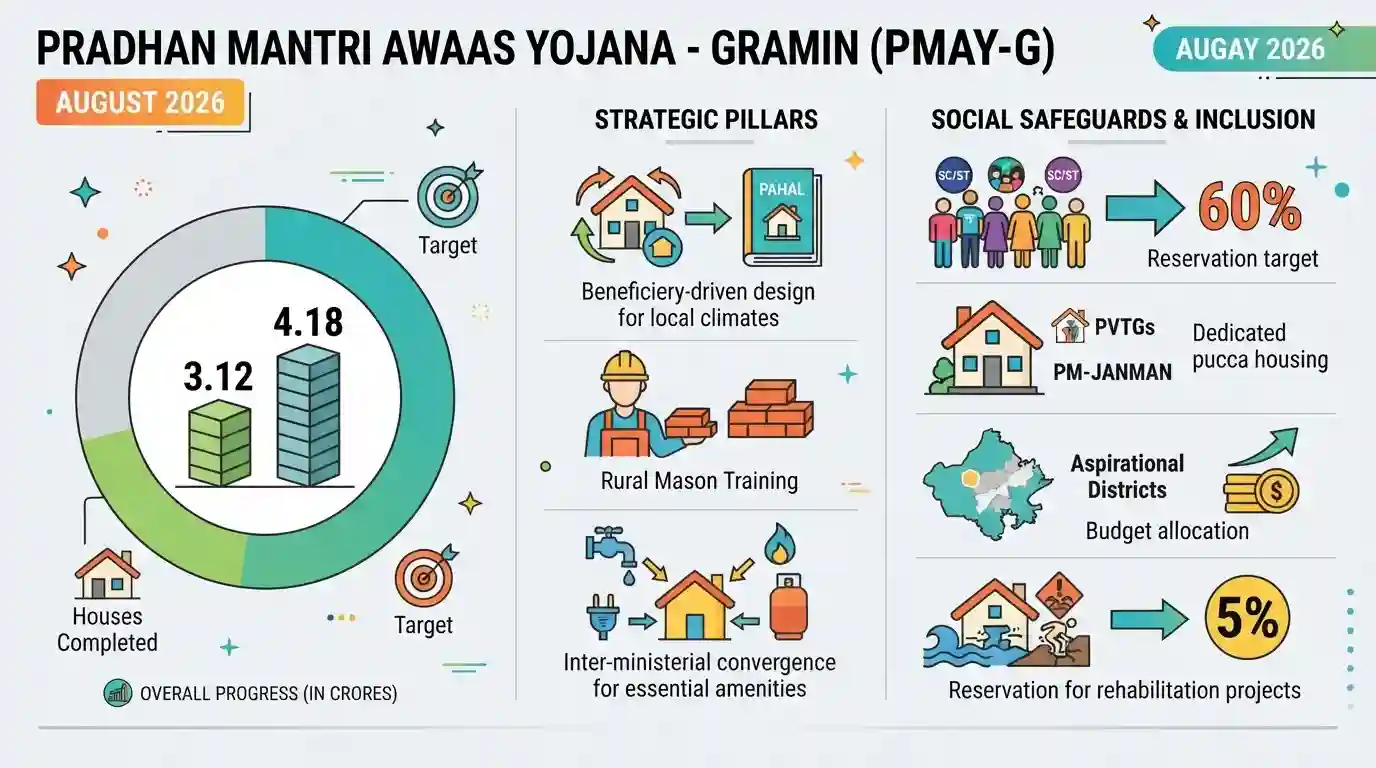
The Ministry of Rural Development has released updated performance and strategic statistics for the Pradhan Mantri Awaas Yojana - Gramin (PMAY-G) as of August 2026. The scheme has successfully completed 3.12 crore houses against a 4.18 crore target. PMAY-G emphasizes beneficiary-driven construction tailored to local climates (using the 'PAHAL' compendium), skill development through Rural Mason Training, and inter-ministerial convergence (water, power, LPG). It incorporates strict social safeguards, reserving 60% of targets for SC/STs, executing dedicated pucca housing for PVTGs under PM-JANMAN, allocating specific budgets for Aspirational Districts, and reserving 5% of housing targets for disaster rehabilitation under Special Projects.
मुख्य मुद्दे
- PMAY-G Progress Status: As of August 3, 2026, 3.12 crore houses have been completed out of 3.91 crore sanctioned houses (against a total target of 4.18 crore houses allocated to States/UTs). In FY 2025-26 alone, 32.47 lakh houses were sanctioned and 26.57 lakh completed.
- Beneficiary-led & Climatically Adapted Construction: Construction is driven directly by beneficiaries. States/UTs offer a range of region-specific housing designs using local materials, guided by 'PAHAL' (a compendium of rural housing typologies developed by MoRD and accessible via AwaasApp). Quality is ensured through the Rural Mason Training (RMT) Program.
- Cross-Sectoral Welfare Convergence: PMAY-G integrates with other flagship schemes to provide holistic living conditions, including piped drinking water (Jal Jeevan Mission/Har Ghar Nal Se Jal), electricity connections (Ministry of Power), and clean cooking gas (PM Ujjwala Yojana).
- Social Equity and Special Projects: At least 60% of targets at the national level are reserved for SC and ST households. Up to 5% of targets are reserved as 'Special Projects' for the rehabilitation of families displaced or affected by natural hazards (such as floods and earthquakes) under the National Disaster Management Plan.
- Focus on PVTGs and Marginalized Areas: Under the PM-JANMAN scheme, MoRD is actively constructing pucca houses for Particularly Vulnerable Tribal Groups (PVTGs), with ₹6,329.06 crore spent in FY 2024-25 and FY 2025-26 (including a Central share of ₹2,465.38 crore). Additionally, ₹17,281.58 crore was spent in Aspirational Districts over the last two fiscal years.
महत्त्वाच्या संज्ञा
Pradhan Mantri Awaas Yojana - Gramin (PMAY-G)

A flagship rural housing scheme launched in 2016 by the Ministry of Rural Development, aiming to provide permanent houses with basic amenities to houseless rural households and those in dilapidated dwellings.
UPSC context
GS Paper II: Welfare Schemes; tests rural infrastructure, socio-economic development, and targeted social empowerment of vulnerable communities.
Pradhan Mantri Janjati Adivasi Nyaya Maha Abhiyan (PM-JANMAN)
A central initiative launched in 2023 to improve the socio-economic status of Particularly Vulnerable Tribal Groups (PVTGs) by saturating their communities with 11 critical interventions, including pucca houses.
UPSC context
GS Paper II: Welfare Schemes for Vulnerable Sections; tests policy initiatives for tribal upliftment, socio-economic marginalization, and inter-ministerial convergence.
Jal Jeevan Mission (JJM)
A flagship program launched in 2019 by the Ministry of Jal Shakti to provide Functional Household Tap Connections delivering 55 liters of safe water per person per day to all rural households.
UPSC context
GS Paper II & III: Governance, Water Security, Rural Development; tests decentralized governance and public health infrastructure.
Har Ghar Nal Se Jal (HGNSJ)
A key component of the Jal Jeevan Mission, announced in 2019, to supply piped safe drinking water to all rural households using community-led, sustainable water-management approaches.
UPSC context
GS Paper II: Government Interventions; tests public utilities implementation, gender empowerment (reducing water-fetching labor), and rural health.
Pradhan Mantri Ujjwala Yojana (PMUY)
A flagship social welfare scheme launched in 2016 by the Ministry of Petroleum and Natural Gas to provide deposit-free LPG connections to women from below-poverty-line households.
UPSC context
GS Paper II & III: Social Justice and Energy Security; tests clean energy access, gender-sensitive policy interventions, and health outcomes.
Ministry of Rural Development
The nodal ministry of the Government of India responsible for the overall socio-economic development, housing, infrastructure, and livelihood security in rural areas of the country.
UPSC context
GS Paper II: Functioning of Ministries; tests administrative frameworks, rural governance, and the execution of flagship central sector schemes.
पूर्वपरीक्षा सापळा
PMAY-G is a 100% Centrally Funded Central Sector Scheme where beneficiaries are selected arbitrarily by individual State Governments.
PMAY-G is a Centrally Sponsored Scheme (60:40 or 90:10 cost-sharing), not a Central Sector Scheme. Furthermore, beneficiaries are identified using objective SECC 2011 deprivation parameters, verified by Gram Sabhas, not arbitrarily by states.
संबंधित स्थिर संकल्पना
What are the four criteria used to identify Particularly Vulnerable Tribal Groups (PVTGs)?
- Technology: Use of pre-agricultural level of technology.
- Demography: A stagnant or declining population trends.
- Literacy: Extremely low levels of literacy compared to other tribes.
- Economy: A subsistence level of economy with minimal surplus.
How do Centrally Sponsored Schemes (CSS) differ from Central Sector Schemes?
- Funding Share: Central Sector Schemes are 100% funded by the Union, whereas CSS are joint-funded (e.g., 60:40, 90:10) with States.
- Implementation Agency: Central Sector Schemes are directly executed by central ministries; CSS are implemented by State/UT administrations.
आंतर-विषय नमुने
Housing resilience and disaster mitigation
Linking climate-resilient architecture ('PAHAL') under PMAY-G to the Sendai Framework's priority of 'building back better' and disaster-resilient infrastructure.
Vocational training and rural employment
Integrating Rural Mason Training (RMT) with NSQF standards to formalize construction skills, directly aligning rural housing targets with India's skill development goals.

PMAY-G's PAHAL compendium, PM-JANMAN convergence, and 60% SC/ST reservation target will likely feature in a 2026 multi-statement prelims question.
संबंधित PYQ · 3
संबंधित PYQ · 3
- 2019PrelimsGS1
Consider the following statements about Particularly Vulnerable Tribal Groups (PVTGs) in India : 1. PVTGs reside in 18 States and one Union Territory. 2. A stagnant or declining population is one of the criteria for determining PVTG status. 3. There are 95 PVTGS officially notified in the country so far. 4. Irular and Konda Reddi tribes are included in the list of PVTGs. Which of the statements given above are correct?
- 2020MainsGS2
Micro-Finance as an anti-poverty vaccine, is aimed at asset creation and income security of the rural poor in India". Evaluate the role of the Self Help Groups in achieving the twin objectives along with empowering women in rural India.
- 2019MainsGS3
It is argued that the strategy of inclusive growth is intended to meet the objectives of inclusiveness and sustainability together. Comment on this statement.
