Department of Financial Services PSB Confluence and Banking Priorities
Source:PIB ↗
हे का महत्त्वाचे आहे
Highlights the evolving strategic priorities of India's state-owned banking sector, balancing traditional mandates like agriculture infrastructure and financial inclusion with support for emerging economic drivers like Global Capability Centres. Crucial for GS3 topics on banking and investment.
सारांश
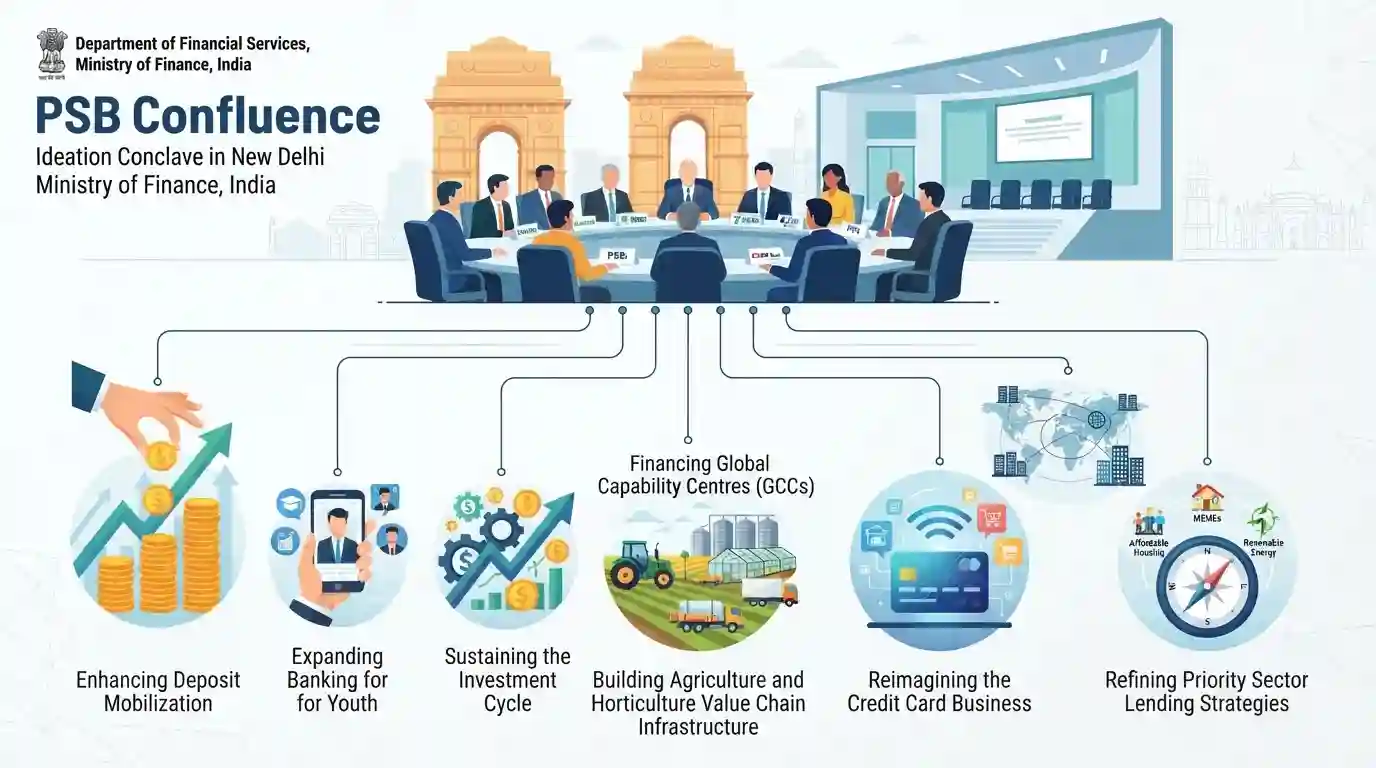
The Department of Financial Services, Ministry of Finance, hosted a two-day ideation conclave titled "PSB Confluence" in New Delhi. The event gathered the leadership of Public Sector Banks (PSBs) and apex Public Financial Institutions (PFIs) like NABARD, SIDBI, and EXIM Bank for an action-oriented dialogue. The agenda focused on seven key themes to support India's economic growth trajectory: enhancing deposit mobilization, expanding banking for the youth, sustaining the investment cycle, financing Global Capability Centres (GCCs), building agriculture and horticulture value chain infrastructure, reimagining the credit card business, and refining Priority Sector Lending strategies.
मुख्य मुद्दे
- The Department of Financial Services (DFS) organized a two-day 'PSB Confluence' in New Delhi to align Public Sector Banks and financial institutions with emerging national economic priorities.
- The conclave focused on seven actionable themes, including deposit mobilization to strengthen bank liabilities and ensuring adequate financing for India's growing youth demographic.
- Strategic dialogue was held on financing infrastructure for the agriculture and horticulture value chains, alongside refining Priority Sector Lending to meet modern credit requirements.
- Banks also deliberated on supporting the broader investment cycle, backing Global Capability Centres (GCCs), and innovating in the credit card business segment.
महत्त्वाच्या संज्ञा
Priority Sector Lending (PSL)

An RBI-mandated framework requiring banks to allocate a specific portion of their total credit to critical but credit-starved sectors like agriculture, MSMEs, education, housing, and weaker sections.
UPSC context
Crucial for GS3 (Indian Economy); frequently tested in Prelims and Mains regarding inclusive growth, RBI guidelines, and credit market interventions.
Department of Financial Services (DFS)
A department under the Ministry of Finance responsible for overseeing banks, public financial institutions, insurance companies, and pension systems to drive financial inclusion and banking reforms.
UPSC context
Important for GS2/GS3 (Governance/Economy) in the context of banking sector reforms and financial inclusion policies.
Public Financial Institutions (PFIs)
Specialized apex institutions under government control, such as NABARD, SIDBI, EXIM Bank, and NHB, established to provide targeted credit and refinancing for infrastructure and critical developmental sectors.
UPSC context
Tests knowledge of development finance, capital markets, and institutional credit frameworks in GS3 (Indian Economy).
Global Capability Centres (GCCs)
Wholly-owned offshore facilities established by multinational corporations to handle high-value strategic functions, such as engineering, R&D, and artificial intelligence, evolving beyond traditional BPOs to become core innovation hubs in India.
UPSC context
A major GS3 topic (Economy/Tech) covering foreign investment, digital economy, job creation, and India's transition in the global services sector.
NABARD
The National Bank for Agriculture and Rural Development is India's apex regulatory and refinancing institution for regional rural banks, focused on credit planning and rural economic development.
UPSC context
Highly relevant for GS3 (Agriculture) regarding rural credit structures, the Rural Infrastructure Development Fund, and microfinance.
SIDBI
The Small Industries Development Bank of India is the principal developmental financial institution for promoting, financing, and developing the Micro, Small, and Medium Enterprises (MSME) sector.
UPSC context
Vital for GS3 (Indian Economy) concerning MSME financing, industrial growth, and job creation policies.
पूर्वपरीक्षा सापळा
All public financial institutions, including IIFCL, IFCI, and NaBFID, are classified as RBI-regulated All India Financial Institutions (AIFIs).
Only five institutions are currently designated as AIFIs under RBI's direct regulatory oversight. Other public financial entities like IIFCL, IFCI, or IRFC are classified under different NBFC categories, not as AIFIs.
संबंधित स्थिर संकल्पना
What are All India Financial Institutions (AIFIs) and their regulatory framework?
- Definition: Specialized financial institutions that provide long-term development finance to targeted sectors like agriculture, housing, trade, and infrastructure.
- The Five AIFIs: The RBI regulates exactly five AIFIs: NABARD, SIDBI, EXIM Bank, National Housing Bank (NHB), and NaBFID.
- Regulatory Oversight: They operate under separate prudential and supervisory guidelines issued by the RBI, distinct from scheduled commercial banks.
What is Priority Sector Lending (PSL) and how is it structured?
- Core Mandate: An RBI mandate requiring domestic commercial banks to allocate 40% of Adjusted Net Bank Credit (ANBC) to designated socio-economic sectors.
- Eligible Sectors: Includes Agriculture, MSMEs, Export Credit, Education, Housing, Social Infrastructure, Renewable Energy, and Weaker Sections.
- Weaker Sections: Includes small and marginal farmers, SHGs, distressed debtors, and has been recently expanded to explicitly include transgender persons.
आंतर-विषय नमुने
Service Exports + GCCs
The rapid expansion of Global Capability Centres (GCCs) links service-export dynamics (GS3 Economy) with urban infrastructure, digital policies, and employment generation frameworks.
Infrastructure Finance + Bond Markets
NaBFID's deployment of Partial Credit Enhancement (PCE) connects developmental infrastructure financing with efforts to deepen India's domestic corporate bond market.

Questions on the AIFI regulatory framework (including NaBFID) and updated PSL classification rules are highly probable for 2026.
संबंधित PYQ · 3
संबंधित PYQ · 3
- 2013PrelimsGS1
Priority Sector Lending by banks in India constitutes the lending to
- 2025MainsGS3
Elaborate the scope and significance of supply chain management of agricultural commodities in India.
- 2022MainsGS3
Why is Public Private Partnership (PPP) required in infrastructural projects ? Examine the role of PPP model in the redevelopment of Railway Stations in India.
