NABL Accreditation Scheme for Mobile Food Testing Laboratories
Source:PIB ↗
ఇది ఎందుకు ముఖ్యం
The Quality Council of India (QCI) and food safety regulations are frequently tested in both UPSC Prelims and Mains. This development illustrates a significant administrative innovation (mobile accreditation) to tackle grassroots food safety issues and showcases regulatory convergence among government bodies.
సారాంశం
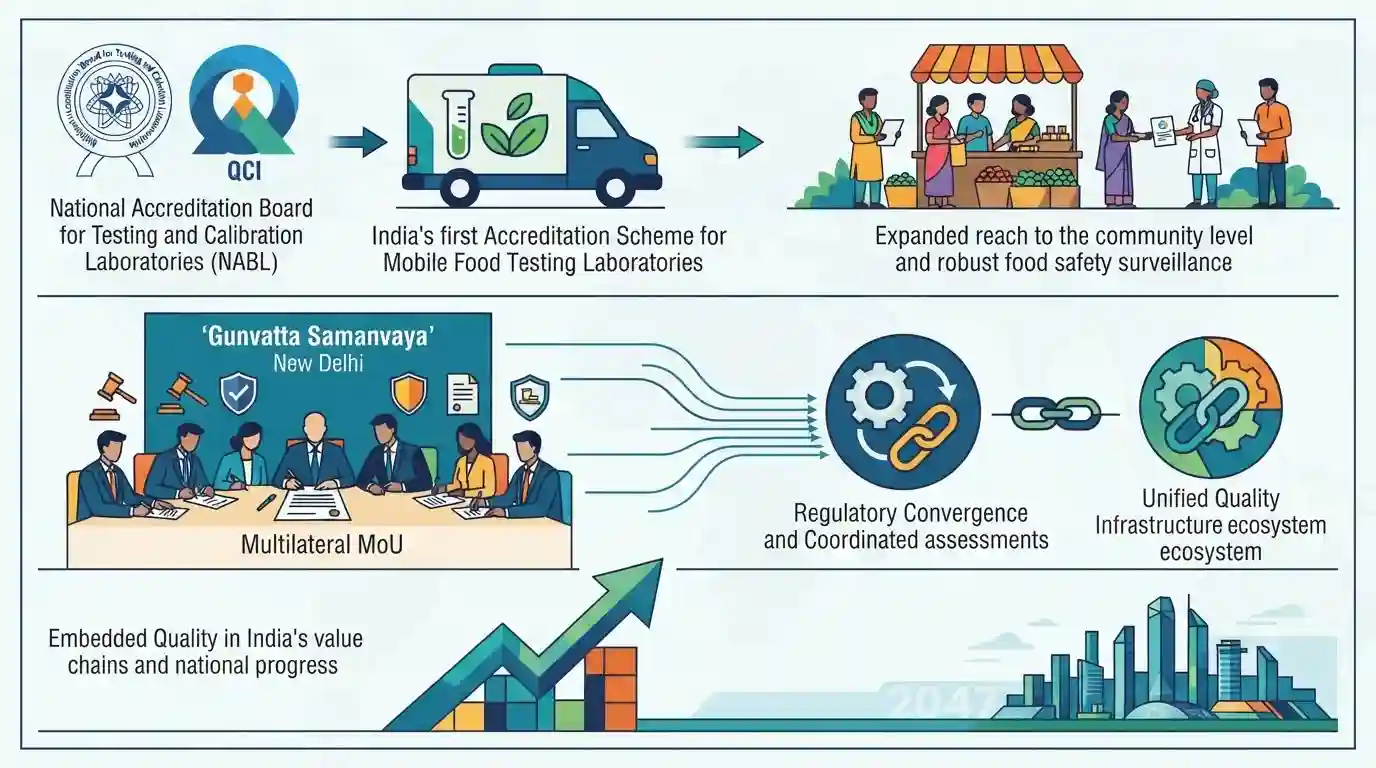
The National Accreditation Board for Testing and Calibration Laboratories (NABL), operating under the Quality Council of India (QCI), has introduced India's first Accreditation Scheme for Mobile Food Testing Laboratories. Launched during the 'Gunvatta Samanvaya' event in New Delhi, the scheme seeks to expand the reach of accredited food testing facilities directly to the community level, ensuring robust food safety surveillance. The event also witnessed the signing of a Multilateral MoU aimed at fostering regulatory convergence, coordinated assessments, and a unified quality infrastructure ecosystem, crucial for embedding quality in India's value chains as the nation progresses toward 2047.
ముఖ్య అంశాలు
- NABL, a constituent board of the Quality Council of India (QCI), launched India's first Accreditation Scheme for Mobile Food Testing Laboratories.
- The scheme was unveiled during 'Gunvatta Samanvaya', an event marked by a Multilateral MoU Exchange to promote regulatory convergence and integrated quality infrastructure.
- The initiative aims to decentralize food safety surveillance by extending reliable, high-quality testing services closer to communities across India.
- It aligns with India's growth trajectory towards 2047 by embedding quality standards across supply chains and improving the ease of doing business.
ముఖ్యమైన పదాలు
Accreditation Scheme for Mobile Food Testing Laboratories

India's first framework by NABL to accredit mobile food-testing units. It extends quality-assured, internationally benchmarked testing beyond fixed labs to communities, enabling rapid, on-site food safety screening.
UPSC context
GS Paper 2 & 3 (Food Security & Public Health). Tests awareness of regulatory steps to improve localized food safety surveillance.
National Accreditation Board for Testing and Calibration Laboratories (NABL)
An autonomous constituent board under the Quality Council of India that provides third-party assessments of the technical competence of testing, calibration, and medical laboratories based on global standards.
UPSC context
GS Paper 2 (Regulatory Bodies). Crucial for questions on India's quality infrastructure, regulatory compliance, and ease of doing business.
Quality Council of India (QCI)
A non-profit autonomous body established in 1997 via a PPP model under DPIIT. It serves as India's national accreditation body to establish, promote, and institutionalize quality standards across socio-economic sectors.
UPSC context
GS Paper 2 (Governance). Frequently tested regarding India's national quality ecosystem, public-private partnerships, and independent third-party assessments.
Integrated Assessment Programme (IAP)
A framework operated by NABL that consolidates multiple accreditation and assessment requirements into a single streamlined process, aiming to eliminate duplication and promote regulatory harmonization.
UPSC context
GS Paper 2 (Governance). Relevant to topics on administrative reforms, regulatory convergence, and improving the Ease of Doing Business.
Gunvatta Samanvaya
An initiative and multilateral MoU exchange program led by QCI and NABL aimed at strengthening India's quality infrastructure by promoting regulatory convergence, coordinated assessments, and mutual trust.
UPSC context
GS Paper 2 (Governance). Highlights inter-agency coordination to reduce regulatory overlaps and improve efficiency in compliance and testing.
ప్రిలిమ్స్ ఉచ్చు
NABL and its parent body QCI are statutory bodies under the Ministry of Health and Family Welfare.
QCI and NABL operate under the Department for Promotion of Industry and Internal Trade (DPIIT), Ministry of Commerce and Industry. They do not belong to the Ministry of Health and Family Welfare, despite their heavy involvement in health and food safety testing.
అనుసంధానమైన స్థిర భావనలు
What is the Quality Council of India (QCI) and how is it governed?
- Origin and Ministry: Established in 1997 via a Cabinet decision as an autonomous registered society under the DPIIT, Ministry of Commerce and Industry.
- Joint Venture: Set up as a joint initiative with three premier industry associations: ASSOCHAM, CII, and FICCI.
- Chairperson appointment: Appointed directly by the Prime Minister of India for a tenure of three years, based on industry recommendations.
What is the linkage between NABL and the Food Safety and Standards (FSS) Act, 2006?
- Section 43 Mandate: Mandates FSSAI to notify food testing laboratories that are formally accredited by NABL or equivalent bodies.
- NABL Role: Acts as India's national accreditation body for testing, calibration, and medical laboratories, operating under global ISO/IEC standards.
అంతర-అంశ నమూనాలు
Food Safety + Decentralized Governance
Mobile labs democratize safety compliance, shifting food testing from capital-intensive urban hubs to rural panchayats, strengthening local health governance.
Accreditation + Agri-Export Compliance
Standardized lab accreditations align domestic food production with international SPS (Sanitary and Phytosanitary) measures, boosting agricultural export competitiveness under WTO norms.

Prelims 2026 may test the institutional division between FSSAI (MoHFW) and NABL/QCI (Ministry of Commerce) in food safety governance.
అనుసంధాన PYQలు · 2
అనుసంధాన PYQలు · 2
- 2017PrelimsGS1
With reference to 'Quality Council of India (QCI)', consider the following statements: 1. QCI was set up jointly by the Government of India and the Indian Industry. 2. Chairman of QCI is appointed by the Prime Minister on the recommendations of the industry to the Government. Which of the above statements is/are correct?
- 2018PrelimsGS1
Consider the following statements: 1. The Food Safety and Standards Act, 2006 replaced the Prevention of Food Adulteration Act, 1954. 2. The Food Safety and Standards Authority of India (FSSAI) is under the charge of Director General of Health Services in the Union Ministry of Health and Family Welfare. Which of the statements given above is/are correct?
