Expansion of International Ports for EVisa Holder Foreign Nationals
Source:PIB ↗
આ શા માટે મહત્વનું છે
Understanding the expansion of E-Visa ports is vital for UPSC aspirants as it bridges multiple syllabus areas: e-Governance applications (GS2), economic growth via tourism facilitation (GS3), and the strategic management of land borders and internal security (GS3). It illustrates how technological interventions can optimize border infrastructure.
સારાંશ
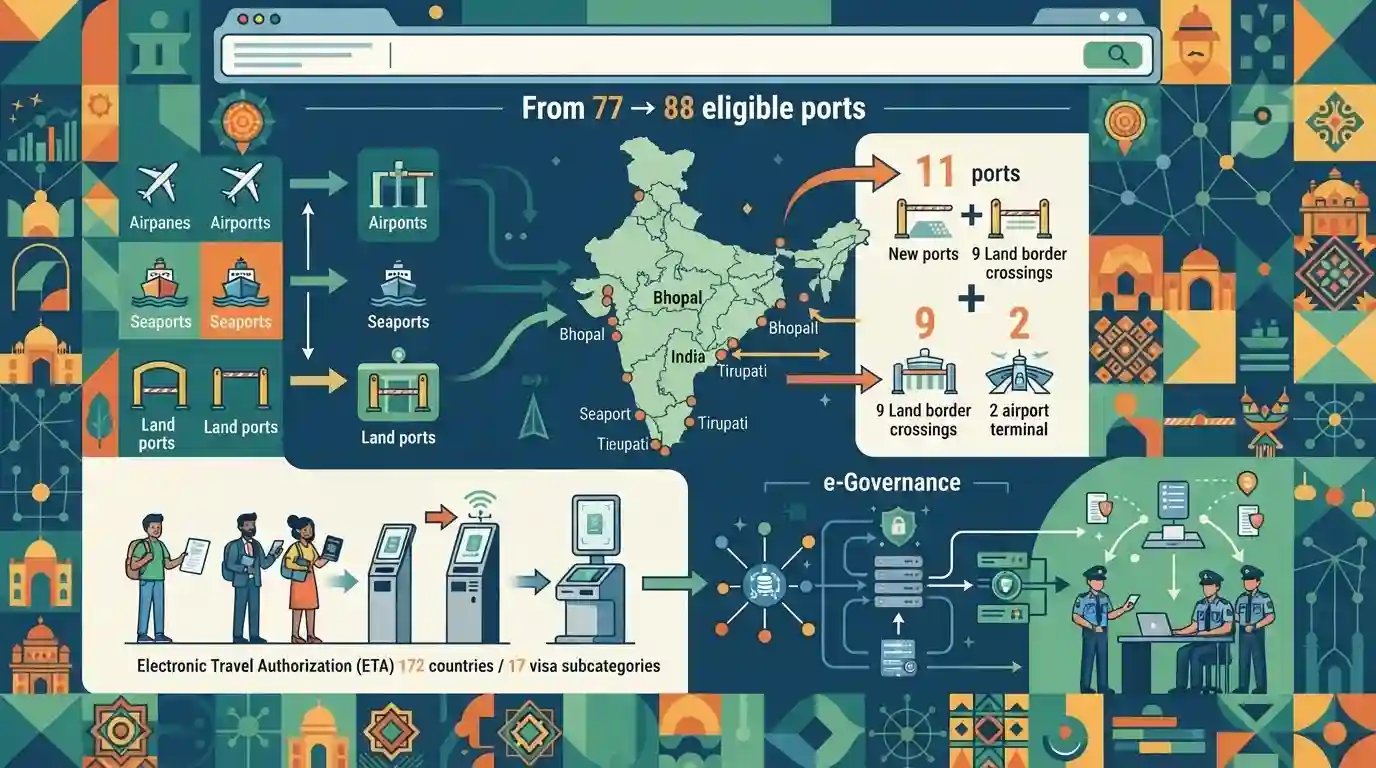
The Government of India has authorized 11 additional International Ports—nine land ports and two airports (Bhopal and Tirupati)—for the entry of foreigners holding E-Visas. This expansion brings the total number of eligible ports to 88, which includes 37 airports, 38 seaports, and 13 land ports. By expanding the E-Visa facility, which uses Electronic Travel Authorization (ETA) and caters to 172 countries across 17 subcategories, the government aims to liberalize, streamline, and simplify travel to India. The move represents a significant intersection of e-Governance and internal security, as it utilizes technological infrastructure to facilitate legitimate travel and tourism while maintaining robust border management.
મુખ્ય મુદ્દા
- The Government of India has designated 11 new International Ports (9 land ports and 2 airports) for the entry of E-Visa holder foreign nationals.
- The newly notified land ports are Agartala, Darranga, Gede, Ghojadanga, Haridaspur, Jaigaon, Dawki, Moreh, and Attari (Road), while the new airports are Bhopal and Tirupati.
- This addition brings the total number of approved E-Visa entry ports to 88, comprising 37 airports, 38 seaports, and 13 land ports.
- The E-Visa facility, which is underpinned by Electronic Travel Authorization (ETA), is now available to citizens of 172 countries under 17 subcategories, accounting for approximately 78% of all visas issued by India.
- The initiative underscores India's push towards e-Governance to liberalize the visa regime for economic gain (tourism, business) while strengthening internal security via robust technology infrastructure at border points.
મહત્વપૂર્ણ શબ્દો
E-Visa Facility

A digital visa portal launched in 2014 enabling foreign nationals to apply, pay, and receive entry visas online, simplifying travel to India.
UPSC context
GS Paper II (e-Governance) and GS Paper III (Tourism/Economy); tests knowledge of digital reforms and ease of travel.
Electronic Travel Authorization (ETA)
An official online document issued to foreign travellers prior to travel, serving as preliminary approval to enter India under the e-visa scheme.
UPSC context
GS Paper II (e-Governance) and GS Paper III (Security); tests awareness of pre-arrival screening and digital travel clearance.
Border Management
The coordination of physical infrastructure, administrative systems, and surveillance technologies to secure international frontiers and regulate trade and migration.
UPSC context
GS Paper III (Internal Security); essential for analyzing border challenges, technological integration, and safe regional connectivity.
Land Ports Authority of India (LPAI)
A statutory body under the Ministry of Home Affairs responsible for creating, upgrading, maintaining, and managing cross-border infrastructure in India.
UPSC context
GS Paper III (Border Infrastructure); tests understanding of statutory agencies managing security and cross-border trade.
Integrated Check Posts (ICPs)
Unified entry and exit points at international land borders consolidating customs, immigration, security, and quarantine clearances in one centralized location.
UPSC context
GS Paper III (Border Area Management); tests knowledge of unified trade and travel facilitation infrastructure along frontiers.
પ્રિલિમ્સ ટ્રેપ
The Land Ports Authority of India is a statutory body under the Ministry of Commerce and Industry.
LPAI is a statutory body established under the LPAI Act, 2010, but it functions under the Ministry of Home Affairs (MHA), not Commerce or Shipping.
સંલગ્ન સ્થિર ખ્યાલો
What is the Land Ports Authority of India (LPAI)?
- Statutory Status: Established as a statutory body under the Land Ports Authority of India Act, 2010.
- Administrative Ministry: Functions under the Department of Border Management, Ministry of Home Affairs (MHA).
- Core Mandate: Tasked with building, maintaining, and managing Integrated Check Posts (ICPs) along India's land borders.
How does India's E-Visa / Electronic Travel Authorization (ETA) system operate?
- Pre-entry Authorization: The E-Visa functions as a pre-authorization; the final entry permit is stamped upon arrival after biometric verification.
- Port Restrictions: Unlike standard paper visas, E-Visas can only be used to enter India through specifically designated international ports.
- Area Exclusions: E-Visa holders are explicitly barred from entering protected, restricted, or cantonment areas without prior civil permission.
આંતર-વિષય પેટર્ન
E-Visa: Soft Power vs. Security Balance
Balancing tourism influx with strict biometric controls at entry ports demonstrates the integration of economic diplomacy with MHA's internal security architecture.
Border Infrastructure and Neighborhood First
Upgrading land ports like Darranga (Bhutan) and Dawki (Bangladesh) reinforces regional economic integration and security under India's Neighborhood First and Act East policies.

2026 Prelims may test Land Ports Authority of India's statutory mandate under MHA alongside digital trade systems like VINIMAY.
સંલગ્ન PYQ · 5
સંલગ્ન PYQ · 5
- 2016MainsGS3
Border management is a complex task due to difficult terrain and hostile relations with some countries. Elucidate the challenges and strategies for effective border management.
- 2024MainsGS3
India has a long and troubled border with China and Pakistan fraught with contentious issues. Examine the conflicting issues and security challenges along the border. Also give out the development being undertaken in these areas under the Border Area Development Programme (BADP) and Border Infrastructure and Management (BIM) Scheme.
- 2023MainsGS2
e-governance, as a critical tool of governance, has ushered in effectiveness, transparency and accountability in governments. What inadequacies hamper the enhancement of these features ?
- 2024MainsGS2
e-governance is not just about the routine application of digital technology in service delivery process. It is as much about multifarious interactions for ensuring transparency and accountability. In this context evaluate the role of the 'Interactive Service Model' of e-governance.
- 2026PrelimsGS1
Consider the following statements about river bridges connecting India with neighbouring countries : 1. 'Maitri Setu', built over Feni river, connects Ramgarh in India with Sabroom in Bangladesh. 2. Jhulaghat suspension bridge connects India with Myanmar. 3. Mechi bridge and its approaches connect Panitanki Bypass in India with Kakarvitta in Nepal. Which of the statements given above is/are correct ?
