Digitalisation of Power Distribution Companies and Energy Reforms
Source:PIB ↗
આ શા માટે મહત્વનું છે
DISCOMs are the weakest link in India's power value chain. Their financial and operational health is critical for ensuring 24x7 affordable electricity, integrating renewable energy, and sustaining broader economic growth.
સારાંશ
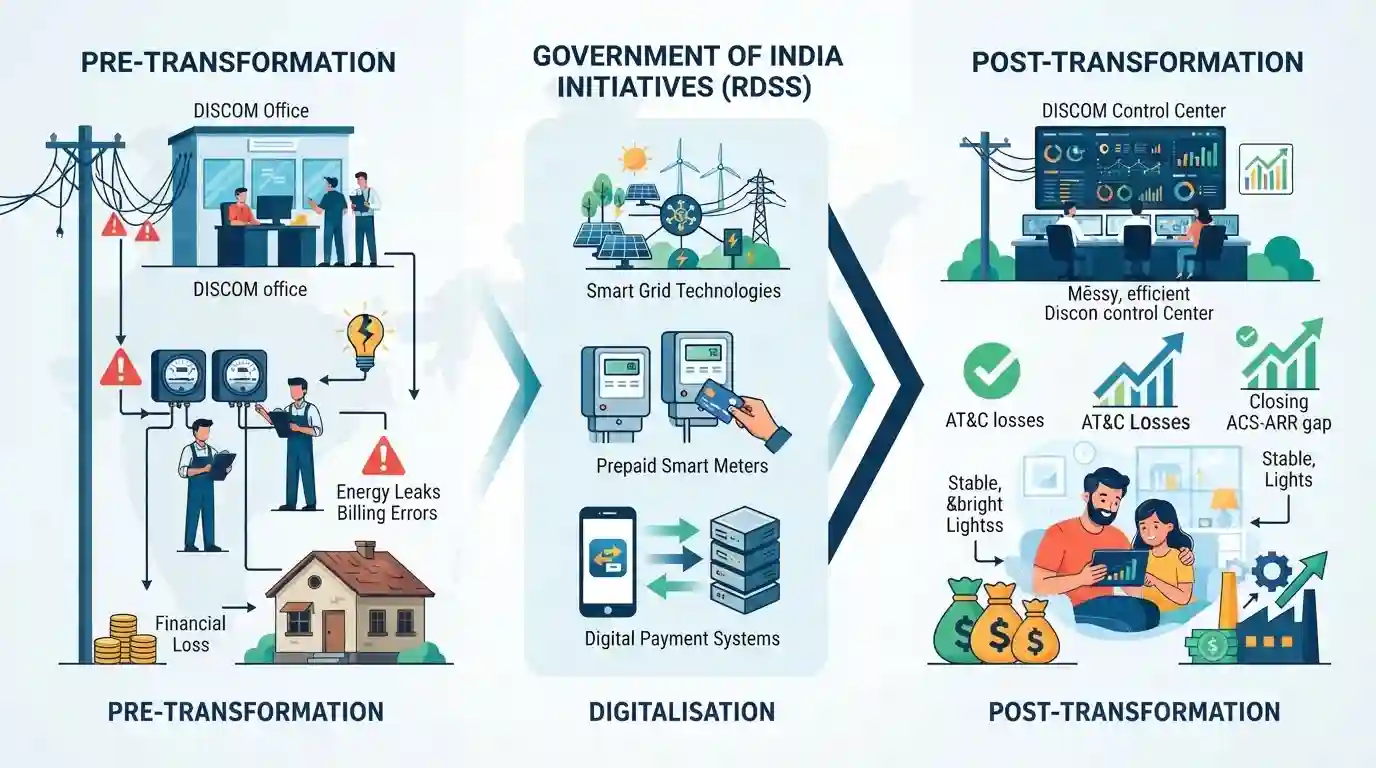
The Government of India is heavily focusing on the digitalisation of Power Distribution Companies (DISCOMs) to address operational inefficiencies and financial distress in the energy sector. By integrating smart grid technologies, prepaid smart meters, and digital payment systems under initiatives like the Revamped Distribution Sector Scheme (RDSS), the government aims to drastically reduce Aggregate Technical and Commercial (AT&C) losses. Digitalisation empowers consumers with real-time energy accounting and accurate billing while enabling DISCOMs to bridge the ACS-ARR gap, ensuring the long-term sustainability and reliability of India's power infrastructure.
મુખ્ય મુદ્દા
- Financial Viability: Digitalisation targets the root causes of DISCOMs' financial distress by improving revenue realization and closing the Average Cost of Supply (ACS) to Average Realizable Revenue (ARR) gap.
- Smart Infrastructure: Rollout of prepaid smart meters and integration of IT/OT (Information and Operational Technology) systems enhance real-time energy accounting and grid management.
- AT&C Loss Reduction: Automated data collection and remote monitoring help curb power theft, leakage, and billing errors, directly reducing Aggregate Technical and Commercial (AT&C) losses.
- Consumer Centricity: Digital ecosystems provide consumers with better grievance redressal, seamless digital payment options, and tools to monitor and optimize their electricity consumption.
- Scheme Implementation: The Revamped Distribution Sector Scheme (RDSS) serves as the primary policy vehicle, offering conditional financial assistance to DISCOMs for achieving digital and operational milestones.
મહત્વપૂર્ણ શબ્દો
Revamped Distribution Sector Scheme (RDSS)

A reform-based, result-linked initiative by the Ministry of Power aiming to improve operational efficiency and financial sustainability of DISCOMs. It focuses on reducing AT&C losses to 12-15% and bridging the ACS-ARR gap via smart metering and infrastructure upgrades.
UPSC context
Crucial for GS-3 (Infrastructure/Energy). It tests knowledge of structural reforms addressing the financial distress of state power utilities.
Ujwal DISCOM Assurance Yojana (UDAY)
A 2015 financial restructuring program allowing state governments to take over 75% of DISCOM debt. It sought a permanent solution to electricity distribution companies' financial crises by issuing low-interest bonds and mandating operational efficiency targets.
UPSC context
Highly relevant for GS-3 (Economy/Infrastructure). It tests historical context for India's power sector debt resolution and cooperative federalism.
Smart Metering National Programme (SMNP)
An initiative spearheaded by Energy Efficiency Services Limited aimed at replacing 25 crore conventional electricity meters with prepaid smart meters across India, improving billing accuracy, enabling real-time energy accounting, and checking power theft.
UPSC context
Relevant for GS-3 (Infrastructure/Technology). Highlights e-governance solutions for reducing AT&C losses and ensuring grid modernization.
DISCOMs
Power Distribution Companies responsible for the critical last-mile delivery of electricity to end consumers. They purchase power from generation companies and handle localized grid maintenance, metering, billing, and revenue collection.
UPSC context
Central to GS-3 (Energy). DISCOM financial health is a primary driver of India's overall power sector viability and economic stability.
REC Limited
A Maharatna Central Public Sector Enterprise under the Ministry of Power that finances power projects across India. It acts as a primary nodal agency for facilitating the implementation of the Revamped Distribution Sector Scheme (RDSS).
UPSC context
Relevant for GS-3 (Infrastructure). Tests knowledge of nodal financial institutions driving national power infrastructure and electrification reforms.
Power Finance Corporation (PFC)
A specialized Maharatna non-banking financial company under the Ministry of Power providing crucial financial backing to India's power sector. Like REC, it serves as a designated nodal agency for executing capacity-building and infrastructure upgrades under RDSS.
UPSC context
Important for GS-3 (Economy/Infrastructure). Evaluates understanding of specialized public financial institutions supporting large-scale energy transmission and distribution upgrades.
પ્રિલિમ્સ ટ્રેપ
The RDSS scheme operates by unconditionally taking over state DISCOM debt, mirroring the financial restructuring model of UDAY.
RDSS is strictly a reforms-based, results-linked conditional grant scheme targeting infrastructure; it explicitly rejects the unconditional debt-takeover approach used under the older UDAY scheme.
સંલગ્ન સ્થિર ખ્યાલો
What distinguishes Transmission & Distribution (T&D) losses from Aggregate Technical & Commercial (AT&C) losses?
- T&D Losses: Measure only physical energy dissipated in cables and transformers during transmission and distribution.
- AT&C Losses: Combine technical transmission losses with commercial leakages, including power theft, billing errors, and payment collection failures.
- Syllabus Significance: AT&C offers a truer picture of DISCOM financial viability by capturing both systemic inefficiencies and revenue realization gaps.
What is the ACS-ARR gap in the power sector?
- ACS Definition: Average Cost of Supply represents the total cost incurred to purchase, transmit, and distribute a unit of electricity.
- ARR Definition: Average Revenue Realised is the actual revenue collected by the utility per unit of electricity sold.
- Viability Gap: A positive ACS-ARR gap indicates the DISCOM is selling power at a loss, necessitating state subsidies or debt accumulation.
આંતર-વિષય પેટર્ન
Fiscal Federalism & Power Reforms
RDSS's conditional grants act as a tool of fiscal federalism, nudging states toward politically sensitive tariff rationalization to unlock central funding.
Prepaid Meters & Financial Inclusion
Prepaid smart-metering systems mimic digital micro-transactions, helping low-income consumers budget energy usage while building credit footprints through digital payments.

Expect questions comparing UDAY and RDSS parameters, specifically distinguishing AT&C losses from T&D losses and the TOTEX public-private model.
સંલગ્ન PYQ · 3
સંલગ્ન PYQ · 3
- 2016PrelimsGS1
Which one of the following is a purpose of 'UDAY', a scheme of the Government?
- 2018MainsGS3
“Access to affordable, reliable, sustainable and modern energy is the sine qua non to achieve Sustainable Development Goals (SDGs).” Comment on the progress made in India in this regard.
- 2024PrelimsGS1
Consider the following: 1. Battery storage 2. Biomass generators 3. Fuel cells 4. Rooftop solar photovoltaic units How many of the above are considered "Distributed Energy Resources"?
