CSIR NEERI NEERI ZAR Water Filters Deployed in Flood Hit Assam
Source:PIB ↗
কেন এটি গুরুত্বপূর্ণ
This article highlights the real-world application of indigenous technology (CSIR-NEERI's NEERI-ZAR) in disaster risk reduction. It directly connects with Mains GS3 topics regarding water-crisis-solving technologies and building community disaster resilience during recurring events like the Assam floods.
সারসংক্ষেপ
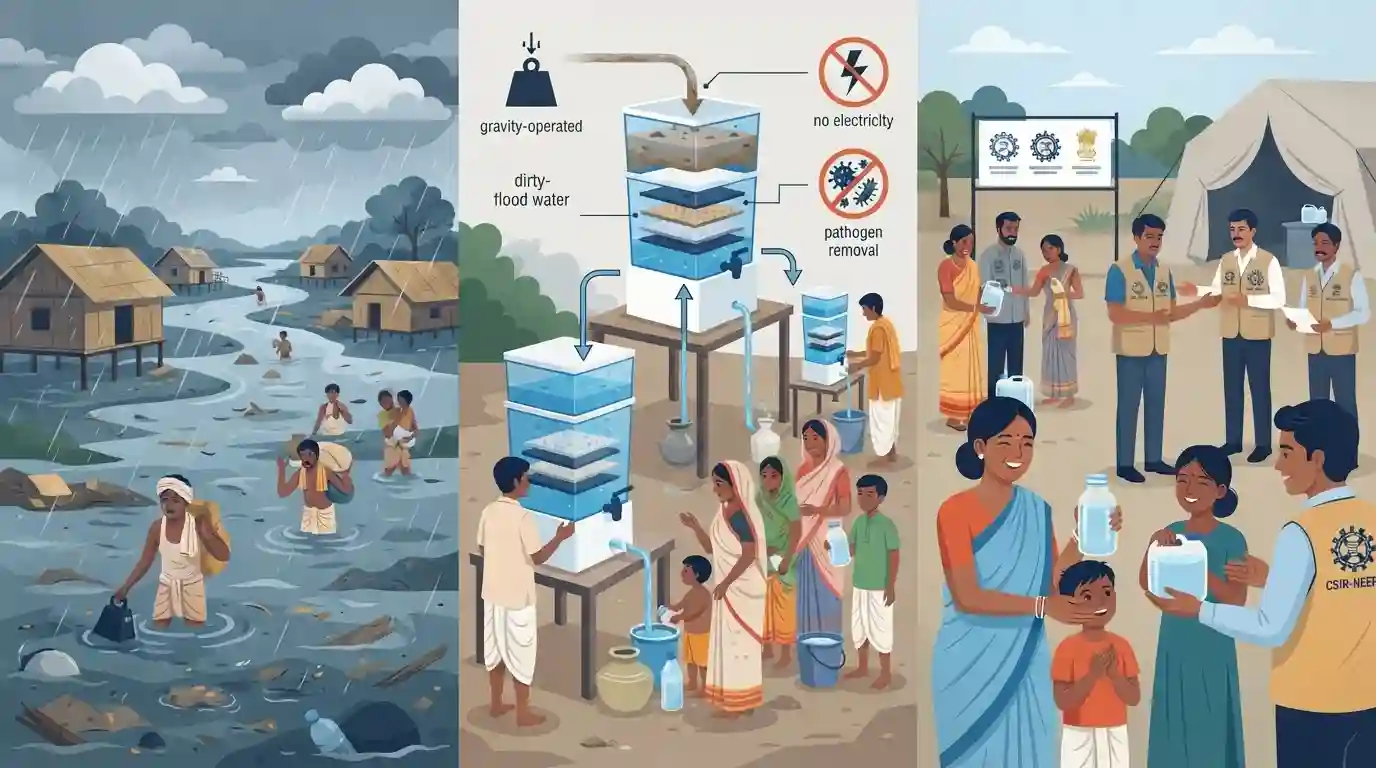
CSIR-NEERI has deployed its indigenously developed emergency water filtration system, NEERI-ZAR, in flood-affected districts of Assam, particularly in Jonakimondal village of Jorhat. Developed to tackle severe water contamination during disasters, NEERI-ZAR is a low-cost, gravity-operated, and zero-electricity purification technology that can swiftly treat heavily turbid and pathogen-laden water. Delivered in cooperation with CSIR-NEIST and the local district administration, the deployment aims to provide immediate relief, secure safe drinking water, and prevent the outbreak of waterborne diseases in inundated rural areas, underscoring the vital role of indigenous scientific research in disaster management and community-level resilience.
মূল বিষয়
- CSIR-NEERI, in collaboration with CSIR-NEIST and the Jorhat District Administration, deployed its indigenous emergency water purification units, NEERI-ZAR, in the flood-ravaged Jonakimondal village of Assam.
- NEERI-ZAR is a portable, gravity-based instant water filter developed by CSIR-NEERI that operates without electricity, making it ideal for disaster zones.
- The technology is designed to rapidly remove suspended solids, turbidity, organic matter, and microbiological pathogens from contaminated floodwaters, rendering it safe for drinking immediately.
- The deployment includes both household-based and community-scale units, helping to prevent the secondary crisis of waterborne disease outbreaks (e.g., cholera, gastroenteritis) following major flood events.
- This initiative highlights the crucial role of decentralised, low-cost, and non-grid-dependent indigenous technologies in enhancing climate adaptation, rural health security, and emergency disaster response.
গুরুত্বপূর্ণ শব্দ
NEERI-ZAR Instant Water Filters

An indigenous, gravity-operated, zero-electricity water purification system developed by CSIR-NEERI to provide clean drinking water by removing high turbidity and pathogens during natural disasters like floods.
UPSC context
GS Paper 3: Science and Technology (indigenous developments); Disaster Management (emergency response and safe drinking water interventions).
National Environmental Engineering Research Institute (CSIR-NEERI)
A constituent laboratory of the Council of Scientific and Industrial Research (CSIR) established in Nagpur in 1958, dedicated to environmental science, water engineering, and pollution mitigation.
UPSC context
GS Paper 3: Environment and Science & Technology; tests knowledge of premier national R&D institutes and environmental governance.
North East Institute of Science and Technology (CSIR-NEIST)
A constituent laboratory of CSIR, established in 1961 in Jorhat, Assam, focusing on multidisciplinary R&D to develop indigenous technologies utilizing the natural resources of Northeast India.
UPSC context
GS Paper 3: Science & Technology (regional R&D centers); helpful for essays on North East development and indigenous innovation.
Council of Scientific and Industrial Research (CSIR)
India's largest autonomous R&D organization, established in 1942 under the Ministry of Science and Technology, tasked with fostering scientific and industrial research to accelerate socio-economic development.
UPSC context
GS Paper 3: Science & Technology; a recurring institution in Prelims and Mains regarding premier scientific bodies and indigenous technologies.
প্রিলিমস ফাঁদ
CSIR-NEERI operates under the administrative control of the Ministry of Environment, Forest and Climate Change (MoEFCC).
CSIR-NEERI is a constituent laboratory of CSIR, which functions under the Union Ministry of Science and Technology, not MoEFCC.
সংযুক্ত স্থির ধারণা
What is the administrative profile and mandate of CSIR-NEERI?
- Origin and Nomenclature: Established in 1958 in Nagpur as CPHERI; renamed NEERI in 1974.
- Parent Ministry: Functions under the Council of Scientific and Industrial Research (CSIR), Ministry of Science and Technology.
- Core Mandate: Conducts R&D in environmental science and engineering, focusing on water, wastewater, and air pollution mitigation.
How do gravity-based disaster water filters operate without electricity?
- Physical Filtration: Utilizes hydrostatic pressure to pass water through graded sand beds or porous terracotta clay membranes to remove turbidity.
- Chemical Disinfection: Deploys controlled chemical dosing (like chlorination at ~2 ppm) to destroy bacterial pathogens and prevent waterborne outbreaks.
- Zero-Electricity Advantage: Operates completely off-grid, ensuring clean drinking water access in disrupted disaster zones like flooded rural areas.
আন্তঃবিষয় প্যাটার্ন
Tech-driven Disaster Resilience
Illustrates a shift from passive relief to active, science-backed field interventions (like NEERI-ZAR) to mitigate post-disaster biological hazards in flooded terrain.
Decentralized Water Security & SDG 6
Demonstrates how low-cost, zero-electricity technologies empower remote, climate-vulnerable communities, advancing progress towards Clean Water and Sanitation goals.

Questions linking indigenous disaster-relief technologies (like NEERI-ZAR) with their physical principles and parent ministries are highly likely.
সংযুক্ত PYQ · 2
সংযুক্ত PYQ · 2
- 2024MainsGS3
The world is facing an acute shortage of clean and safe freshwater. What are the alternative technologies which can solve this crisis? Briefly discuss any three such technologies citing their key merits and demerits.
- 2024MainsGS3
What is disaster resilience? How is it determined? Describe various elements of a resilience framework. Also mention the global targets of Sendai Framework for Disaster Risk Reduction (2015–2030).
