Ministry of Minority Affairs Leadership Programs for Minority Women
Source:PIB ↗
কেন এটি গুরুত্বপূর্ণ
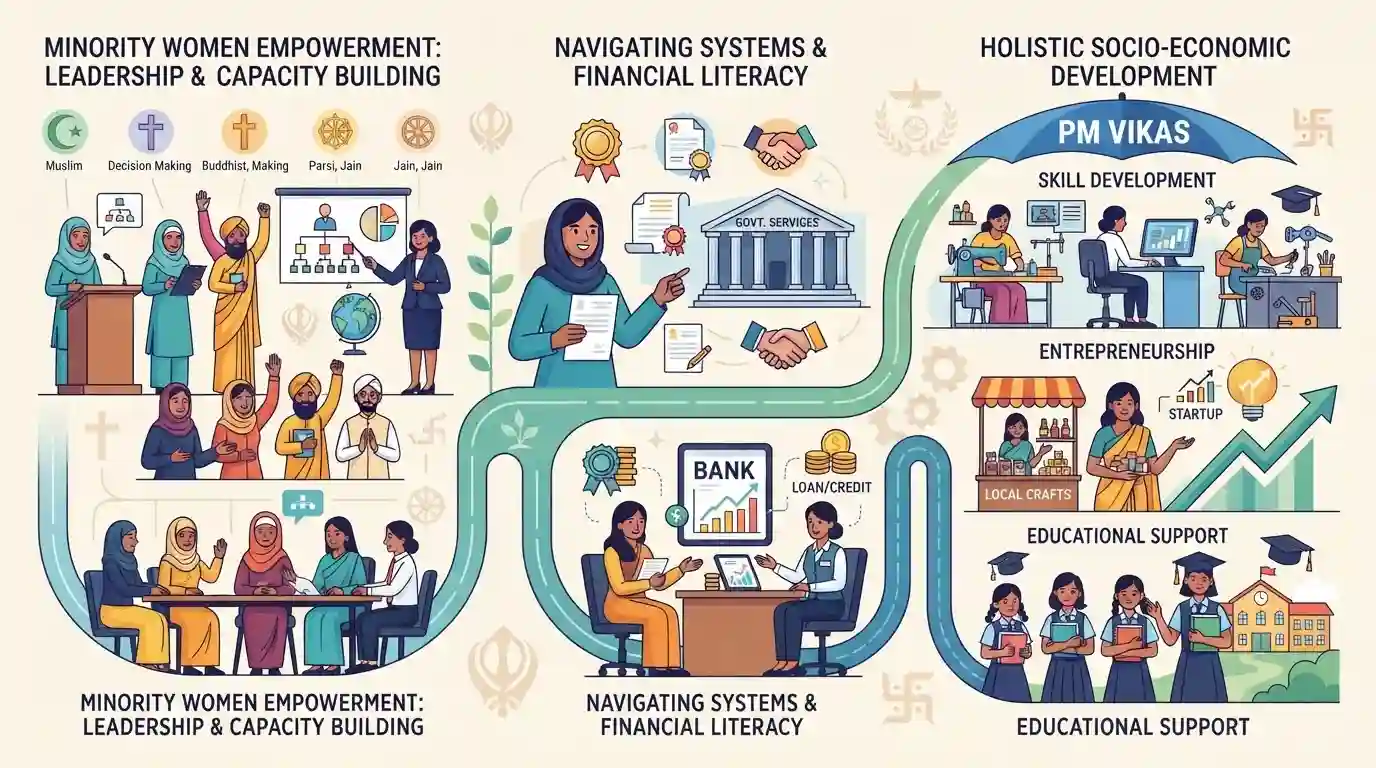
It demonstrates the rationalization of government schemes, specifically how targeted interventions like 'Nai Roshni' are integrated into a broader umbrella scheme (PM VIKAS) to streamline the socio-economic empowerment of marginalized communities, forming a crucial case study for GS2 answers on social justice and welfare.
সারসংক্ষেপ
The Ministry of Minority Affairs provides leadership and capacity-building programs for minority women, previously under the 'Nai Roshni' scheme and now subsumed within the integrated PM VIKAS (Pradhan Mantri Virasat Ka Samvardhan) umbrella scheme. These initiatives, implemented in states like Odisha, seek to empower women from the six notified minority communities by enhancing their leadership qualities and providing practical knowledge for navigating government systems and banks. PM VIKAS focuses on holistic socio-economic empowerment through skill development, entrepreneurship, and educational support, targeting intersectional vulnerabilities faced by minority women.
মূল বিষয়
- The Ministry of Minority Affairs implemented the 'Nai Roshni' scheme, focusing on the leadership development and confidence-building of minority women.
- Nai Roshni, along with other minority welfare schemes, has now been converged into the integrated umbrella scheme named PM VIKAS (Pradhan Mantri Virasat Ka Samvardhan).
- PM VIKAS aims for the socio-economic and educational empowerment of six notified minority communities through skill development, entrepreneurship, education support, and infrastructure interventions.
- These capacity-building programs provide minority women with vital tools and techniques to interact effectively with government systems, banks, and other institutions, thereby asserting their rights and entitlements.
গুরুত্বপূর্ণ শব্দ
Nai Roshni Scheme

A leadership development program launched in 2012-13 for minority women aged 18-65. Now subsumed under PM VIKAS, it trains women to confidently access government services, banks, and assert their legal rights.
UPSC context
GS-II (Social Justice). Tests awareness of women’s empowerment, intersectionality (minority + gender), and financial literacy initiatives.
PM VIKAS (Pradhan Mantri Virasat Ka Samvardhan)
An integrated Central Sector Scheme converging five earlier Ministry of Minority Affairs programs (including Nai Roshni). It focuses on skilling, education, and leadership development for minority and artisan communities to ensure socio-economic empowerment.
UPSC context
GS-II (Welfare Schemes). Essential for questions on minority empowerment, capacity building, and policy convergence.
Notified Minority Communities
Six religious groups—Muslims, Christians, Sikhs, Buddhists, Parsis, and Jains—designated as minorities by the Central Government under Section 2(c) of the National Commission for Minorities Act, 1992, for targeted welfare.
UPSC context
GS-II (Polity). Highly tested in Prelims regarding the NCM Act and the central recognition of minority status.
Ministry of Minority Affairs
A central government ministry established in 2006 to formulate policies, plan development programs, and implement welfare schemes specifically targeted at India's six notified religious minority communities.
UPSC context
GS-II (Governance). Relevant for institutional mechanisms designed to support vulnerable and minority populations.
প্রিলিমস ফাঁদ
PM VIKAS scheme is exclusively applicable to candidates belonging to the six centrally notified religious minority communities.
False. To address intersectional poverty, PM VIKAS actually allows up to 25% of non-minority Economically Weaker Sections (EWS) candidates in skilling components and 15% in others.
সংযুক্ত স্থির ধারণা
Who are the notified minority communities in India and how are they defined?
- Constitutional Status: Articles 29 and 30 recognize religious and linguistic minorities, but the Constitution does not explicitly define the term 'minority'.
- Statutory Notification: The Central Government notifies religious minorities at the national level under Section 2(c) of the National Commission for Minorities Act, 1992.
- Six Communities: Muslims, Christians, Sikhs, Buddhists, Parsis, and Jains (added in 2014) are the six centrally notified minority communities.
What distinguishes a Central Sector Scheme from a Centrally Sponsored Scheme?
- Funding Mechanism: Central Sector Schemes are 100% funded by the Union government, whereas Centrally Sponsored Schemes have a shared funding ratio between the Centre and States.
- Implementation Agency: Central Sector Schemes (like PM VIKAS) are implemented directly by Central ministries or their agencies, while Centrally Sponsored Schemes are implemented by State governments.
আন্তঃবিষয় প্যাটার্ন
Scheme rationalization in welfare governance
PM VIKAS converges five standalone schemes (Nai Roshni, USTTAD, etc.), reflecting the 15th Finance Commission's broader push to reduce scheme fragmentation and optimize resource utilization across ministries.
Biz Sakhis and peer-led entrepreneurship
PM VIKAS’s ‘Biz Sakhi’ mentorship for minority women mirrors the rural development ministry's Lakhpati Didi and Krishi Sakhi models, indicating a standardized governance approach toward women-led peer entrepreneurship.

Expect a 2026 Prelims statement testing PM VIKAS's inclusion of non-minority EWS (up to 25%), breaking the "minorities-only" assumption.
সংযুক্ত PYQ · 3
সংযুক্ত PYQ · 3
- 2019MainsGS2
Performance of welfare schemes that are implemented for vulnerable sections is not so effective due to absence of their awareness and active involvement at all stages of policy process. Discuss.
- 2023MainsGS2
“Development and welfare schemes for the vulnerable, by its nature, are discriminatory in approach.” Do you agree? Give reasons for your answer.
- 2025MainsGS2
Women's social capital complements in advancing empowerment and gender equity. Explain.
