Pradhan Mantri Awas Yojana Urban Delivers One Crore Homes
Source:PIB ↗
Why It Matters
The article provides concrete data on the performance of a flagship housing scheme, crucial for GS2 answers on welfare policies, and highlights a structural approach to women's empowerment (asset creation) that can be cited in GS1 and GS2 essays or answers on gender equity.
Summary
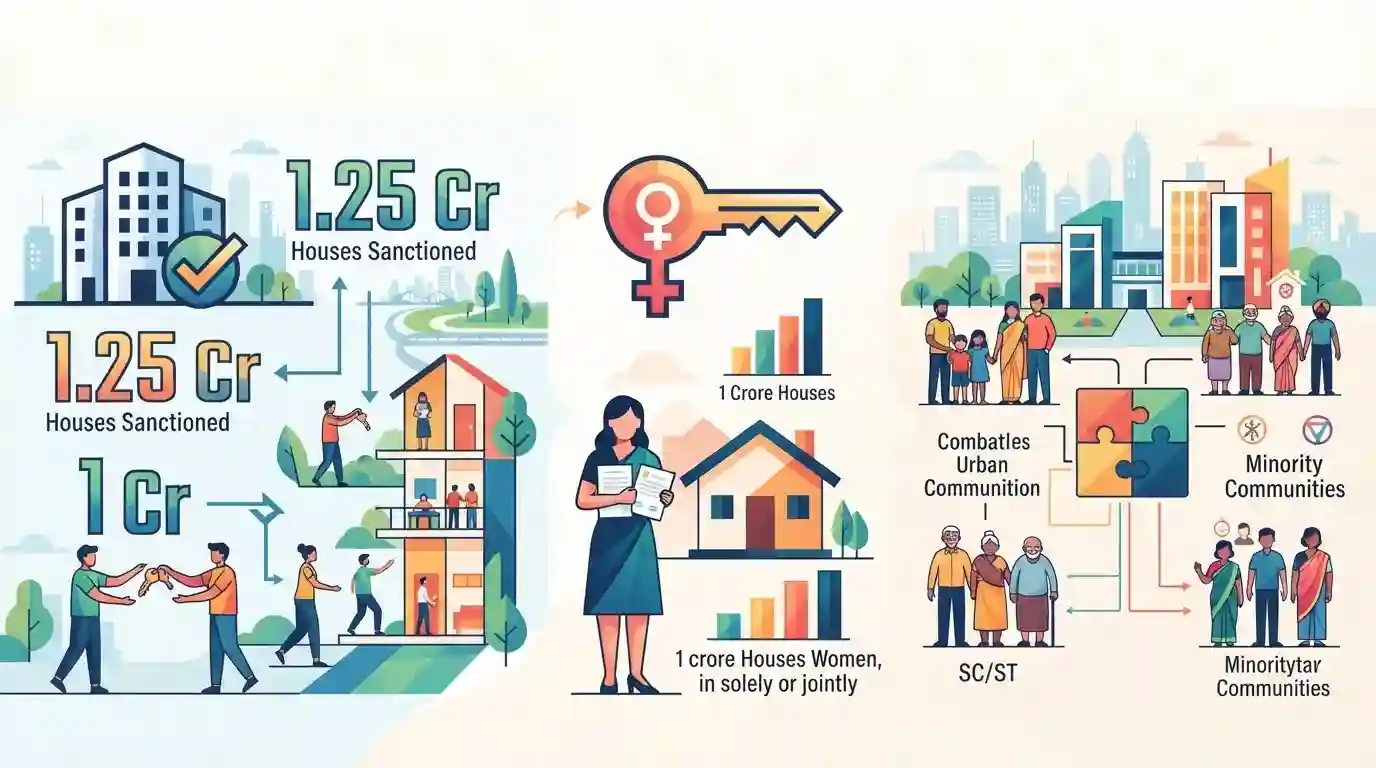
The Pradhan Mantri Awas Yojana - Urban (PMAY-U) has achieved a significant milestone with the sanctioning of 1.25 crore houses and the delivery of 1 crore homes to urban residents. Reviewed during the 8th CSMC meeting for PMAY-U 2.0, the scheme stands out for its structural push toward women's empowerment, having allotted 1 crore houses either solely or jointly to women, thereby facilitating female asset ownership. PMAY-U targets EWS, LIG, and MIG families, heavily emphasizing social inclusion by prioritizing vulnerable groups like SC/STs, minorities, and transgender individuals to combat urban segregation and poverty.
Key Points
- PMAY-U has reached a milestone of 1.25 crore sanctioned houses, with 1 crore already constructed and delivered to beneficiaries.
- The scheme champions 'Nari Shakti' by mandating female or joint ownership of houses, resulting in 1 crore women acquiring property assets.
- PMAY-U 2.0 extends affordable housing support to EWS, LIG, and MIG families with an annual income up to ₹9 lakh.
- Implementation occurs across four verticals: Beneficiary Led Construction (BLC), Affordable Housing in Partnership (AHP), Affordable Rental Housing (ARH), and Interest Subsidy Scheme (ISS).
- The scheme prioritizes social inclusion by focusing on marginalized groups including SC/STs, OBCs, minorities, senior citizens, PwDs, and transgender individuals.
Important Terms
Pradhan Mantri Awas Yojana - Urban (PMAY-U)

A flagship Central scheme launched in June 2015 by India's government to provide all-weather pucca houses with basic amenities to all eligible urban households.
UPSC context
GS Paper II: Welfare schemes; tests knowledge of urban housing policies, poverty alleviation, and social inclusion of vulnerable sections.
PMAY-U 2.0
The second phase of the scheme, launched in September 2024, targeting affordable housing, interest subsidies, and rental solutions for an additional one crore urban families.
UPSC context
GS Paper II & III: Urbanization and policies; tests comprehension of expanded welfare targets and multi-dimensional urban governance frameworks.
Ministry of Housing and Urban Affairs (MoHUA)
The apex ministry of the Government of India responsible for policy formulation, urban development projects, and coordination of national housing and sanitation schemes.
UPSC context
GS Paper II: Executive ministries; tests awareness of institutional frameworks administering major urban social welfare and infrastructure initiatives.
Central Sanctioning and Monitoring Committee (CSMC)
The apex-level committee under the Ministry of Housing and Urban Affairs that evaluates, approves, and reviews progress of housing projects submitted by States/UTs.
UPSC context
GS Paper II: Governance; tests understanding of federal coordination, implementation, and quality monitoring of welfare schemes.
Prelims Trap
"Beneficiaries under PMAY-U are strictly limited to Below Poverty Line (BPL) and Economically Weaker Section (EWS) households."
PMAY-U 2.0 extends housing assistance to Lower Income Group (LIG) and Middle Income Group (MIG) households (incomes up to ₹9 lakh), not just EWS.
Static Concepts Connected
What are the three categories of 'Slums' defined by Census of India?
- Notified Slums: Areas formally notified as slums by respective municipalities, corporations, or local bodies under any Act.
- Recognized Slums: Areas recognized as slums by State governments or local bodies, but not formally notified under any Act.
- Identified Slums: A compact area of at least 300 population (60-70 households) with poorly built tenements and inadequate sanitary/drinking water infrastructure.
How do structural welfare interventions incentivize female property ownership in India?
- Mandatory Ownership: Programs like PMAY structurally mandate that the female head of the household must be the owner or co-owner of the dwelling.
- Stamp Duty Concessions: Many Indian states offer a 1% to 2% rebate on stamp duty and registration charges if property is registered in a woman's name.
- Collateral Enablement: Providing clear property titles to women allows them to use the housing asset as collateral for business loans under schemes like Stand-Up India.
Cross-Topic Patterns
Migrant labor + Affordable Rental Housing
The Affordable Rental Housing (ARH) vertical responds directly to post-pandemic migrant labor crises, linking formal urban planning frameworks to the realities of informal, circular migration.
Female Asset Creation + Financial Inclusion
Mandatory female ownership reduces the gender wealth gap. Having property titles in women's names directly improves their household bargaining power and enables them to access formal credit for micro-enterprises.

Expect a multi-statement question linking PMAY-U 2.0's MIG inclusion and mandatory female ownership with urban slum demographic criteria.
Linked PYQs · 2
Linked PYQs · 2
- 2023MainsGS1
Does urbanization lead to more segregation and/or marginalization of the poor in Indian metropolises?
- 2025MainsGS2
Women's social capital complements in advancing empowerment and gender equity. Explain.
