Biotechnology and AI Drive India Next Industrial Revolution
Source:PIB ↗
ఇది ఎందుకు ముఖ్యం
This article provides a comprehensive overview of India's current technological and policy trajectory. It highlights key frameworks (BioE3, Quantum, AI) and the economic impacts of privatizing high-tech sectors like space and nuclear energy, all of which are highly relevant for GS3 questions concerning indigenization of technology, economic growth, and the role of tech in governance.
సారాంశం
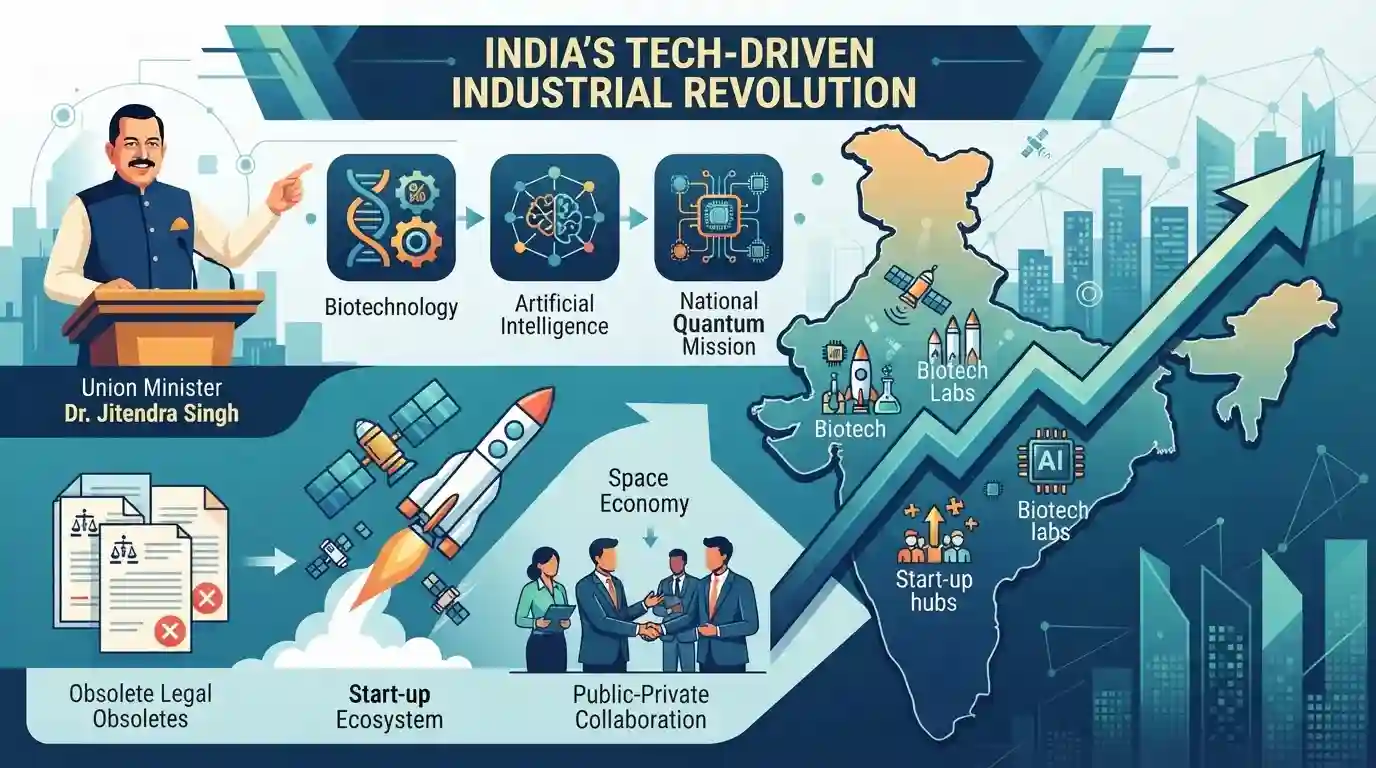
Union Minister Dr. Jitendra Singh asserted that India is poised to be an essential player in the next industrial revolution, which will be driven by biotechnology and artificial intelligence. Highlighting a series of strategic technology missions such as the BioE3 Policy, National Quantum Mission, and India AI Mission, he showcased the government's commitment to cutting-edge science. The address also detailed significant growth in India's space economy, bolstered by opening the sector to private enterprise, and underscored systemic governance reforms—such as scrapping 2,000 obsolete laws—that have catalyzed a thriving start-up ecosystem and deeper public-private collaboration.
ముఖ్య అంశాలు
- India is positioning itself as an essential player in the next industrial revolution, driven by biotechnology, AI, and quantum technology, supported by initiatives like the BioE3 policy, India AI Mission, and National Quantum Mission.
- The Indian space sector, opened to private participation in 2020, has grown to a USD 9 billion economy and is projected to reach USD 40-45 billion in the next 8-9 years.
- Significant scientific achievements include the Chandrayaan mission's detection of evidence of water molecules on the Moon.
- Governance and regulatory reforms have played a crucial role in enabling a vibrant startup ecosystem, highlighted by the removal of nearly 2,000 obsolete laws and bureaucratic hurdles like the requirement for gazetted officer attestation.
- A 'whole of government plus whole of nation' approach is being emphasized to break down silos between public institutions, private industry, and academia to fulfill India's 2047 ambitions.
ముఖ్యమైన పదాలు
BioE3 Policy

A national policy (Biotechnology for Economy, Environment, and Employment) focused on high-performance biomanufacturing. It aims to build a regenerative bioeconomy by developing bio-based chemicals, smart proteins, and climate-resilient agriculture, shifting away from chemical-based industries.
UPSC context
Crucial for GS Paper 3 (S&T, Environment). Tests knowledge of India's strategy for a circular bioeconomy, sustainable growth, and climate change mitigation.
India AI Mission
An initiative launched under MeitY to build an indigenous artificial intelligence ecosystem. It focuses on seven pillars, including democratizing compute access, subsidizing GPUs, building sovereign datasets, and fostering AI startups to position India globally.
UPSC context
Important for GS Paper 3 (IT/Computers). Tests understanding of India's self-reliance in AI, foundational models, compute infrastructure, and digital public goods.
National Quantum Mission
A DST-led flagship mission (2023-2031) to establish India as a global quantum technology leader. It targets developing 50-1000 qubit quantum computers, satellite-based secure quantum communications, and advanced quantum materials via four specialized thematic hubs.
UPSC context
Key for GS Paper 3 (Science & Tech). Tests awareness of India's capabilities in frontier technologies, quantum computing ecosystems, and secure communications.
ప్రిలిమ్స్ ఉచ్చు
The BioE3 Policy is framed and implemented primarily by the Ministry of Environment, Forest and Climate Change (MoEFCC).
It is actually formulated and piloted by the Department of Biotechnology (DBT) under the Ministry of Science and Technology.
అనుసంధానమైన స్థిర భావనలు
What are the core pillars of India's National Quantum Mission (NQM)?
- Nodal Department: Implemented by the Department of Science & Technology (DST) targeting quantum computers with 50-1000 physical qubits.
- Thematic Hubs: Establishes four T-Hubs covering computing, communication, sensing/metrology, and materials/devices.
- Quantum Properties: Leverages superposition and entanglement to perform calculations exponentially faster than classical binary-bit systems.
అంతర-అంశ నమూనాలు
Biomanufacturing & WTO green subsidies
Aligning the BioE3 Policy's subsidies for bio-based plastics with WTO rules, ensuring green incentives are not classified as trade-distorting actionable subsidies.
Private Space Tech & Liability
Reconciling domestic space startup growth with the Outer Space Treaty of 1967, where state parties bear international liability for non-governmental activities.

Mains 2026 will likely test the synergy of the BioE3 policy and India AI Mission in driving India's transition to a green circular economy.
అనుసంధాన PYQలు · 3
అనుసంధాన PYQలు · 3
- 2016MainsGS3
Discuss India's achievements in the field of Space Science and Technology. How the application of this technology has helped India in its socio-economic development?
- 2023MainsGS3
Introduce the concept of Artificial Intelligence (AI). How does Al help clinical diagnosis? Do you perceive any threat to privacy of the individual in the use of Al in healthcare?
- 2026PrelimsGS1
Which of the following statements with regard to the National Quantum Mission (NQM) is/are correct? 1. It aims at developing intermediate-scale quantum computers with 50-1000 physical qubits. 2. Its implementation includes setting up of four Thematic Hubs (T-Hubs) in academic and national R&D institutes across India. Select the answer using the code given below :
