India Achieves Three Hundred GW Non Fossil Fuel Capacity Milestone
Source:PIB ↗
Why It Matters
India's successful scale-up of renewable energy is a direct realization of its global climate commitments (such as the Panchamrit targets from COP26). It also serves as a critical case study for UPSC Mains on energy security, sustainable infrastructure, and transitioning away from fossil fuel dependency.
Summary
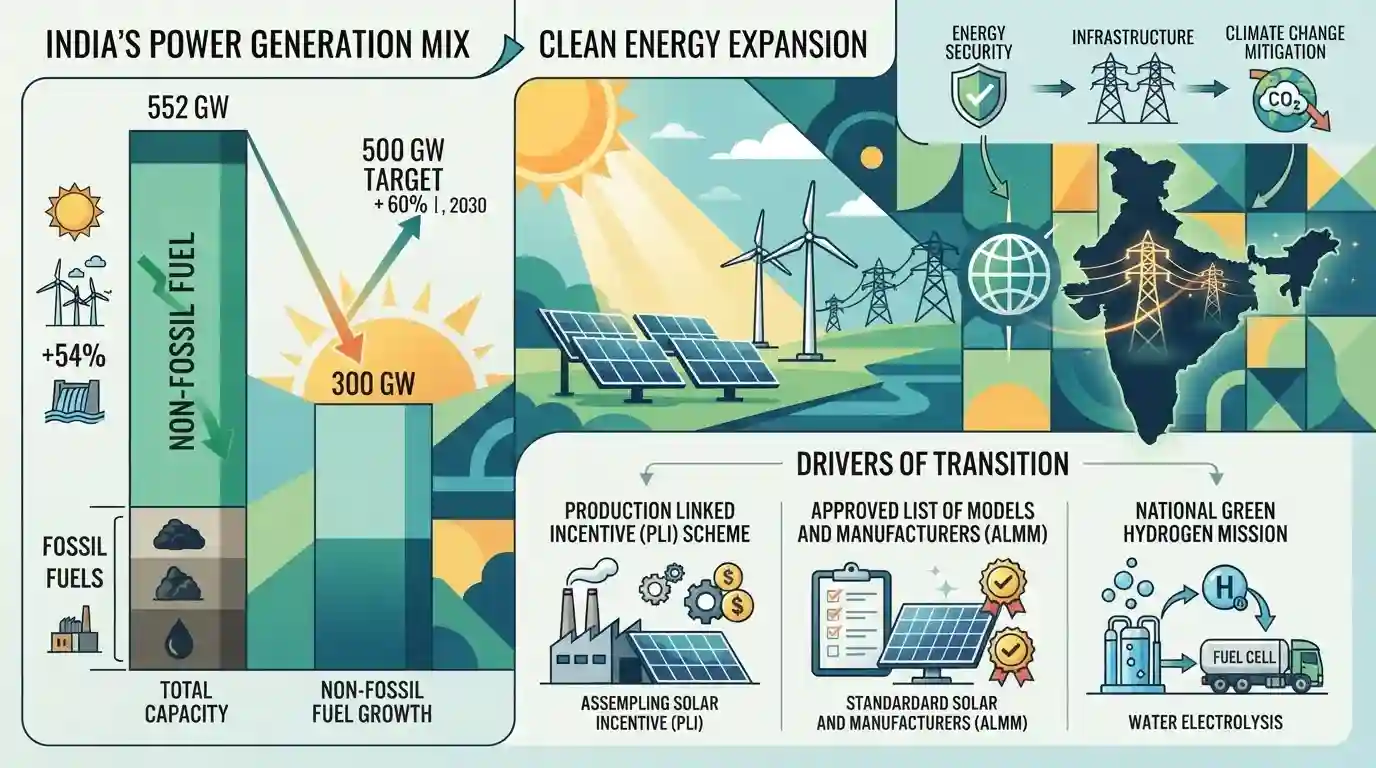
India has achieved a historic milestone by crossing 300 GW of non-fossil fuel power generation capacity, representing over 54% of its total installed capacity of 552 GW. This rapid expansion, predominantly driven by solar (164.59 GW) and wind energy, means the country has already completed more than 60% of its commitment to reach 500 GW of non-fossil capacity by 2030. Key government initiatives such as the Production Linked Incentive (PLI) scheme for solar PV modules, the Approved List of Models and Manufacturers (ALMM), and the National Green Hydrogen Mission have been instrumental in accelerating this clean energy transition.
Key Points
- India's non-fossil fuel electricity generation capacity successfully reached 300 GW as of July 31, 2026.
- This achievement marks the completion of over 60% of the government's ambitious target to attain 500 GW of non-fossil capacity by 2030.
- Solar power makes up the largest share of this capacity at 164.59 GW, followed by wind (58.14 GW) and hydro power (57.24 GW).
- Non-fossil fuel sources now comprise more than 54% of the country's total installed electricity generation capacity, which stands at around 552 GW.
- The rapid growth is attributed to proactive policy frameworks including the PLI scheme for high-efficiency solar PV modules, ALMM, and the National Green Hydrogen Mission.
Important Terms
Production Linked Incentive (PLI) Scheme

A central government incentive scheme that rewards solar manufacturers on actual production, efficiency, and domestic value addition to reduce import reliance and build a self-reliant solar component manufacturing ecosystem.
UPSC context
GS Paper 3 (Economic Development, Energy Security). Tests industrial policy, clean energy transition, and domestic manufacturing initiatives.
National Green Hydrogen Mission
A flagship central initiative aiming to make India a global hub for producing, utilizing, and exporting green hydrogen, targeting at least 5 million metric tonnes (MMT) annual production capacity by 2030.
UPSC context
GS Paper 3 (Environment, S&T). Tests deep decarbonization, renewable technology, and clean energy transition strategies.
Approved List of Models and Manufacturers (ALMM)
A compliance register by the Ministry of New and Renewable Energy specifying approved domestic solar module and cell manufacturers eligible for government-assisted, net-metering, and subsidy-linked solar projects.
UPSC context
GS Paper 3 (Infrastructure, Economy). Tests solar supply chain protectionism, domestic quality control, and local manufacturing policies.
Ministry of New and Renewable Energy
The nodal ministry of the Government of India responsible for clean energy policies, research, international cooperation, and administering schemes for solar, wind, and green hydrogen technologies.
UPSC context
GS Paper 3 (Infrastructure, Energy Security). Tests institutional mechanisms, central schemes, and sustainable energy targets.
Prelims Trap
India's Panchamrit commitment pledges to install 500 GW of renewable energy capacity by 2030.
The actual COP26/NDC target is 500 GW of 'non-fossil fuel' capacity, which includes nuclear power, whereas 'renewable energy' traditionally excludes nuclear energy.
Static Concepts Connected
What are India's five 'Panchamrit' climate targets announced at COP26?
- Non-fossil capacity: Reach 500 GW non-fossil energy capacity by 2030.
- Carbon intensity: Reduce carbon intensity of the economy by 45% by 2030 from 2005 levels.
- Emissions reduction: Reduce total projected carbon emissions by one billion tonnes from now to 2030.
- Net Zero: Achieve the target of Net Zero emissions by 2070.
How are Large Hydro and Nuclear Power classified in India's energy accounting?
- Large Hydro: Classified as Renewable Energy since 2019, allowing them to help utilities meet Renewable Purchase Obligations (RPOs).
- Nuclear energy: Counted under 'non-fossil fuel' sources but excluded from the standard definition of 'renewable energy' under MNRE.
Cross-Topic Patterns
Green Trade Barriers & ALMM
India's ALMM acts as a non-tariff barrier to boost domestic solar manufacturing, intersecting with WTO rules on domestic content requirements and international trade disputes.
Grid Stability & Intermittent Energy
Expanding solar and wind capacity beyond 300 GW threatens grid stability, necessitating parallel investments in Pumped Storage Projects (PSP) and Battery Energy Storage Systems (BESS).

UPSC may test the conceptual distinction between non-fossil and renewable capacity, alongside WTO compliance of ALMM domestic sourcing norms.
Linked PYQs · 5
Linked PYQs · 5
- 2022MainsGS3
Do you think India will meet 50 percent of its energy needs from renewable energy by 2030 ? Justify your answer. How will the shift of subsidies from fossil fuels to renewables help achieve the above objective ? Explain.
- 2025MainsGS3
How can India achieve energy independence through clean technology by 2047? How can biotechnology can play a crucial role in this endeavour?
- 2024PrelimsGS1
Consider the following: 1. Battery storage 2. Biomass generators 3. Fuel cells 4. Rooftop solar photovoltaic units How many of the above are considered "Distributed Energy Resources"?
- 2025PrelimsGS1
Consider the following statements about 'PM Surya Ghar Muft Bijli Yojana': I. It targets installation of one crore solar rooftop panels in the residential sector. II. The Ministry of New and Renewable Energy aims to impart training on installation, operation, maintenance and repairs of solar rooftop systems at grassroot levels. III. It aims to create more than three lakhs skilled manpower through fresh skilling, and up-skilling, under scheme component of capacity building. Which of the statements given above are correct?
- 2026PrelimsGS1
Which of the following statements with regard to Green Hydrogen is/are correct ? 1. It is decarbonized hydrogen obtained from natural gas reforming combined with carbon capture and storage (CCS). 2. It is produced using electrolysis of water with electricity generated by renewable energy. 3. National Green Hydrogen Mission of India aims for abatement of nearly 50 MMT of annual greenhouse gas emissions by 2030. Select the answer using the code given below :
