Operation Sindoor and India Zero Tolerance Policy on Terrorism
Source:PIB ↗
Why It Matters
Highlights India's strategic posture against cross-border terrorism through proactive operations ('Operation Sindoor'), relevant for internal security and defence topics in GS-3. It also touches upon public health initiatives and youth empowerment, offering context for governance discussions.
Summary
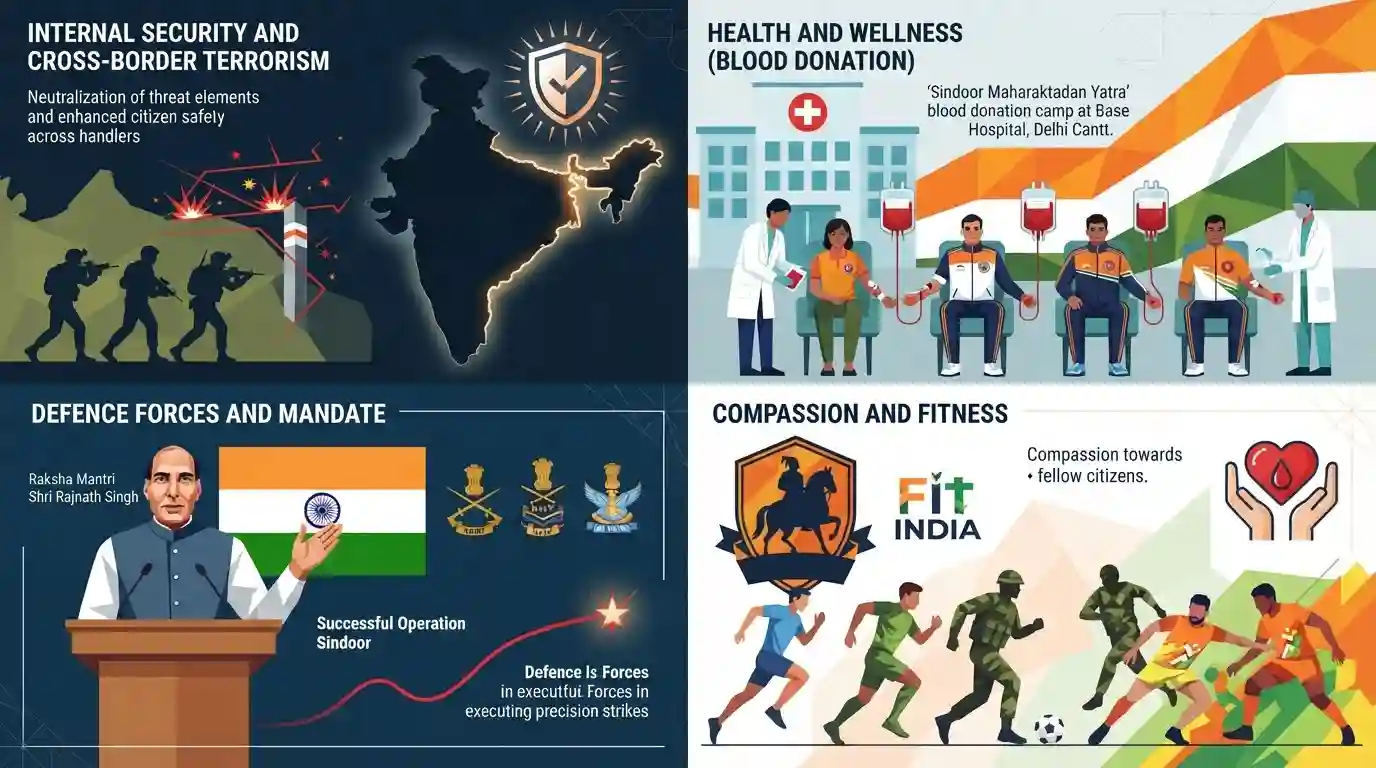
Raksha Mantri Shri Rajnath Singh inaugurated the 'Sindoor Maharaktadan Yatra', a blood donation camp at Base Hospital, Delhi Cantt. Organized with the participation of athletes from Maharashtra, the event honored the successful execution of 'Operation Sindoor' by the Indian Defence Forces. The Raksha Mantri stated that the operation, which eliminated terrorists and their handlers in Pakistan, sent a strong global message about India's zero-tolerance policy towards terrorism and its commitment to citizen safety. The initiative also highlighted the values of compassion, inspired by Chhatrapati Shivaji Maharaj, and the importance of physical fitness as promoted by the 'Fit India' and 'Khelo India' campaigns.
Key Points
- Raksha Mantri Shri Rajnath Singh inaugurated the 'Sindoor Maharaktadan Yatra' blood donation camp at Base Hospital, Delhi Cantt.
- The event honored the bravery of Indian Defence Forces during 'Operation Sindoor', which successfully eliminated terrorists and handlers based in Pakistan.
- Operation Sindoor served as a stern warning against cross-border terrorism, demonstrating India's willingness to go to any extent to protect its citizens.
- The blood donation drive saw participation from athletes and youth from Maharashtra, promoting values of compassion and national service.
- The Raksha Mantri praised the 'Fit India' and 'Khelo India' campaigns for fostering a culture of physical fitness and health among the youth.
- Blood collected during the camp will bolster the reserves of the Armed Forces Medical Services (AFMS) for use in military hospitals.
Important Terms
Operation Sindoor

A 2025 multi-domain, tri-service military operation by India targeting terrorist infrastructure in Pakistan and PoJK. It was launched as a decisive, non-escalatory response to the Pahalgam terror attack to neutralise cross-border terrorism.
UPSC context
Crucial for GS-3 (Internal Security); tests understanding of India's counter-terrorism doctrine, strategic deterrence, and cross-border security responses.
Sindoor Maharaktadan Yatra
A mega blood donation camp inaugurated in August 2026 at Base Hospital, Delhi Cantt, to honor 'Operation Sindoor'. It symbolized compassion by building critical blood reserves for armed forces personnel and their families.
UPSC context
Relevant to GS-2 (Health) and GS-3 (Defence); highlights civil-military integration and voluntary initiatives supporting armed forces' operational readiness.
Armed Forces Medical Services (AFMS)
A tri-service medical organization of the Indian Armed Forces responsible for managing routine healthcare, operational trauma, and emergency medical requirements for military personnel, veterans, and their dependents.
UPSC context
Pertinent to GS-3 (Security Forces and their Mandate); tests knowledge of defense logistics, military healthcare systems, and troop welfare.
Khelo India
A national programme introduced to revive India's grassroots sports culture by building a robust framework for all sports and developing talent to establish India as a global sporting nation.
UPSC context
Connects to GS-2 (Social Sector); tests knowledge on youth empowerment, skill development, and sports infrastructure policies.
Fit India Movement
A government initiative aimed at encouraging Indian citizens to adopt physical fitness and wellness as an integral part of their daily lifestyle to promote preventive health.
UPSC context
Relates to GS-2 (Issues relating to Health); highlights preventive healthcare, human resource development, and youth empowerment schemes.
Prelims Trap
Indian troops and aircraft crossed the border to neutralize targets during Operation Sindoor.
Operation Sindoor was South Asia's first 'non-contact war'. It relied on stand-off weapons like drones and cruise missiles; no troops or aircraft physically crossed the border.
Static Concepts Connected
What characterizes 'Non-Contact Warfare' in modern military strategy?
- Standoff Weapons: Relies on long-range cruise missiles, suicide drones, and precision-guided munitions launched from safe distances.
- Zero Border Crossing: Kinetic strikes are executed without ground troops or manned aircraft physically entering enemy territory or airspace.
- Network-Centric: Depends heavily on satellite intelligence, real-time data links, cyber operations, and integrated counter-interception grids.
What are the key provisions of the 1960 Indus Waters Treaty (IWT)?
- Eastern Rivers: India has unrestricted use of the water from the Ravi, Beas, and Sutlej rivers.
- Western Rivers: Pakistan receives the Indus, Jhelum, and Chenab, but India is permitted to build 'run-of-the-river' hydroelectric projects.
- Suspension Mechanics: The treaty lacks a formal unilateral exit clause, making India's move to hold it in abeyance a drastic diplomatic lever.
Cross-Topic Patterns
Kinetic strikes + Transboundary water diplomacy
Operation Sindoor integrates military 'deterrence by punishment' with holding the 1960 Indus Waters Treaty in abeyance, turning a transboundary river agreement into an explicit counter-terrorism lever.
Civil initiatives + Military medical reserves
The 'Sindoor Maharaktadan Yatra' reflects a growing trend of leveraging civil campaigns like Khelo India to build strategic blood reserves for the Armed Forces Medical Services (AFMS).

Expect a multi-statement question in 2026 linking Op Sindoor's 'non-contact warfare' tech with the suspension of the Indus Waters Treaty.
Linked PYQs · 3
Linked PYQs · 3
- 2016MainsGS3
The terms 'Hot Pursuit' and 'Surgical Strikes' are often used in connection with armed action against terrorist attacks. Discuss the strategic impact of such actions.
- 2025MainsGS3
Terrorism is a global scourge. How has it manifested in India? Elaborate with contemporary examples. What are the counter measures adopted by the State? Explain.
- 2021MainsGS2
“Besides being a moral imperative of a Welfare State, primary health structure is a necessary precondition for sustainable development.” Analyze.
