Puducherry Police President Colours and Criminal Law Reforms
Source:PIB ↗
ఇది ఎందుకు ముఖ్యం
This article showcases the specific administrative and financial mechanisms the Centre utilizes for the planned development of Union Territories. It highlights the paradigm shift in the criminal justice system via new penal laws and emphasizes the importance of regional police forces in internal security.
సారాంశం
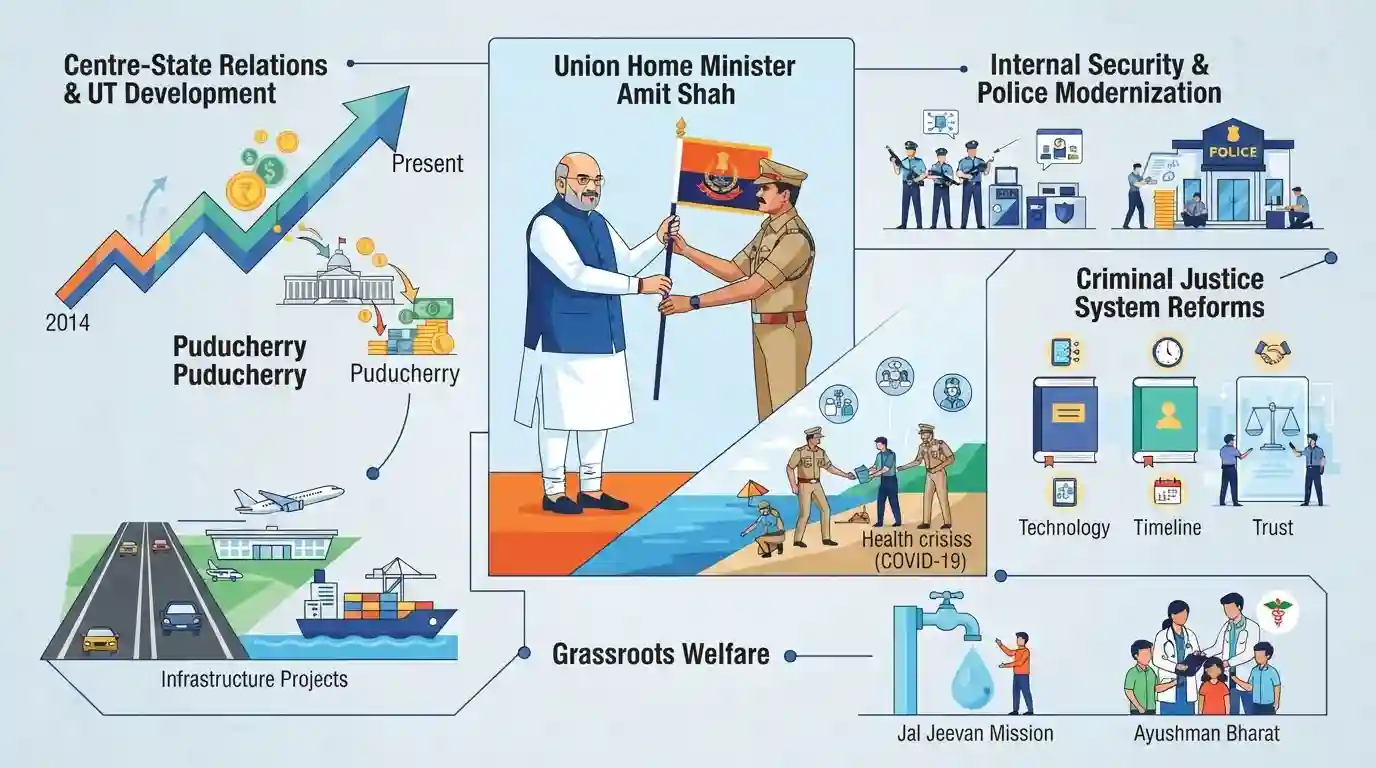
Union Home Minister Amit Shah conferred the President’s Colours upon the Puducherry Police, honoring its historic commitment to safeguarding the region's internal security and its exceptional service during the COVID-19 crisis. During the event, Shah highlighted the overarching shift in India's legal framework with the introduction of three new criminal laws centered on justice rather than punishment, guided by Technology, Timeline, and Trust. Additionally, he underscored the Center's push for the development of Union Territories, citing a nearly fourfold increase in central funding to Puducherry since 2014. This support has enabled massive infrastructure projects like highway expansions and airport upgrades, drawing substantial industrial investments and driving grassroots welfare via schemes like Jal Jeevan Mission and Ayushman Bharat.
ముఖ్య అంశాలు
- Union Home Minister Amit Shah presented the prestigious President’s Colours to the Puducherry Police for its bravery, dedication, and internal security efforts since 1963.
- The Union Government has introduced three new criminal laws replacing British-era punitive codes, aiming to ensure justice through Technology, Timeline, and Trust.
- Financial support for Puducherry's development increased significantly, with ₹13,762 crore provided between 2014-2026, compared to ₹3,500 crore from 1950 to 2014.
- Major infrastructure boosts in the Union Territory include the four-laning of NH 332-A (₹2,200 crore) and a new 3,400-meter extended airport runway, facilitating ₹39,000 crore in industrial investments over nine years.
ముఖ్యమైన పదాలు
President's Colour Award

The highest ceremonial honour bestowed upon any military unit, military training establishment, or state/Union Territory police force in India in recognition of exceptional service during peace and war.
UPSC context
GS Paper II (Governance) and GS Paper III (Security); tests awareness of prestigious national military and policing honours.
Jal Jeevan Mission
A flagship centrally sponsored scheme launched in 2019 to provide functional household tap connections supplying safe and adequate drinking water to every rural home in India, extended to 2028.
UPSC context
GS Paper II (Welfare Schemes) and GS Paper III (Infrastructure); tests understanding of rural water security and sustainable development.
Ayushman Bharat
A flagship national health program launched in 2018 to achieve Universal Health Coverage through two main components: Ayushman Arogya Mandirs for primary care and PM-JAY for secondary and tertiary hospitalisation insurance.
UPSC context
GS Paper II (Social Sector and Health); tests knowledge of universal healthcare, financial protection, and major public health schemes.
Direct Benefit Transfer (DBT)
A governance reform mechanism launched in 2013 that leverages the JAM trinity to transfer government subsidies, pensions, and scholarships directly into the Aadhaar-linked bank accounts of beneficiaries, reducing leakages and corruption.
UPSC context
GS Paper II (E-Governance/Welfare) and GS Paper III (Indian Economy); tests analysis of welfare delivery efficiency and technology-driven reforms.
Lakhpati Didi
An initiative under DAY-NRLM that empowers women in Self-Help Groups (SHGs) to achieve a sustainable annual household income of at least ₹1,00,000 through diversified livelihoods and skill development.
UPSC context
GS Paper II (Welfare Schemes/SHGs) and GS Paper III (Inclusive Growth); tests knowledge of rural women empowerment and livelihood strategies.
Pradhan Mantri Awas Yojana (PMAY)
A flagship national housing mission launched to provide affordable, permanent (pucca) houses with basic amenities to eligible urban and rural poor households who do not own a pucca house in India.
UPSC context
GS Paper II (Welfare Schemes) and GS Paper III (Urbanization/Infrastructure); tests understanding of housing-for-all initiatives and poverty alleviation.
Puducherry Police
The law enforcement agency of the Union Territory of Puducherry, functioning under the direct administrative control of the Union Ministry of Home Affairs, notable for retaining its historic French-era red kepis.
UPSC context
GS Paper II (Federalism/Union Territories) and GS Paper III (Internal Security); tests awareness of UT administration and regional security dynamics.
ప్రిలిమ్స్ ఉచ్చు
Union Territories like Puducherry receive a constitutionally mandated share of net tax proceeds from the Finance Commission.
UTs do not receive mandatory tax devolution under Article 280. They are financed through direct Central budgetary allocations managed by the Ministry of Home Affairs.
అనుసంధానమైన స్థిర భావనలు
How is Puducherry administered differently from other Union Territories?
- Article 239A: Inserted by the 14th Amendment, it empowers Parliament to create a local Legislature and Council of Ministers for the UT.
- Legislative Overlap: The legislature can make laws on State and Concurrent list subjects, but Parliament retains overriding power to legislate on the same subjects.
How are Union Territories funded compared to full States?
- Finance Commission: States receive a constitutionally mandated share of central taxes determined by the Finance Commission under Article 280.
- MHA Allocations: UTs are financed through direct Central budgetary allocations and grants, which are managed primarily by the Ministry of Home Affairs (MHA).
అంతర-అంశ నమూనాలు
Coastal UTs + Internal Security
Recognition of Puducherry Police highlights the strategic role of coastal UT forces in addressing multidimensional maritime security threats alongside traditional law and order.
Criminal Justice Reforms + Digital Governance
The "Technology" pillar of the BNS/BNSS ties directly into CCTNS and e-Courts projects, linking substantive criminal justice reform to national digital governance infrastructure.

UTs with legislatures (Delhi, J&K, Puducherry) and their exclusion from Finance Commission tax devolution is a prime 2026 Prelims target.
అనుసంధాన PYQలు · 3
అనుసంధాన PYQలు · 3
- 2023MainsGS3
What are the internal security challenges being faced by India? Give out the role of Central Intelligence and Investigative Agencies tasked to counter such threats.
- 2024MainsGS2
What changes has the Union Government recently introduced in the domain of Centre-State relations ? Suggest measures to be adopted to build the trust between the Centre and the States and for strengthening federalism.
- 2025MainsGS2
Examine the evolving pattern of Centre-State financial relations in the context of planned development in India. How far have the recent reforms impacted the fiscal federalism in India?
