Monitoring and Fund Utilization Gaps in Scheduled Castes Welfare
Source:PIB ↗
આ શા માટે મહત્વનું છે
Highlights the ongoing implementation gap between budgetary allocation and actual fund utilization in schemes meant for marginalized communities. It showcases the governance mechanisms required (like inter-ministerial coordination and nodal officers) to execute targeted social justice plans.
સારાંશ
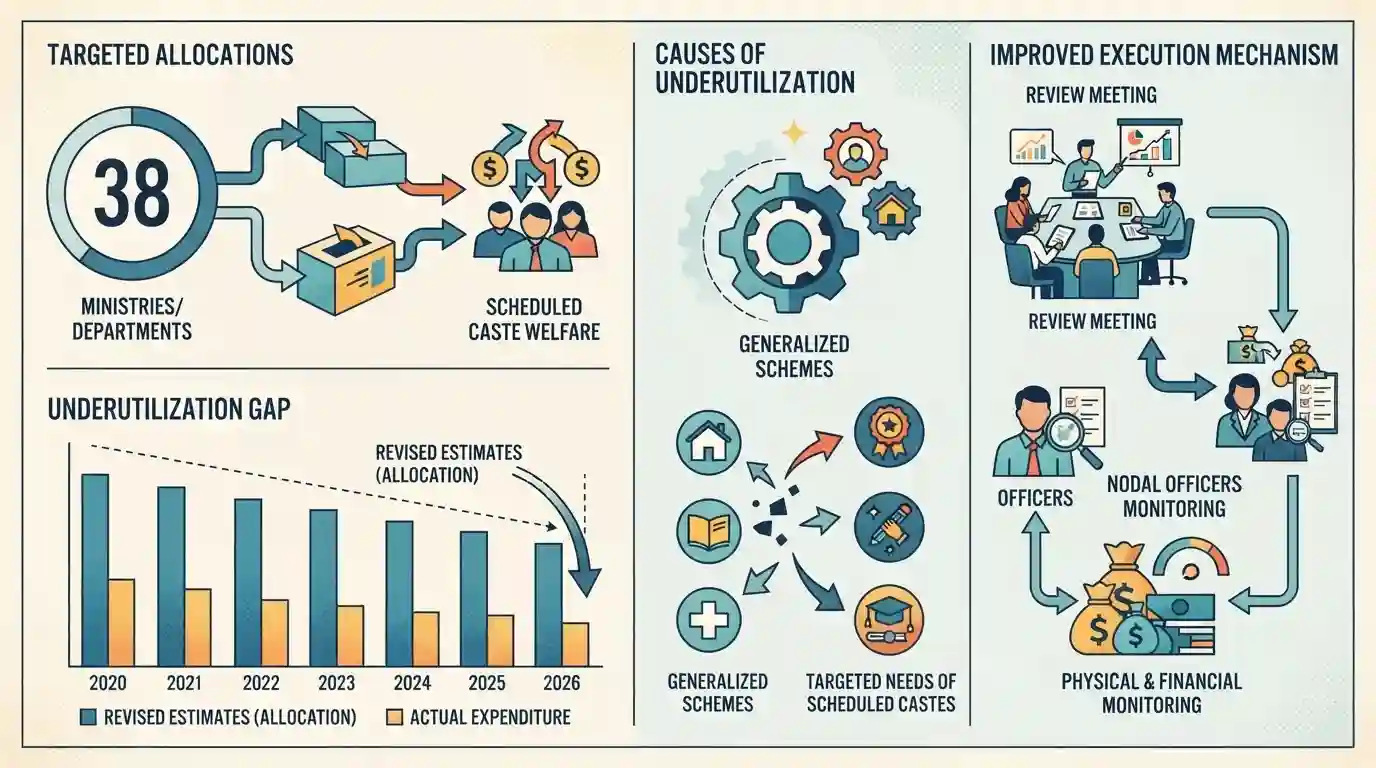
The government has informed the Rajya Sabha that 38 Ministries and Departments are earmarking funds for the welfare of Scheduled Castes under the Development Action Plan for Scheduled Castes (DAPSC), previously known as the Scheduled Caste Sub-Plan (SCSP). Despite these targeted allocations mandated by NITI Aayog Guidelines, actual expenditure has continuously fallen short of the Revised Estimates between 2020 and 2026. The underutilization is largely due to the generalized nature of certain government schemes. To improve execution, the Ministry of Social Justice and Empowerment conducts frequent review meetings and has directed all participating ministries to nominate dedicated nodal officers for stringent physical and financial monitoring of the funds.
મુખ્ય મુદ્દા
- 38 Government Ministries and Departments are earmarking funds for Scheduled Castes (SCs) under the Development Action Plan for Scheduled Castes (DAPSC), guided by NITI Aayog 2017 frameworks.
- Actual expenditure has consistently remained below the Revised Estimates across 2020-21 to 2025-26.
- Underutilization of funds is partially attributed to the general nature of some schemes, complicating targeted spending.
- All 38 implementing Ministries/Departments have nominated nodal officers to ensure stricter financial and physical monitoring of DAPSC funds.
મહત્વપૂર્ણ શબ્દો
Development Action Plan for Scheduled Castes (DAPSC)

A policy framework requiring designated central ministries to earmark a specific percentage of budget funds exclusively for schemes that directly benefit Scheduled Caste communities.
UPSC context
GS Paper 2: Welfare schemes for vulnerable sections; mechanisms, laws, and institutions for their protection and betterment.
Scheduled Caste Sub-Plan (SCSP)
A historical planning strategy introduced in the late 1970s to channel developmental funds and benefits to Scheduled Castes; renamed to DAPSC in 2018.
UPSC context
GS Paper 2: Evolution of affirmative action, budgetary planning, and welfare interventions for marginalized sections.
NITI Aayog
The policy think tank of the Indian Government that replaced the Planning Commission, providing directional inputs, monitoring schemes, and establishing guidelines for developmental funds.
UPSC context
GS Paper 2: Statutory, regulatory and quasi-judicial bodies; planning, federalism, and public policy formulation.
Ministry of Social Justice and Empowerment
The nodal ministry of the Government of India responsible for social defense, welfare, and empowerment of marginalized groups, including Scheduled Castes and OBCs.
UPSC context
GS Paper 2: Government policies and interventions for development; institutional mechanisms for weaker sections.
Rajya Sabha
The Upper House of India's bicameral Parliament, representing states and union territories, playing a critical role in legislative scrutiny and executive accountability.
UPSC context
GS Paper 2: Parliament—Structure, functioning, conduct of business, powers, and legislative oversight.
પ્રિલિમ્સ ટ્રેપ
NITI Aayog acts as the nodal agency for monitoring physical and financial progress of DAPSC.
While NITI Aayog frames the allocation guidelines, the Ministry of Social Justice and Empowerment (MoSJE) is the nodal ministry for outcome monitoring via e-Utthaan.
સંલગ્ન સ્થિર ખ્યાલો
What is the Development Action Plan for Scheduled Castes (DAPSC)?
- Evolution: Introduced during the 6th Five Year Plan as the Special Component Plan, later renamed SCSP, and now DAPSC.
- Mandated Earmarking: Union Ministries must allocate funds at least proportional to the overall SC population of India (16.6% as per Census 2011).
- Non-divertible: Ministry of Finance guidelines strictly prohibit the re-appropriation of DAPSC funds to any non-SC budget heads.
What governance mechanisms prevent welfare fund diversion?
- Dedicated Budget Heads: Obligated departments must present targeted funds under separate minor budget heads to ensure financial traceability.
- Digital Tracking: Real-time portals like e-Utthaan enable centralized, outcome-based monitoring of welfare expenditures across multiple generalized ministries.
- Outcome Accountability: Transitioning from tracking financial outlays to measuring physical beneficiaries ensures that generalized schemes actually reach target populations.
આંતર-વિષય પેટર્ન
Gender Budgeting vs SC/ST Earmarking
Both strategies mandate cross-ministry fund allocation. UPSC often tests the systemic governance challenge of mapping generalized scheme funds to specific demographic outcomes.
Digital Tracking & PFMS Linkages
Portals like e-Utthaan act as specialized layers over general financial systems, reflecting a core syllabus theme: utilizing e-governance to improve fiscal accountability and stop leakages.

Targeted budgeting mechanisms (DAPSC) and their nodal monitoring portals (e-Utthaan) are prime candidates for 2026 Prelims traps.
સંલગ્ન PYQ · 5
સંલગ્ન PYQ · 5
- 2019MainsGS2
Performance of welfare schemes that are implemented for vulnerable sections is not so effective due to absence of their awareness and active involvement at all stages of policy process. Discuss.
- 2023MainsGS2
“Development and welfare schemes for the vulnerable, by its nature, are discriminatory in approach.” Do you agree? Give reasons for your answer.
- 2020MainsGS2
In order to enhance the prospects of social development, sound and adequate health care policies are needed particularly in the fields of geriatric and maternal health care. Discuss.
- 2015PrelimsGS1
The Government of India has established NITI Aayog to replace the
- 2026PrelimsGS1
Consider the following statements about Multidimensional Poverty Index (MPI) : 1. MPI is calculated using Alkire-Foster methodology. 2. MPI calculated by NITI Aayog has a total of twelve indicators. 3. Maternal Health and Bank Account are common indicators in the MPI of NITI Aayog and MPI of United Nations Development Programme (UNDP). Which of the statements given above is/are correct ?
