Dr Ambedkar Foundation Schemes Merged into Centrally Sponsored Scheme
Source:PIB ↗
આ શા માટે મહત્વનું છે
Understanding the restructuring and merger of schemes is crucial for questions on governance, cooperative federalism, and the effective delivery of welfare to vulnerable sections. It also provides examples for answers related to social justice, caste-based atrocities, and inter-caste social integration.
સારાંશ
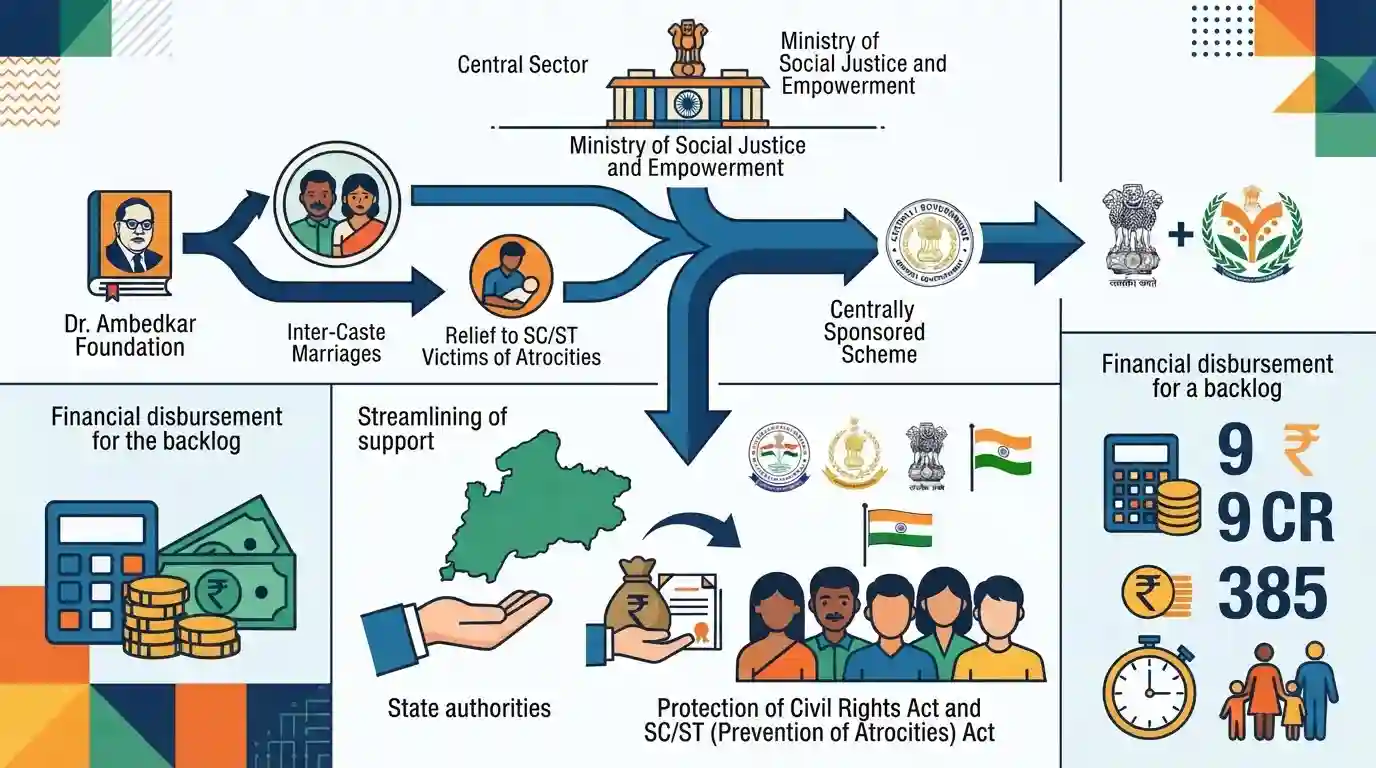
The Ministry of Social Justice and Empowerment has merged two central sector schemes of the Dr. Ambedkar Foundation—the Scheme for Social Integration through Inter-Caste Marriages and the National Relief to the SC/ST Victims of Atrocities Scheme—into an existing Centrally Sponsored Scheme. Effective March 31, 2023, the merger aims to avoid duplication and streamline the implementation of the Protection of Civil Rights Act, 1955 and the SC/ST (Prevention of Atrocities) Act, 1989. Implementation and disbursement of incentives will now be managed by State/UT governments. The Ministry recently disbursed over Rs. 9 crore to clear the backlog of 385 inter-caste couples pending since the merger.
મુખ્ય મુદ્દા
- The Dr. Ambedkar Foundation's Inter-Caste Marriage and SC/ST Atrocity Relief schemes were merged into a Centrally Sponsored Scheme on March 31, 2023.
- The merger aims to eliminate duplication of efforts and ensure streamlined implementation by State and UT governments.
- The Centrally Sponsored Scheme implements the Protection of Civil Rights Act, 1955 and the SC/ST (Prevention of Atrocities) Act, 1989.
- Funding is shared between the Centre and States (usually 50:50), while UTs receive 100% central assistance.
- The Ministry of Social Justice and Empowerment cleared pending backlog cases by releasing Rs. 9.03 crore to 385 inter-caste couples in December 2024.
મહત્વપૂર્ણ શબ્દો
Dr. Ambedkar Scheme for Social Integration through Inter-Caste Marriages

An initiative by the Dr. Ambedkar Foundation providing financial incentives to inter-caste couples where one spouse belongs to a Scheduled Caste, aiming to promote social integration.
UPSC context
GS Paper II (Social Justice); tests knowledge of social integration and caste-eradication policies.
Dr. Ambedkar National Relief to Scheduled Castes/Scheduled Tribes Victims of Atrocities Scheme
A former central sector scheme of the Dr. Ambedkar Foundation that provided immediate financial relief to SC/ST victims of severe crimes registered under the SC/ST Act.
UPSC context
GS Paper II (Vulnerable Sections); tests understanding of relief and rehabilitation frameworks for victims.
Protection of Civil Rights Act, 1955
A parliamentary act prescribing penalties for practicing untouchability and enforcing disabilities associated with it, giving statutory effect to Article 17 of the Constitution.
UPSC context
GS Paper II (Constitutional Provisions); tests knowledge of civil rights laws and untouchability abolition.
Scheduled Castes and the Scheduled Tribes (Prevention of Atrocities) Act, 1989
A comprehensive central law enacted to prevent crimes and discrimination against Scheduled Castes and Scheduled Tribes, providing for special courts and relief.
UPSC context
GS Paper II (Social Justice); tests knowledge of protective legal safeguards for marginalized groups.
Centrally Sponsored Scheme for Implementation of PCR and PoA Acts
A scheme providing cost-sharing central assistance to states and UTs to enforce anti-untouchability and anti-atrocity laws, fund special courts, and support victims.
UPSC context
GS Paper II (Welfare Schemes); tests command over central-state fiscal sharing and scheme implementation.
Dr. Ambedkar Foundation (DAF)
An autonomous body under the Ministry of Social Justice and Empowerment, established in 1992 to propagate Dr. B.R. Ambedkar's ideals of social justice.
UPSC context
GS Paper II (Autonomous Bodies); tests familiarity with institutions promoting socioeconomic empowerment.
પ્રિલિમ્સ ટ્રેપ
The Dr. Ambedkar Foundation atrocity relief schemes are implemented as Central Sector schemes with 100% Union funding.
The schemes were converted from Central Sector to Centrally Sponsored Schemes in 2023. Funding is now shared 50:50 with states, which handle implementation.
સંલગ્ન સ્થિર ખ્યાલો
What distinguishes a Central Sector Scheme from a Centrally Sponsored Scheme (CSS)?
- Funding Ratio: Central Sector schemes are 100% funded by the Union government, while CSS funding is shared between the Centre and States (e.g., 50:50, 60:40).
- Implementation Agency: Central Sector schemes are executed directly by Central agencies. CSS are implemented by State or UT governments.
- Jurisdiction: Central Sector focuses on Union List subjects. CSS targets State/Concurrent List subjects to supplement state efforts.
How do the PCR Act (1955) and PoA Act (1989) operationalize Constitutional rights?
- Article 17: Abolishes 'untouchability', making its practice a punishable offense. The PCR Act, 1955 was enacted to provide the penal framework for this Article.
- PoA Act 1989: Expands beyond untouchability to criminalize specific socio-economic atrocities, such as social boycotts, forced labor, and land dispossession targeting SC/ST communities.
આંતર-વિષય પેટર્ન
Cooperative Federalism + Welfare Rationalization
Rationalizing Central Sector schemes into Centrally Sponsored Schemes reflects recent Finance Commission recommendations. It aims to reduce duplication, streamline State-level implementation, and enhance cooperative federalism in targeted welfare delivery.
Scheme linkages to Statutory Acts
UPSC frequently tests the statutory backing of welfare programs. This CSS directly enforces the punitive frameworks of the Protection of Civil Rights Act (1955) and the SC/ST PoA Act (1989).

Expect 2026 prelims to pair SC/ST welfare schemes with their funding models (CSS vs Central Sector) and parent laws (PoA/PCR Acts).
સંલગ્ન PYQ · 3
સંલગ્ન PYQ · 3
- 2024MainsGS1
Intercaste marriages between castes which have socio-economic parity have increased, to some extent, but this is less true of interreligious marriages. Discuss.
- 2023MainsGS2
“Development and welfare schemes for the vulnerable, by its nature, are discriminatory in approach.” Do you agree? Give reasons for your answer.
- 2019MainsGS2
Performance of welfare schemes that are implemented for vulnerable sections is not so effective due to absence of their awareness and active involvement at all stages of policy process. Discuss.
