Government Clarifies UPI Payment Charges and Regulatory Framework
Source:PIB ↗
কেন এটি গুরুত্বপূর্ণ
The issue touches upon the core debate surrounding India's Digital Public Infrastructure (DPI)—balancing the goal of widespread financial inclusion with the need for a financially viable, self-sustaining technology ecosystem. It is highly relevant for GS Paper 3 questions on the digital economy, infrastructure financing, and cyber security, as well as Prelims questions on the economics of payment systems (like MDR) and legislative frameworks (PSS Act).
সারসংক্ষেপ
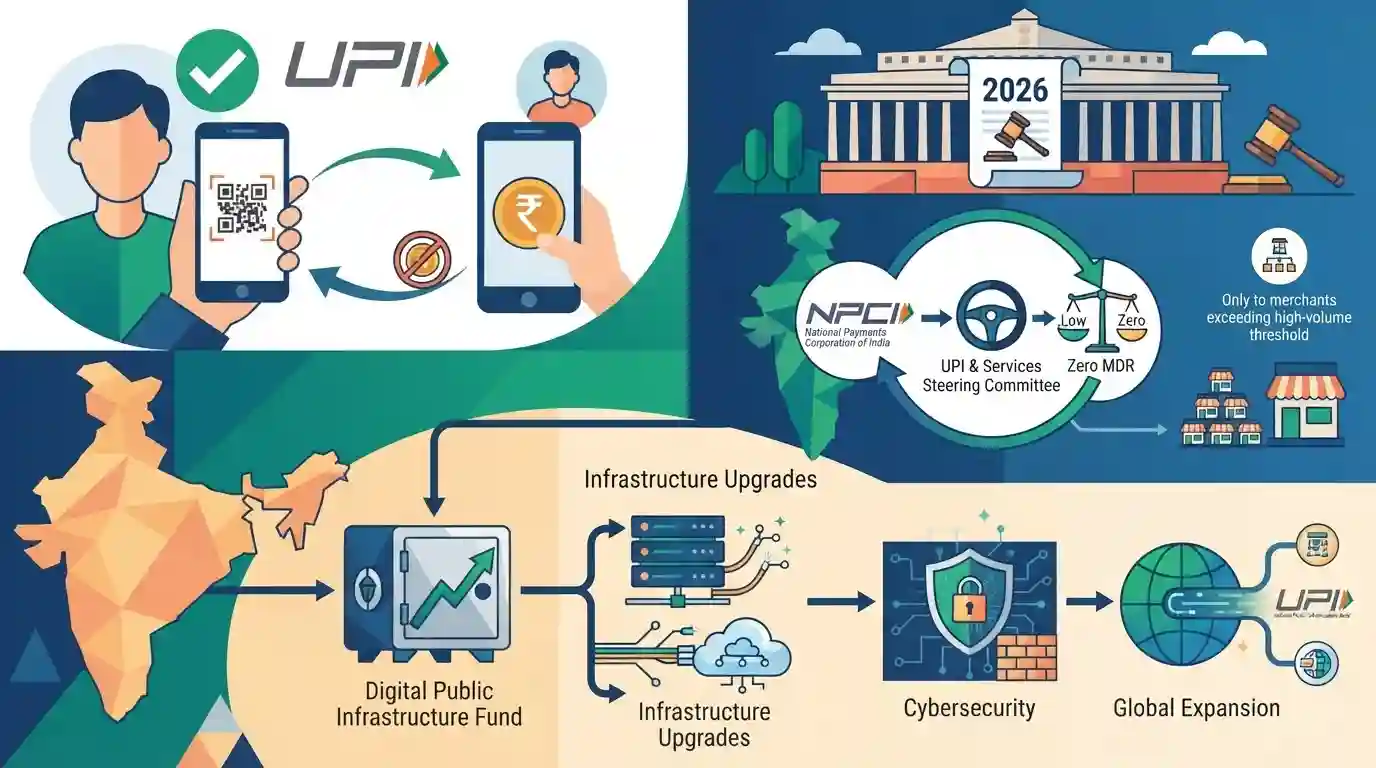
The Ministry of Finance has clarified that no charges will be levied on users making UPI payments, and all Person-to-Person (P2P) transfers will remain free. Through the Taxation and Other Laws (Amendment) Bill, 2026, the government is amending Section 10A of the Payment and Settlement Systems Act, 2007. This amendment enables the NPCI-led "UPI and Services Steering Committee" to potentially introduce a nominal Merchant Discount Rate (MDR) for merchants exceeding a specific transaction threshold. The vast majority of merchants will remain exempt from MDR, which will be kept lower than card MDRs. This policy shift seeks to establish a self-sustaining revenue model for India's digital public infrastructure, generating funds for critical infrastructure upgrades, cybersecurity, and global expansion, while reducing dependence on government subsidies.
মূল বিষয়
- UPI user payments and Person-to-Person (P2P) transactions remain entirely free of charge.
- The Taxation and Other Laws (Amendment) Bill, 2026 amends Section 10A of the Payment and Settlement Systems Act, 2007 to allow regulatory flexibility.
- The NPCI-led 'UPI and Services Steering Committee' will decide on imposing a nominal Merchant Discount Rate (MDR) on merchants above a specific transaction threshold.
- The vast majority of merchants will continue to be exempt from MDR, and any applied rate will be significantly lower than debit and credit card MDRs.
- The amendment aims to ensure a self-sustaining revenue model for UPI to fund cybersecurity, infrastructure upgrades, and fraud prevention, reducing reliance on government subsidies.
- In July 2026, UPI recorded 2,366 crore transactions worth ₹29.9 lakh crore and is live in 11 foreign countries.
গুরুত্বপূর্ণ শব্দ
Unified Payments Interface (UPI)

A real-time digital payment system developed by the National Payments Corporation of India (NPCI). It enables instant, interoperable peer-to-peer and peer-to-merchant inter-bank transfers via mobile applications, anchoring India's Digital Public Infrastructure.
UPSC context
GS Paper III (Economy). Tests knowledge of financial inclusion, digital public infrastructure, and interoperability of payment networks.
Payment and Settlement Systems Act (PSS Act), 2007
A legislative framework enacted to regulate and supervise payment systems in India. It designates the Reserve Bank of India (RBI) as the sole authority to oversee, authorize, and establish standards for digital transaction networks.
UPSC context
GS Paper III (Economy). Essential for questions regarding statutory backing of digital payments and the RBI's regulatory powers.
National Payments Corporation of India (NPCI)
A not-for-profit umbrella organization established in 2008 by the RBI and IBA. Operating under the PSS Act, it manages retail payment and settlement systems like UPI and RuPay to promote a cashless economy.
UPSC context
GS Paper III (Economy). Frequently tested regarding key institutions driving India's digital economy and cashless initiatives.
Taxation and Other Laws (Amendment) Bill, 2026
A bill amending Section 10A of the PSS Act, 2007, to remove the absolute zero-charge framework. It enables the introduction of a targeted Merchant Discount Rate (MDR) on high-volume UPI transactions.
UPSC context
GS Papers II & III. Tests current affairs regarding legislative updates and self-sustaining revenue models for digital public goods.
UPI and Services Steering Committee
An NPCI-led committee empowered by recent legislative changes to regulate and potentially introduce a nominal Merchant Discount Rate (MDR) for merchants exceeding specified transaction thresholds.
UPSC context
GS Paper III. Highlights governance frameworks in digital finance, testing knowledge of bodies balancing payment infrastructure sustainability with user adoption.
প্রিলিমস ফাঁদ
The recent amendment to the PSS Act allows banks to charge end-users for high-value P2P UPI transactions.
P2P transfers and user payments remain 100% free. The amendment only enables a nominal Merchant Discount Rate (MDR) for high-volume merchants, never the consumer.
সংযুক্ত স্থির ধারণা
What is Merchant Discount Rate (MDR) and who pays it?
- Definition: A fee charged by a bank to a merchant for processing payments made by customers via credit/debit cards or digital means.
- Components: The fee is typically split between the acquiring bank (merchant's bank), the issuing bank (customer's bank), and the payment network (e.g., Visa, NPCI).
- Burden: Legally, it is borne by the merchant as a cost of doing business, not charged directly as a fee to the retail customer.
What is the structure and mandate of the NPCI?
- Origin: Set up by the RBI and Indian Banks' Association (IBA) under the Payment and Settlement Systems Act, 2007 to operate retail payments and settlement systems.
- Status: It is incorporated as a "Not for Profit" Company under the provisions of Section 25 of the Companies Act 1956 (now Section 8 of Act 2013).
- Operations: Promoted by a consortium of major banks; it operates platforms like UPI, RuPay, IMPS, FASTag, and AePS.
আন্তঃবিষয় প্যাটার্ন
DPI Export & Soft Power Diplomacy
Funding a self-sustaining UPI model directly supports India's foreign policy goal of exporting Digital Public Infrastructure (DPI) to the Global South as a tool of soft power.
Zero MDR vs. Banking Viability
This shift resolves the long-standing conflict between the 'Zero MDR' regime (which boosted financial inclusion) and banking profitability (banks struggled to recover digital infrastructure costs).

A multi-statement question on the PSS Act 2007 is likely, contrasting P2P vs P2M MDR rules and NPCI's exact legal status under the Act.
সংযুক্ত PYQ · 5
সংযুক্ত PYQ · 5
- 2026PrelimsGS1
Which one of the following statements about Unified Payments Interface (UPI) and Central Bank Digital Currency (Digital Rupee) is not correct ?
- 2017PrelimsGS1
Which of the following is a most likely consequence of implementing the 'Unified Payments Interface (UPI)'?
- 2025PrelimsGS1
Consider the following countries : I. United Arab Emirates II. France III. Germany IV. Singapore V. Bangladesh How many countries amongst the above are there other than India where international merchant payments are accepted under UPI?
- 2018PrelimsGS1
Which one of the following best describes the term "Merchant Discount Rate" sometimes seen in news?
- 2023MainsGS3
What is the status of digitalization in the Indian economy? Examine the problems faced in this regard and suggest improvements.
