ESamudra Platform Accelerates Maritime Digital Governance
Source:PIB ↗
ఇది ఎందుకు ముఖ్యం
E-Samudra is a prime example of targeted e-governance (GS2) transforming an entire sector. It showcases how digital tools (Interactive Service Models) can enhance transparency, ease of doing business, and labor welfare simultaneously, offering a valuable case study for answers on Digital India, infrastructure development (GS3), and maritime security.
సారాంశం
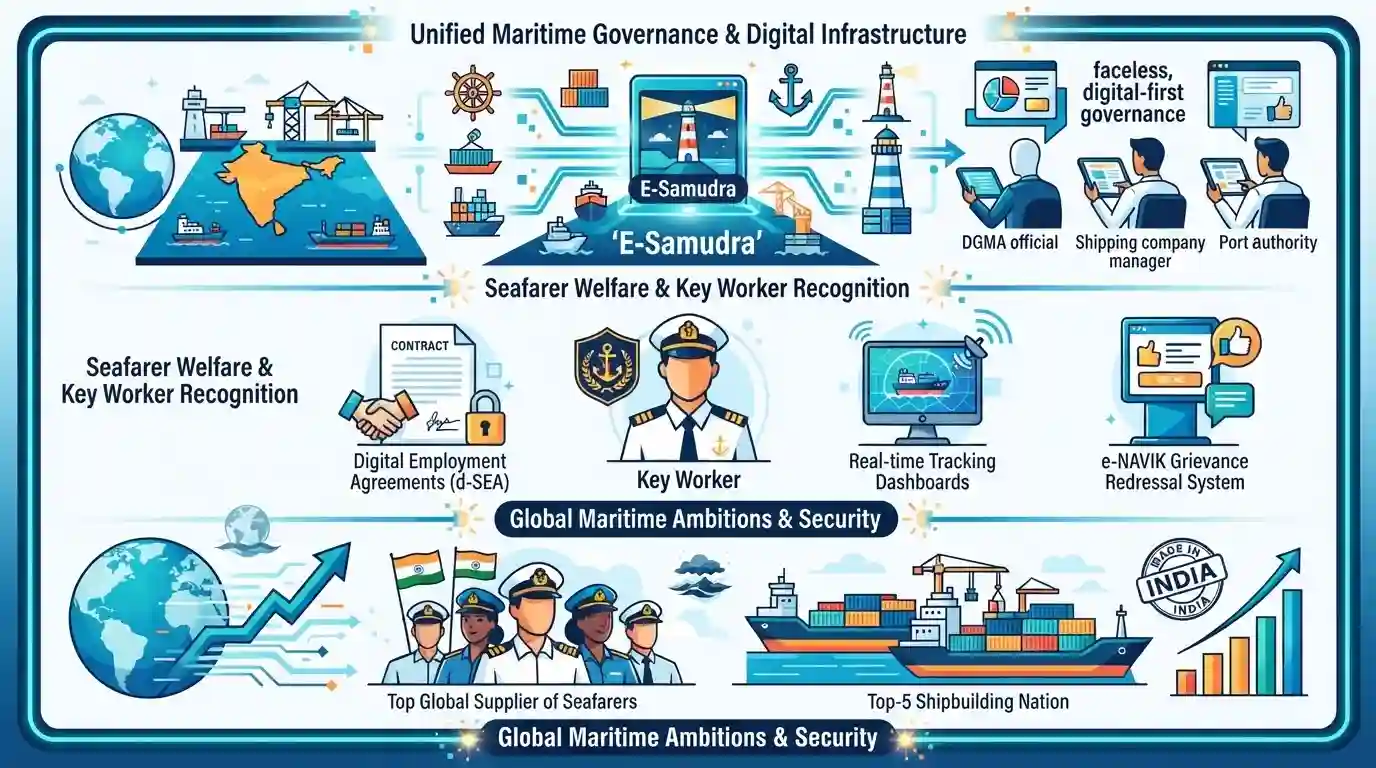
India has launched 'E-Samudra', a unified digital platform aimed at transforming maritime governance through a single-window system for seafarers, shipping companies, and ports. Driven by the Directorate General of Maritime Administration (DGMA), the initiative aligns with the Maritime Amrit Kaal Vision 2047 and shifts the sector towards faceless, digital-first governance. Crucially, the platform prioritises the welfare and security of Indian seafarers—who are now recognised as 'Key Workers' under the Merchant Shipping Act, 2025—by introducing digital employment agreements (d-SEA), real-time tracking dashboards, and the e-NAVIK grievance redressal system. As India aims to become the top global supplier of seafarers and a top-5 shipbuilding nation, these reforms bolster both infrastructural efficiency and labor security amid global geopolitical disruptions.
ముఖ్య అంశాలు
- The Ministry of Ports, Shipping and Waterways launched 'E-Samudra', a comprehensive digital platform designed to integrate maritime administrative services into a single-window system.
- E-Samudra shifts maritime administration towards 'Faceless Governance' and a 'Digital First' approach, reflecting the philosophy of 'Minimum Government, Maximum Governance'.
- The Merchant Shipping Act, 2025 officially recognises seafarers as 'Key Workers', extending critical protections and welfare measures.
- The platform introduces welfare initiatives such as e-NAVIK for 24x7 grievance redressal, the Seafarer Tracking Dashboard for crisis management, and the Digital Seafarers Employment Agreement (d-SEA).
- India is currently the second-largest supplier of seafarers globally, the leading destination for ship recycling, and is targeting a top-5 position in global shipbuilding under the Maritime Amrit Kaal Vision 2047.
- Special programmes like 'Sagar Mein Yog' (health and wellbeing) and 'Sagar Mein Samman' (promoting women seafarers) were highlighted to improve labor conditions.
ముఖ్యమైన పదాలు
E-Samudra

A unified digital platform launched by the government to integrate maritime services for seafarers, shipping companies, and ports, promoting faceless, digital-first governance.
UPSC context
Relevant for GS-2 (E-Governance) and GS-3 (Infrastructure). Highlights India's push towards ease of doing business in maritime administration.
Merchant Shipping Act, 2025
Landmark legislation replacing the 1958 Act to modernize India's maritime legal framework, mandate universal vessel registration, strengthen environmental protections, and prioritize seafarer welfare.
UPSC context
Crucial for GS-2 (Government Policies) and GS-3 (Infrastructure). Tests knowledge of maritime reforms and alignment with international conventions.
Maritime Amrit Kaal Vision 2047
A long-term strategic roadmap by the Ministry of Ports, Shipping and Waterways aiming to transform India into a global maritime leader and boost the blue economy by 2047.
UPSC context
Highly relevant for GS-3 (Infrastructure, Blue Economy). Tests India's long-term developmental goals and transition to sustainable maritime operations.
e-NAVIK
A 24x7 integrated digital grievance redressal portal for maritime workers to register and track complaints regarding safety, wage disputes, or fraudulent recruitment practices.
UPSC context
Vital for GS-2 (Welfare of Vulnerable Sections). Tests understanding of institutional mechanisms protecting Indian seafarers globally.
Directorate General of Maritime Administration (DGMA)
The regulatory body (formerly DG Shipping) under the Ministry of Ports, Shipping and Waterways, responsible for enforcing shipping laws, ensuring vessel safety, and overseeing seafarer welfare.
UPSC context
GS-2 (Regulatory Bodies). Important for understanding the statutory framework and regulatory modernization of India's shipping sector.
ప్రిలిమ్స్ ఉచ్చు
E-Samudra is a coastal security and surveillance network managed by the Indian Navy.
E-Samudra is a civilian e-governance and seafarer welfare portal launched by the Ministry of Ports, Shipping and Waterways, not a defense or maritime security platform.
అనుసంధానమైన స్థిర భావనలు
What is the Maritime Labour Convention (MLC), 2006?
- ILO Convention: An ILO convention, often called the "Seafarers' Bill of Rights", setting minimum working and living standards for seafarers globally.
- Four Core Pillars: It covers employment conditions, accommodation, recreational facilities, health protection, medical care, and welfare. India is a ratifying member.
How is global ship recycling regulated internationally?
- Hong Kong Convention: An IMO treaty aimed at ensuring that ships being recycled do not pose unnecessary risks to human health, safety, or the environment. India is a signatory.
- Basel Convention: Regulates the transboundary movements of hazardous wastes, which includes hazardous materials found in end-of-life ships being sent for dismantling.
అంతర-అంశ నమూనాలు
Sectoral DPI and Labor Formalization
E-Samudra mirrors the e-Shram portal's trajectory, applying India's Digital Public Infrastructure (DPI) model to a highly mobile, global workforce to ensure seamless social security and grievance tracking.
Maritime Logistics and Chokepoint Crises
Upgrading domestic port infrastructure and logistics efficiency via E-Samudra directly acts as a hedge against external supply chain vulnerabilities seen during recent Red Sea shipping disruptions.

Expect a multi-statement Prelims question testing E-Samudra's civilian scope (MoPSW) alongside India's #1 global rank in ship recycling.
అనుసంధాన PYQలు · 5
అనుసంధాన PYQలు · 5
- 2024MainsGS2
e-governance is not just about the routine application of digital technology in service delivery process. It is as much about multifarious interactions for ensuring transparency and accountability. In this context evaluate the role of the 'Interactive Service Model' of e-governance.
- 2023MainsGS2
e-governance, as a critical tool of governance, has ushered in effectiveness, transparency and accountability in governments. What inadequacies hamper the enhancement of these features ?
- 2025MainsGS2
e-governance projects have a built-in bias towards technology and back-end integration than user-centric designs. Examine.
- 2022MainsGS3
What are the maritime security challenges in India ? Discuss the organisational, technical and procedural initiatives taken to improve the maritime security.
- 2023PrelimsGS1
Consider the following pairs: Port Well known as 1. Kamarajar Port: First major port in India registered as a company 2. Mundra Port: Largest privately owned port in India 3. Visakhapatnam Port: Largest container port in India How many of the above pairs are correctly matched?
