CSIR CRRI Indigenous Road Technology Promotes Sustainable Infra
Source:PIB ↗
Why It Matters
India's vast road network expansion requires sustainable solutions to mitigate heavy carbon emissions associated with conventional construction. Indigenous technologies like MSS+ align with the nation's Net Zero by 2070 targets, offering vital case studies for UPSC questions on sustainable infrastructure and environmental conservation.
Summary
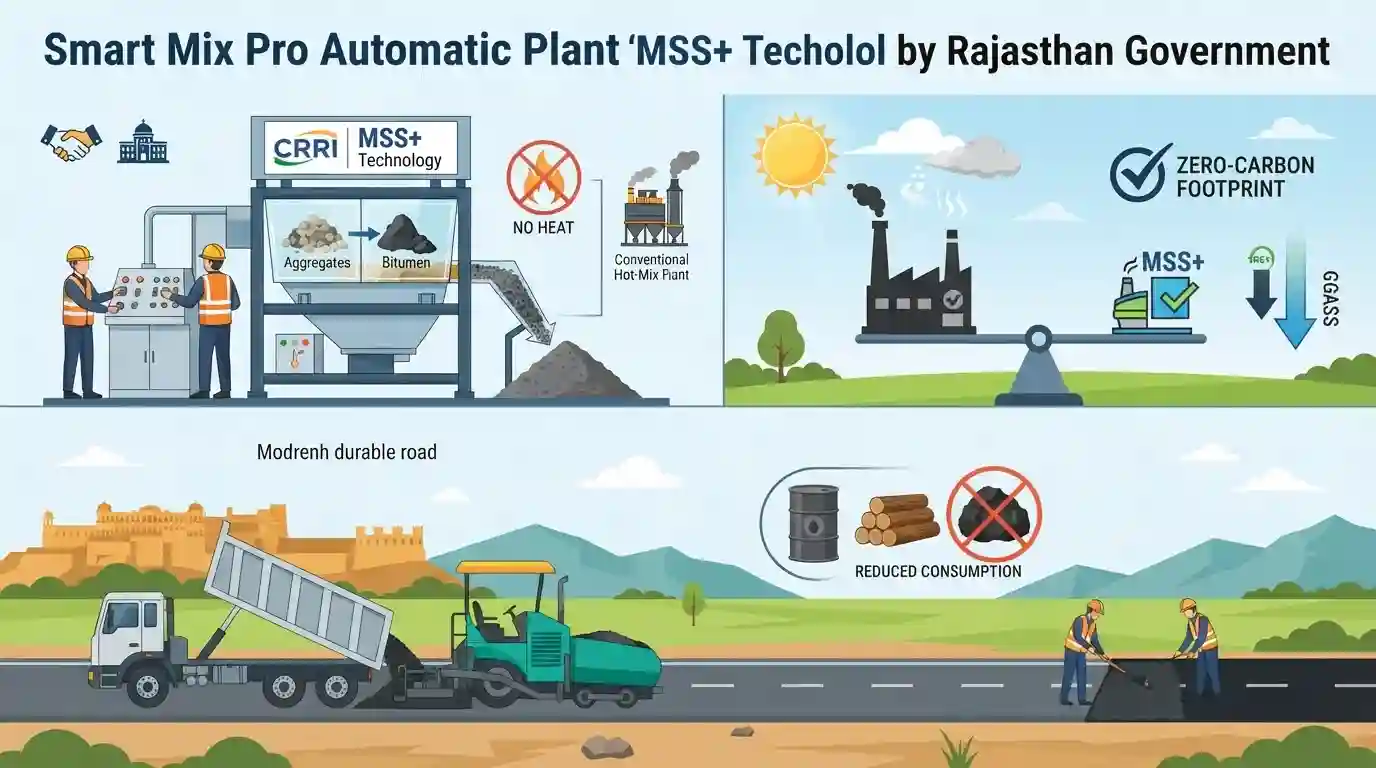
The CSIR-Central Road Research Institute (CRRI) showcased its indigenously developed 'MSS+ Technology' and 'Smart Mix Pro Automatic Plant' to the Rajasthan government. This innovative technology allows for the construction and maintenance of roads without heating bitumen or aggregates, drastically cutting down fuel, wood, and coal consumption. By providing a zero-carbon footprint and reducing greenhouse gas emissions, MSS+ offers a sustainable, cost-effective, and highly durable alternative to conventional hot-mix road construction methods.
Key Points
- CSIR-CRRI demonstrated its indigenous Micro Surfacing (MSS+) road technology to the Rajasthan government.
- The associated Smart Mix Pro Automatic Plant operates fully automatically via a mobile app, eliminating manual interference.
- The technology ensures a zero-carbon footprint by eliminating the need to heat aggregates or bitumen, saving significant amounts of fuel, wood, and coal.
- MSS+ technology provides a highly sustainable, cost-effective alternative to conventional hot-mix methods, reducing greenhouse gas emissions and improving road durability.
Important Terms
MSS+ Technology

An indigenously developed cold-mix road construction technology by CSIR-CRRI that eliminates the need to heat bitumen or aggregates. It enables faster, weather-independent road laying with a zero-carbon footprint and significantly reduced greenhouse gas emissions.
UPSC context
Highly relevant for GS Paper 3 (Infrastructure, Indigenization of Technology, Environment) as a model for sustainable, climate-resilient development.
Smart Mix Pro Automatic Plant
India's first indigenously developed automatic mobile mixing plant designed for MSS+. It automates material proportioning, minimizes wastage, reduces manual intervention, and significantly enhances the efficiency of eco-friendly road construction and maintenance operations.
UPSC context
Relevant for GS Paper 3 (Science & Technology, Infrastructure). Demonstrates how indigenous automation enhances resource efficiency in public works.
CSIR-Central Road Research Institute (CRRI)
A premier national laboratory established in 1952 under the Council of Scientific and Industrial Research. It conducts targeted R&D on road design, construction, traffic planning, and sustainable transport infrastructure.
UPSC context
Important for GS Paper 3 (Institutions). CRRI drives indigenous innovations like MSS+ to align Indian infrastructure with Sustainable Development Goals.
Bitumen
A viscous, black byproduct of crude oil distillation used primarily as a binder in road construction. Conventional hot-mix methods require heating it, which emits greenhouse gases—an issue mitigated by cold-mix alternatives like MSS+.
UPSC context
Relevant for GS-1 (Geography) and GS-3 (Environment). Understanding its environmental impact is crucial for adopting sustainable, low-carbon infrastructure technologies.
Prelims Trap
MSS+ technology completely eliminates the use of bitumen in road construction to achieve a zero-carbon footprint.
MSS+ does not eliminate bitumen; it uses specialized bitumen emulsions in a cold-mix process. It only eliminates the heating (burning fuel) of bitumen and aggregates.
Static Concepts Connected
What is Cold Mix Asphalt (CMA) technology and how does it differ from Hot Mix Asphalt (HMA)?
- Temperature dynamics: CMA is prepared and laid at ambient temperatures using specialized emulsified bitumen, whereas HMA requires heating aggregates and bitumen to 150–170°C.
- Emissions profile: CMA reduces energy consumption by up to 50% and drastically cuts down greenhouse gas and toxic volatile organic compound (VOC) emissions during laying.
- Weather resilience: Unlike HMA, which cannot be laid during rains or in cold climates, cold mix emulsions are compatible with damp aggregates, permitting year-round construction.
What is the mandate and role of the CSIR-Central Road Research Institute (CRRI)?
- Institutional mandate: Established in 1952 in New Delhi as a constituent laboratory of CSIR, it carries out R&D on roads, bridges, transportation planning, and road safety.
- Standardization role: It acts as a key technical advisor to the Indian Roads Congress (IRC), helping draft standard specifications and codes of practice for India's highways.
Cross-Topic Patterns
Rural roads and green technology mandates
PMGSY guidelines mandate green technologies like cold mix, waste plastics, and geo-textiles, linking rural connectivity to climate commitments.
IoT and automation in infrastructure
Mobile-app-operated automated mixing plants reduce human error in material proportioning, ensuring structural durability and fiscal accountability in public works.

Expect questions comparing hot-mix vs. cold-mix asphalt advantages or green technologies mandated under PMGSY in Prelims 2026.
Linked PYQs · 3
Linked PYQs · 3
- 2020PrelimsGS1
In rural road construction, the use of which of the following is preferred for ensuring environmental sustainability or to reduce carbon footprint? 1. Copper slag 2. Cold mix asphalt technology 3. Geotextiles 4. Hot mix asphalt technology 5. Portland cement Select the correct answer using the code given below:
- 2021MainsGS3
“Investment in infrastructure is essential for more rapid and inclusive economic growth.” Discuss in the light of India's experience.
- 2023MainsGS3
The adoption of electric vehicles is rapidly growing worldwide. How do electric vehicles contribute to reducing carbon emissions and what are the key benefits they offer compared to traditional combustion engine vehicles?
