APEDA Facilitates First Sea Export of Mithila Makhana
Source:PIB ↗
Why It Matters
Highlights the role of specialized agencies like APEDA and incubation initiatives (BHARATI) in enhancing agricultural supply chains, formalizing trade (HS code), and uplifting traditional farming communities through direct export linkages. Relevant for GS-3 Agriculture and Economy, particularly in the context of doubling farmers' income and GI tags.
Summary
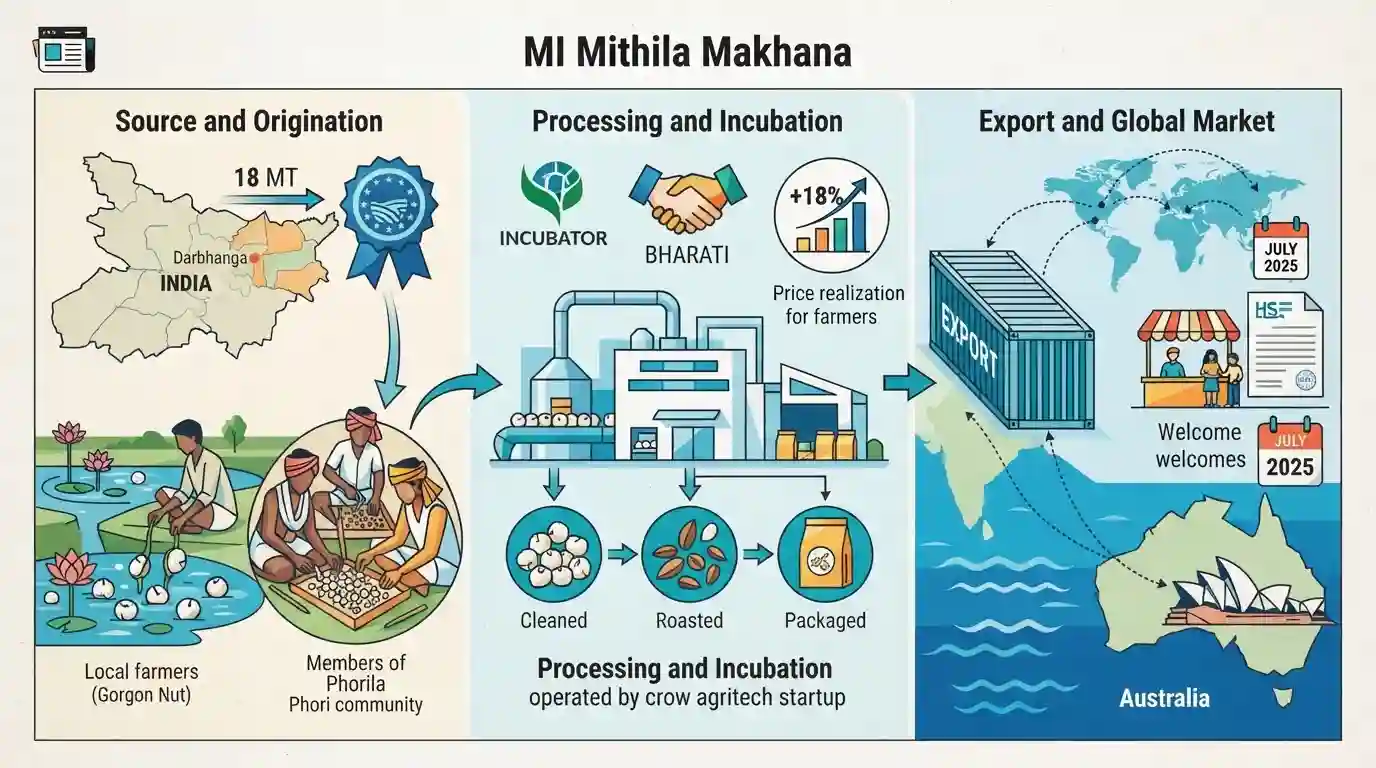
The Agricultural and Processed Food Products Export Development Authority (APEDA) has successfully facilitated the maiden sea-route export of 18 MT of GI-tagged Mithila Makhana from Darbhanga, Bihar, to Australia. Executed by an agritech startup under APEDA's BHARATI incubation initiative, this move links local farmers and the Phori community—known for their traditional Makhana processing skills—to international markets, aiming to increase farmers' price realization by 18%. With Bihar producing 85% of India's Makhana, the recent allocation of a dedicated HS Code for the product starting July 2025 is expected to further streamline and boost its global trade footprint.
Key Points
- APEDA facilitated the first-ever export of 18 Metric Tonnes of GI-tagged Mithila Makhana via the sea route from Bihar to Australia.
- The export was executed by an agritech startup supported under APEDA's BHARATI incubation initiative.
- The processing of Makhana relies heavily on the traditional skills and expertise of the Phori community.
- Direct export-oriented market linkages are expected to boost farmers' price realization by approximately 18%.
- Bihar accounts for 85% of India's total Makhana production.
- A dedicated Harmonised System (HS) Code for Makhana will come into effect from July 2025, facilitating smoother global trade tracking.
Important Terms
APEDA

A statutory body under the Ministry of Commerce and Industry, established in 1986 to promote and develop the export of scheduled agricultural and processed food products.
UPSC context
GS Paper III (Agriculture & Economic Development): Tests knowledge of export promotion bodies, agricultural marketing, and initiatives to boost farmer incomes.
Geographical Indication (GI) tags
A sign used on products having a specific geographical origin, possessing qualities or a reputation due to that origin, governed in India by the GI Act, 1999.
UPSC context
GS Paper III (IPR) & GS Paper I (Art/Culture): Tests understanding of intellectual property rights, rural livelihood protection, and regional heritage preservation.
BHARATI
APEDA's flagship startup incubation and acceleration initiative designed to mentor agri-food startups, foster export-oriented innovation, and target high-value categories like GI products.
UPSC context
GS Paper III (Agritech & Food Processing): Evaluates understanding of government-backed tech incubation, agricultural value addition, and startup ecosystem development.
Finance Bill 2025
A key legislative bill introduced during the Union Budget 2025 that enacted structural trade reforms, including assigning a dedicated Harmonised System (HS) code to streamline Makhana exports.
UPSC context
GS Paper III (Indian Budgeting & Economy): Tests familiarity with budget-related tax legislation and structural trade classification mechanisms like HS codes.
M/s Jitban Supply Chain Pvt. Ltd
An agritech startup supported under APEDA’s BHARATI initiative that provided logistical support for the maiden sea-route export of GI-tagged Mithila Makhana to Australia.
UPSC context
GS Paper III (Agritech & Supply Chain): Shows how private-public agritech startups streamline logistic bottlenecks and bypass middlemen to raise farmer income.
Prelims Trap
APEDA functions as a statutory export promotion body under the Ministry of Agriculture and Farmers Welfare.
Aspirants conflate agricultural exports with the Ministry of Agriculture; however, APEDA is strictly under the Ministry of Commerce & Industry.
Static Concepts Connected
What is APEDA's statutory mandate and administrative oversight?
- Administrative Ministry: Functions under the Ministry of Commerce and Industry, not the Ministry of Agriculture and Farmers Welfare.
- Statutory Origin: Established under the APEDA Act, 1985, replacing the Processed Food Export Promotion Council (PFEPC).
- Scheduled Products: Responsible for promoting exports of scheduled items like floriculture, dairy, poultry, and processed foods.
How is the Geographical Indications (GI) framework governed in India?
- Governing Legislation: Enacted under the Geographical Indications of Goods Act, 1999, to comply with the WTO TRIPS Agreement.
- Regulatory Authority: Administered by the Controller General of Patents, Designs and Trade Marks under the DPIIT.
- Validity and Renewal: Registration is valid for 10 years, which can be renewed indefinitely for successive 10-year periods.
Cross-Topic Patterns
Wetland Ecology + Rural Livelihoods
Cultivation of Euryale ferox (Makhana) highlights how stagnant wetland ecosystems can be economically leveraged for sustainable local livelihoods and rural income generation.
GI Tags + WTO TRIPS compliance
Protecting indigenous processing methods of communities like the Phori under TRIPS framework prevents global commercial exploitation and ensures fair local price realization.

APEDA’s BHARATI initiative and the ecological requirements of GI-tagged Makhana could be integrated into a 2026 prelims agri-export question.
Linked PYQs · 2
Linked PYQs · 2
- 2018PrelimsGS1
India enacted The Geographical Indications of Goods (Registration and Protection) Act, 1999 in order to comply with the obligations to
- 2025MainsGS3
Elaborate the scope and significance of supply chain management of agricultural commodities in India.
