Legislative Reforms for Judicial Pendency and Ease of Doing Business
Source:PIB ↗
ఇది ఎందుకు ముఖ్యం
Judicial pendency and high compliance burdens are significant bottlenecks to India's developmental and economic potential. This article provides crucial quantitative data (e.g., mediation cases doubling, case resolution time reducing from 3.1 to 2.6 years with better infrastructure) and structural details (Jan Vishwas Act 2026, Mediation Act 2023, PIMS under Commercial Courts Act) that can be directly used as evidence/value-addition in Mains GS2 (Judiciary/Governance) and GS3 (Economy/Business environment) questions.
సారాంశం
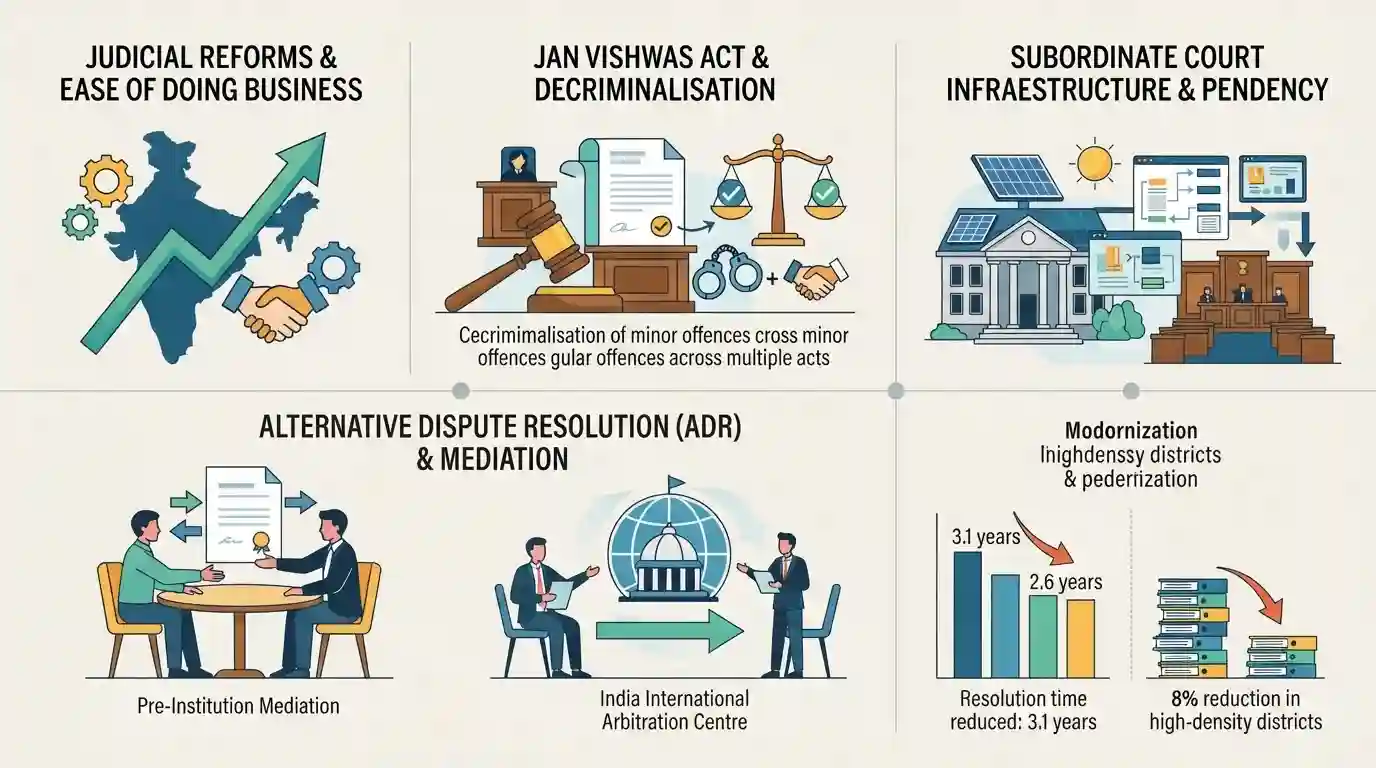
This article covers a Lok Sabha response highlighting India's legislative and judicial reforms to enhance the Ease of Doing Business (EoDB) and reduce judicial pendency. Major highlights include the gazetting of the Jan Vishwas (Amendment of Provisions) Act, 2026 to decriminalise minor offences across 79 Central Acts; structural promotion of Alternative Dispute Resolution (ADR) via the Arbitration and Conciliation Act amendments, mandatory Pre-Institution Mediation and Settlement (PIMS), the Mediation Act 2023, and the India International Arbitration Centre (IIAC). Additionally, third-party NITI Aayog evaluations confirm that judicial infrastructure improvements have reduced District Court case resolution times by 16% (from 3.1 to 2.6 years) and lowered pendency by up to 8% in high courtroom density districts.
ముఖ్య అంశాలు
- The Jan Vishwas (Amendment of Provisions) Act, 2026 (gazetted on April 8, 2026) expands decriminalisation of minor offences across 79 Central Acts administered by 23 Ministries and Departments, building on the 2023 Act to promote trust-based governance and reduce the compliance burden.
- Policy and legislative interventions in Alternative Dispute Resolution (ADR) include progressive amendments to the Arbitration and Conciliation Act, 1996 (in 2015, 2019, 2020) to ensure arbitrator neutrality, minimize judicial intervention, and promote institutional arbitration.
- The Commercial Courts Act (amended in 2018) mandates Pre-Institution Mediation and Settlement (PIMS) for commercial disputes of specified value lacking urgent interim relief, reducing litigation inflow.
- The Mediation Act, 2023 provides a standalone legal framework to foster a culture of out-of-court, amicable settlements through institutional mediation.
- Legal Services Authorities under the Legal Services Authorities Act, 1987 have seen an exponential rise in cases settled through mediation, leaping from 98,406 in FY 2024-25 to 2,25,647 in FY 2025-26.
- A NITI Aayog third-party evaluation of the Centrally Sponsored Scheme for the Development of Infrastructure Facilities for District and Subordinate Courts highlights that higher courtroom density corresponds to a 3-8% drop in average case pendency and a 16% reduction in case resolution time (from 3.1 years down to 2.6 years).
- India's Ease of Doing Business (EoDB) rank in the World Bank's discontinued Doing Business Report improved significantly from 142nd in 2014 to 63rd in 2019 due to these regulatory and legal reforms.
ముఖ్యమైన పదాలు
Jan Vishwas (Amendment of Provisions) Act, 2026

Compliance reform legislation that decriminalises minor, procedural offences across 79 Central Acts, replacing jail terms and criminal fines with civil penalties and administrative adjudication.
UPSC context
GS Paper II (Government Policies) and GS III (Ease of Doing Business). Tests trust-based regulatory governance and compliance decriminalisation.
Mediation Act, 2023
A comprehensive legal framework that structures and regulates voluntary institutional, online, and pre-litigation mediation, giving mediated settlement agreements the same enforceable status as court decrees.
UPSC context
GS Paper II (Dispute Redressal Mechanisms). Tests knowledge of alternative dispute resolution (ADR) frameworks to reduce judicial backlogs.
Commercial Courts Act, 2015
An Act establishing specialized Commercial Courts and divisions at the district and High Court levels to expedite the resolution of high-value commercial disputes in India.
UPSC context
GS Paper II (Judicial Reforms) & GS III (Ease of Doing Business). Tests mechanisms to fast-track corporate and investment litigation.
Arbitration and Conciliation Act, 1996
The core legislation consolidating Indian law on domestic and international commercial arbitration and conciliation, designed to reduce judicial intervention in alternative dispute resolution.
UPSC context
GS Paper II (Dispute Redressal). Tests understanding of private contract enforcement and statutory out-of-court settlement systems.
India International Arbitration Centre Act, 2019
An Act establishing the IIAC as an autonomous statutory body of national importance, aimed at standardising institutional arbitration and positioning India as a global dispute resolution hub.
UPSC context
GS Paper II (Statutory Bodies). Tests reforms targeting global commercial standard compliance and institutionalised dispute adjudication.
Centrally Sponsored Scheme for the Development of Infrastructure Facilities for District and Subordinate Courts
A central program (since 1993-94) that co-funds construction of courtrooms, residential quarters, and digital computer rooms to modernize physical facilities in district and subordinate courts.
UPSC context
GS Paper II (Judicial Infrastructure & Pendency). Tests center-state cooperation in modernizing district judiciaries.
ప్రిలిమ్స్ ఉచ్చు
"Mediation is a mandatory pre-requisite for filing any civil or commercial suit in India."
Mandatory Pre-Institution Mediation and Settlement (PIMS) under the Commercial Courts Act applies ONLY to commercial disputes of a specified value where no urgent interim relief is sought, not all civil suits.
అనుసంధానమైన స్థిర భావనలు
What are the recognized ADR mechanisms under Section 89 of the Civil Procedure Code?
- Arbitration: A binding adjudicatory process where a neutral third party renders a decision (award) with minimal judicial intervention.
- Conciliation: A non-binding process where a neutral conciliator actively evaluates the case and proposes settlement terms to the parties.
- Mediation: A facilitated negotiation where a neutral mediator helps parties communicate to reach their own mutually acceptable agreement.
- Lok Adalat: Statutory forums under the Legal Services Authorities Act, 1987, that settle pending or pre-litigation disputes through compromise.
How is infrastructure for District and Subordinate Courts funded in India?
- Shared Funding: The scheme for judicial infrastructure is a Centrally Sponsored Scheme (CSS), meaning financial burden is shared between the Centre and States (typically 60:40).
- State Responsibility: While 'Administration of Justice' is a Concurrent List subject, the primary responsibility for developing subordinate court infrastructure lies with State Governments.
- Fund Routing: Central funds under the CSS are allocated and released directly to State Governments, not to High Courts or district judiciary bodies.
అంతర-అంశ నమూనాలు
EoDB & Trust-Based Governance
Decriminalisation under the Jan Vishwas Act directly supports the economic objective of Ease of Doing Business, signaling a paradigm shift from 'inspector raj' to self-certification and administrative penalties.
NITI Aayog as an Outcome Evaluator
NITI Aayog's evaluation of the judicial infrastructure scheme highlights its evolving governance role—shifting from a policy think-tank to an active outcome-auditor for Centrally Sponsored Schemes.

Expect a multi-statement Prelims question contrasting Arbitration, Conciliation, and Mediation processes alongside the mandatory PIMS rule.
అనుసంధాన PYQలు · 5
అనుసంధాన PYQలు · 5
- 2024MainsGS2
Explain and distinguish between Lok Adalats and Arbitration Tribunals. Whether they entertain civil as well as criminal cases ?
- 2023MainsGS2
Who are entitled to receive free legal aid? Assess the role of the National Legal Services Authority (NALSA) in rendering free legal aid in India.
- 2013PrelimsGS1
With reference to National Legal Services Authority, consider the following statements : 1. Its objective is to provide free and competent legal services to the weaker sections of the society on the basis of equal opportunity. 2. It issues guidelines for the State Legal Services Authorities to implement the legal programmes and schemes throughout the country. Which of the statements given above is/are correct?
- 2020PrelimsGS1
In India, Legal Services Authorities provide free legal services to which of the following type of citizens? 1. Person with an annual income of less than ₹ 1,00,000 2. Transgender with an annual income of less than ₹ 2,00,000 3. Member of Other Backward Classes (OBC) with an annual income of less than ₹ 3,00,000 4. All Senior Citizens Select the correct answer using the code given below:
- 2010PrelimsGS1
With reference to Lok Adalats, which of the following statements is correct?
