BRICS Trade Ministers Meeting outcomes on WTO and MSME finance
Source:PIB ↗
ఇది ఎందుకు ముఖ్యం
This article is highly significant for UPSC aspirants as it details India's strategic leadership in navigating trade diplomacy within the expanded BRICS bloc (BRICS+). The outcomes address critical structural issues in global trade, including the reform of the WTO dispute settlement mechanism, innovative cash-flow-based credit solutions for MSMEs to tackle the global trade finance gap, and supply chain resilience (GVCs), all of which are frequently tested themes in GS Paper II (International Relations) and GS Paper III (Indian Economy & Trade).
సారాంశం
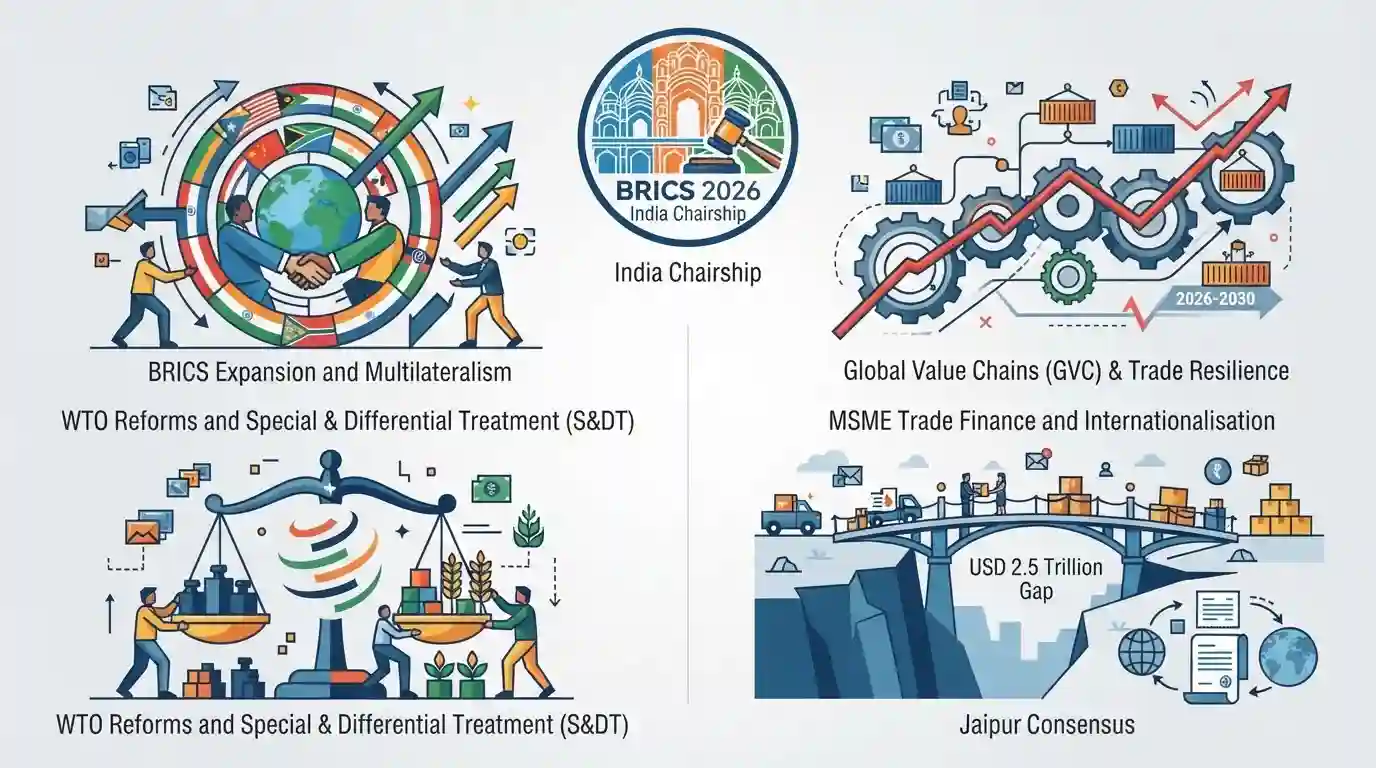
The 16th BRICS Trade Ministers' Meeting successfully concluded in Jaipur under India's 2026 BRICS Chairship. Chaired by Shri Piyush Goyal, the meeting produced a landmark Chair’s Statement and Outcome Document featuring four Annexes. These agreements aim to reform the WTO while securing policy space for food security, address the USD 2.5 trillion global trade finance gap for MSMEs through the 'Jaipur Consensus' (Invoice Discounting Mechanism), build resilient Global Value Chains through a 2026-2030 Action Plan, and facilitate cross-border digitally delivered services. The meeting also advanced the Strategy for BRICS Economic Partnership 2030, aligning with India's long-term vision of Viksit Bharat@2047.
ముఖ్య అంశాలు
- Hosted under India's 2026 BRICS Chairship with the theme 'Building for Resilience, Innovation, Cooperation and Sustainability'.
- Annex-I (Multilateral Trade): Reaffirmed a reformed, member-driven WTO-centric trading system. Pushed for the restoration of a fully functioning, two-tier, and binding dispute settlement system, preserving Special and Differential Treatment (S&DT) and the Most-Favoured-Nation (MFN) principle to protect developing nations' policy space for food and livelihood security.
- Annex-II (MSMEs & Finance): Agreed on the 'Jaipur Consensus' to study a BRICS Invoice Discounting Mechanism and adopted Guiding Principles for Credit Assessment Frameworks for Export-Oriented MSMEs. This focuses on cash-flow-based credit instead of collateral to help bridge the USD 2.5 trillion global trade finance gap.
- Annex-III (Global Value Chains): Developed the GVC Action Plan 2026-2030 which establishes a BRICS Technical Council, BRICS Connect, a Joint Study, and a strategic supply chain/investment platform focusing on key sectors like pharmaceuticals and food security.
- Annex-IV (Digital Trade & Future Strategy): Adopted principles for secure, cross-border digitally delivered services and made progress toward finalising the Strategy for BRICS Economic Partnership 2030 to guide the bloc's cooperation over the next decade.
ముఖ్యమైన పదాలు
Jaipur Consensus

A landmark agreement by BRICS trade ministers proposing a BRICS Invoice Discounting Mechanism to bridge the $2.5 trillion global trade finance gap and improve finance access for small enterprises.
UPSC context
Crucial for GS Paper 2 (IR) & GS 3 (Economy). Tests knowledge of BRICS initiatives addressing MSME trade finance and global trade gaps.
Strategy for BRICS Economic Partnership 2030
A comprehensive BRICS roadmap finalized under India’s 2026 Chairship, spanning the multilateral trading system, digital economy, industry, innovation, and sustainable development to guide intra-BRICS economic cooperation.
UPSC context
Important for GS Paper 2 (IR). Highlights India's leadership in shaping long-term economic strategies and multi-sectoral BRICS cooperation frameworks.
GVC Action Plan 2026-2030
A BRICS work plan to build resilient and diversified Global Value Chains, promoting cooperation among Special Economic Zones, strategic supply-chain platforms, and the digitization of trade documents.
UPSC context
Relevant for GS Paper 3 (Economy) & GS 2 (IR). Tests understanding of international multilateral efforts to secure and diversify global supply chains.
BRICS Principles to Facilitate Digitally Delivered Services Across Borders
An agreed framework among BRICS nations to facilitate the safe, secure, and seamless cross-border flow of digitally delivered services while supporting the broader digital economy and trade diversification.
UPSC context
GS Paper 2 (IR) & GS 3 (Digital Economy). Highlights BRICS alignment on digital trade norms and cross-border digital service facilitation.
Contact Group on Economic and Trade Issues (CGETI)
The dedicated BRICS working group responsible for deliberating economic and trade matters, finalizing strategic documents like the 2030 Partnership Strategy, and advancing practical trade cooperation among members.
UPSC context
GS Paper 2 (International Institutions). Important for understanding the institutional architecture and specific working mechanisms of the BRICS grouping.
World Trade Organization (WTO)
An intergovernmental organization regulating international trade. At the 2026 BRICS meeting, members reiterated support for its rules-based system, a binding dispute-settlement mechanism, and Special and Differential Treatment for developing nations.
UPSC context
GS Paper 2 (International Institutions). Frequently tested on WTO reforms, global trade governance, and the preservation of developing economies' policy space.
ప్రిలిమ్స్ ఉచ్చు
The Jaipur Consensus is a recent WTO agreement focused on agricultural public stockholding.
The 'Jaipur Consensus' is not a WTO treaty on agriculture. It is a BRICS initiative adopted to explore an Invoice Discounting Mechanism for MSME trade finance.
అనుసంధానమైన స్థిర భావనలు
What is the two-tier structure of the WTO Dispute Settlement System?
- First Tier (Panels): Ad-hoc panels established by the Dispute Settlement Body (DSB) examine trade complaints and issue initial reports.
- Second Tier (Appellate Body): A standing committee of 7 members that reviews the legal interpretations of panel reports. It is currently paralyzed due to blocked appointments.
- Reverse Consensus: Rulings are automatically adopted under "reverse consensus," meaning they pass unless all member nations unanimously vote against adoption.
What is Invoice Discounting in MSME financing?
- Core Mechanism: A financial mechanism where businesses receive immediate funds by borrowing against their unpaid customer invoices before the due date.
- Working Capital Relief: It provides immediate liquidity, allowing MSMEs to maintain operations without waiting out the typical 30-90 day credit cycle.
- Collateral-Free Nature: Lenders assess creditworthiness based on cash-flow and the buyer's payment history rather than requiring physical collateral.
అంతర-అంశ నమూనాలు
BRICS Expansion & Standard-Setting
The expanded BRICS bloc is shifting from a mere dialogue forum to an alternative rule-making body, mirroring Western standard-setting in digital trade and supply chain resilience.
GVC Resilience & "Friendly-shoring"
The BRICS GVC Action Plan mirrors recent Quad and IPEF supply chain frameworks, indicating a global pivot towards "friendly-shoring" and resilient supply lines in critical sectors like pharmaceuticals and agriculture.

Prelims 2026 will likely test the 'Jaipur Consensus' as a match-the-pair question (Initiative: BRICS / Purpose: MSME Trade Finance).
అనుసంధాన PYQలు · 4
అనుసంధాన PYQలు · 4
- 2012MainsGS2
Compare the significance of IBSA and BRICS in the context of India's multilateral diplomacy.
- 2016MainsGS2
The broader aims and objectives of WTO are to manage and promote international trade in the era of globalization. But the Doha round of negotiations seem doomed due to differences between the developed and the developing countries." Discuss in the Indian perspective.
- 2023MainsGS3
Faster economic growth requires increased share of the manufacturing sector in GDP, particularly of MSMEs. Comment on the present policies of the Government in this regard.
- 2017MainsGS3
Account for the failure of manufacturing sector in achieving the goal of labour-intensive exports. Suggest measures for more labour-intensive rather than capital-intensive exports.
