MSME Development Amendment Act and Dispute Resolution Mechanisms
Source:PIB ↗
Why It Matters
The MSME sector is a major driver of employment and GDP in India, making it a highly recurring topic in GS3. This amendment tackles the critical bottleneck of delayed payments and liquidity issues (via ODR and TReDS) while streamlining formalization. The push for alternative dispute resolution and decriminalization also provides excellent fodder for GS2 Governance answers.
Summary
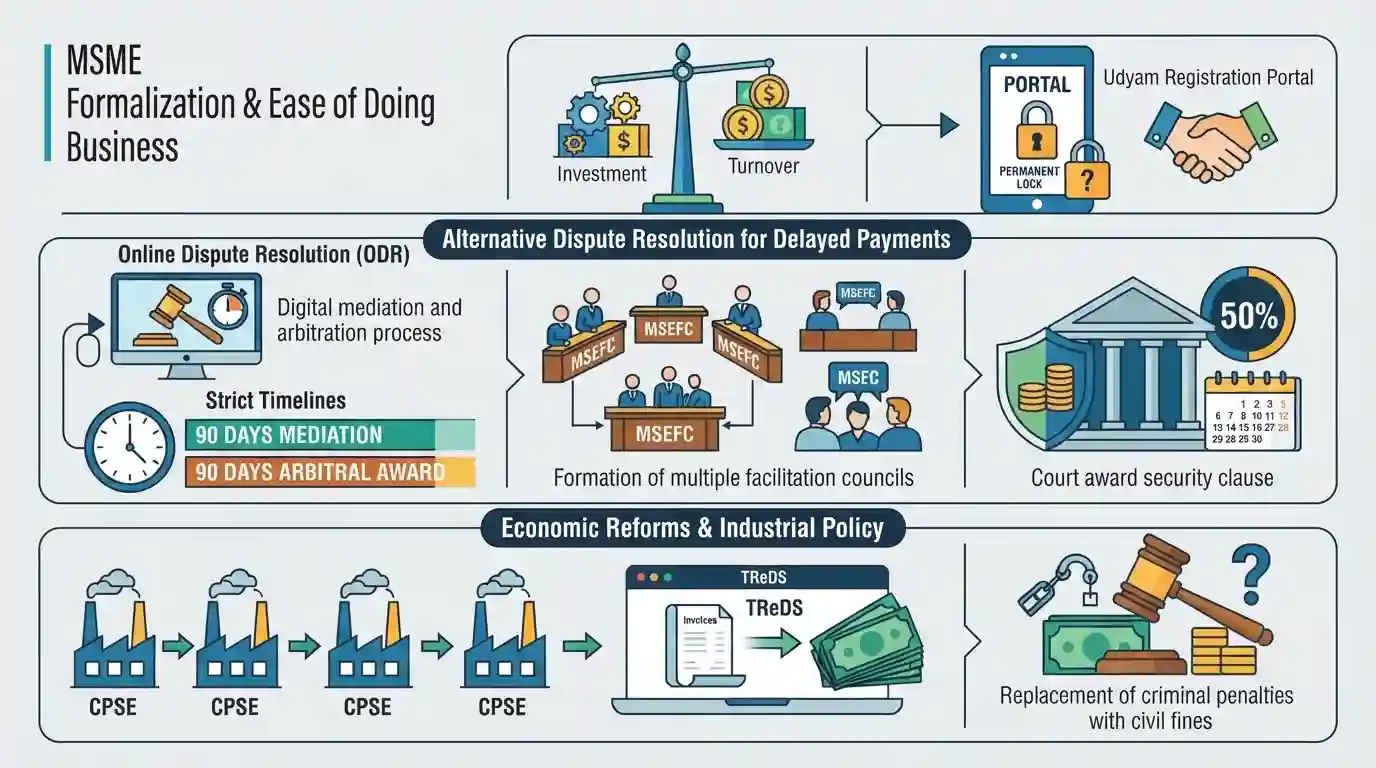
Parliament has passed the Micro, Small and Medium Enterprises Development (Amendment) Bill, 2026, which overhauls the 2006 MSMED Act to boost formalization and Ease of Doing Business. The Bill establishes a twin-criteria definition for MSMEs (investment and turnover) and gives statutory permanence to the Udyam Registration Portal. A major focus is resolving delayed payments, a chronic issue for the sector: it introduces an Online Dispute Resolution (ODR) mechanism with strict timelines (90-day mediation, 90-day arbitral awards), allows states to form multiple Micro and Small Enterprises Facilitation Councils (MSEFCs), and requires courts to secure at least 50% of the awarded amount if a buyer challenges an award after six months. Additionally, it mandates CPSEs to use the TReDS platform for invoice discounting and replaces criminal penalties with civil fines.
Key Points
- Replaces the 2006 MSME definition with a composite twin criteria based on both 'Investment in Plant and Machinery or Equipment' and 'Turnover'.
- Provides statutory backing to the Udyam Registration Portal, permanently institutionalizing the MSME registration process.
- Introduces an Online Dispute Resolution (ODR) mechanism for delayed payments, enforcing strict timelines: 90 days for mediation and 90 days for passing the arbitral award.
- Mandates all Central Public Sector Enterprises (CPSEs) to onboard onto the TReDS platform to facilitate faster invoice discounting and liquidity.
- Decriminalizes offenses under the Act, replacing fines with graded civil penalties to improve the Ease of Doing Business.
Important Terms
Micro, Small and Medium Enterprises Development (Amendment) Bill, 2026

A 2026 legislation updating the 2006 MSMED Act to improve ease of doing business. It removes fixed investment thresholds, introduces online dispute resolution for delayed payments, and mandates TReDS usage for Central Public Sector Enterprises.
UPSC context
GS Paper 2/3. Tests knowledge of MSME statutory reforms, delayed payment resolutions, and Ease of Doing Business initiatives.
MSMED Act, 2006
The principal Indian legislation governing the promotion and development of MSMEs. It provides the statutory framework for enterprise classification, credit facilitation, procurement preferences, and legal protections against delayed payments to micro and small suppliers.
UPSC context
GS Paper 2/3. Foundational statute for India's industrial policy; frequently cited when analyzing government interventions in the MSME sector.
Udyam Registration Portal
A paperless government portal launched in 2020 for registering MSMEs. Integrated with Aadhaar and GST databases, it replaces Udyog Aadhaar. The 2026 MSMED Amendment formally establishes it as the national digital platform for voluntary enterprise registration.
UPSC context
GS Paper 3. Important for evaluating MSME formalization, digital governance, and administrative frameworks enabling access to government schemes.
Micro and Small Enterprises Facilitation Councils (MSEFCs)
Quasi-judicial bodies established by state governments under the MSMED Act to resolve delayed payment disputes between MSMEs and buyers. They use conciliation and arbitration to enforce mandatory payment timelines and impose penalties for defaults.
UPSC context
GS Paper 2. Highly relevant for topics on quasi-judicial bodies, Alternative Dispute Resolution (ADR), and statutory protections for small businesses.
Trade Receivables Discounting System (TReDS)
An RBI-regulated electronic platform enabling MSMEs to discount trade receivables through competitive bidding by multiple financiers. It unlocks instant working capital. The 2026 Bill mandates Central Public Sector Enterprises to settle MSME invoices via TReDS.
UPSC context
GS Paper 3. A high-yield Prelims and Mains topic regarding MSME financing, working capital liquidity, and RBI financial inclusion platforms.
Prelims Trap
The 2026 Bill introduces the twin-criteria (investment and turnover) classification for MSMEs for the first time.
The twin-criteria definition was practically introduced in 2020 via an executive notification. The 2026 Bill formally codifies this into the principal Act rather than creating it from scratch.
Static Concepts Connected
What is the Trade Receivables Discounting System (TReDS)?
- Regulatory Framework: An RBI-regulated electronic platform operating under the Payment and Settlement Systems Act, 2007.
- Core Function: It facilitates the discounting of MSME trade receivables (invoices) drawn on corporate buyers, PSUs, and government departments.
- Key Participants: MSME sellers, corporate/government buyers, and financiers (banks/NBFCs) participate. Financiers bid on uploaded invoices, providing immediate liquidity to MSMEs.
What are the primary modes of Alternative Dispute Resolution (ADR) in India?
- Arbitration: A quasi-judicial process where an arbitrator makes a binding decision (award) on the dispute.
- Mediation: A non-binding process where a neutral third party facilitates negotiation between parties to reach a mutually acceptable agreement.
- Conciliation: Similar to mediation, but the conciliator plays a more active role by proposing terms of settlement.
Cross-Topic Patterns
Jan Vishwas to MSME decriminalization
Decriminalizing minor MSME offenses mirrors the Jan Vishwas Act's philosophy. This shows a macro-governance trend of replacing imprisonment with civil penalties to enhance Ease of Doing Business.
DPI integration for MSME formalization
Statutory backing for the Udyam portal cements it as a core Digital Public Infrastructure (DPI), natively linking PAN, GSTIN, and MSME data to drive credit access and economic formalization.

TReDS mandates, Udyam's statutory backing, and the ODR timeline for MSMEs are highly likely to form a multi-statement Prelims question.
Linked PYQs · 2
Linked PYQs · 2
- 2023MainsGS3
Faster economic growth requires increased share of the manufacturing sector in GDP, particularly of MSMEs. Comment on the present policies of the Government in this regard.
- 2024MainsGS2
Explain and distinguish between Lok Adalats and Arbitration Tribunals. Whether they entertain civil as well as criminal cases ?
