Home affairs parliamentary reports on internal security and disasters
Source:PIB ↗
આ શા માટે મહત્વનું છે
Parliamentary committee reports offer authoritative evaluations and policy recommendations. The insights from these three reports are highly relevant for addressing structural gaps in GS3 Mains answers concerning disaster resilience, cyber security regulation, and border area development.
સારાંશ
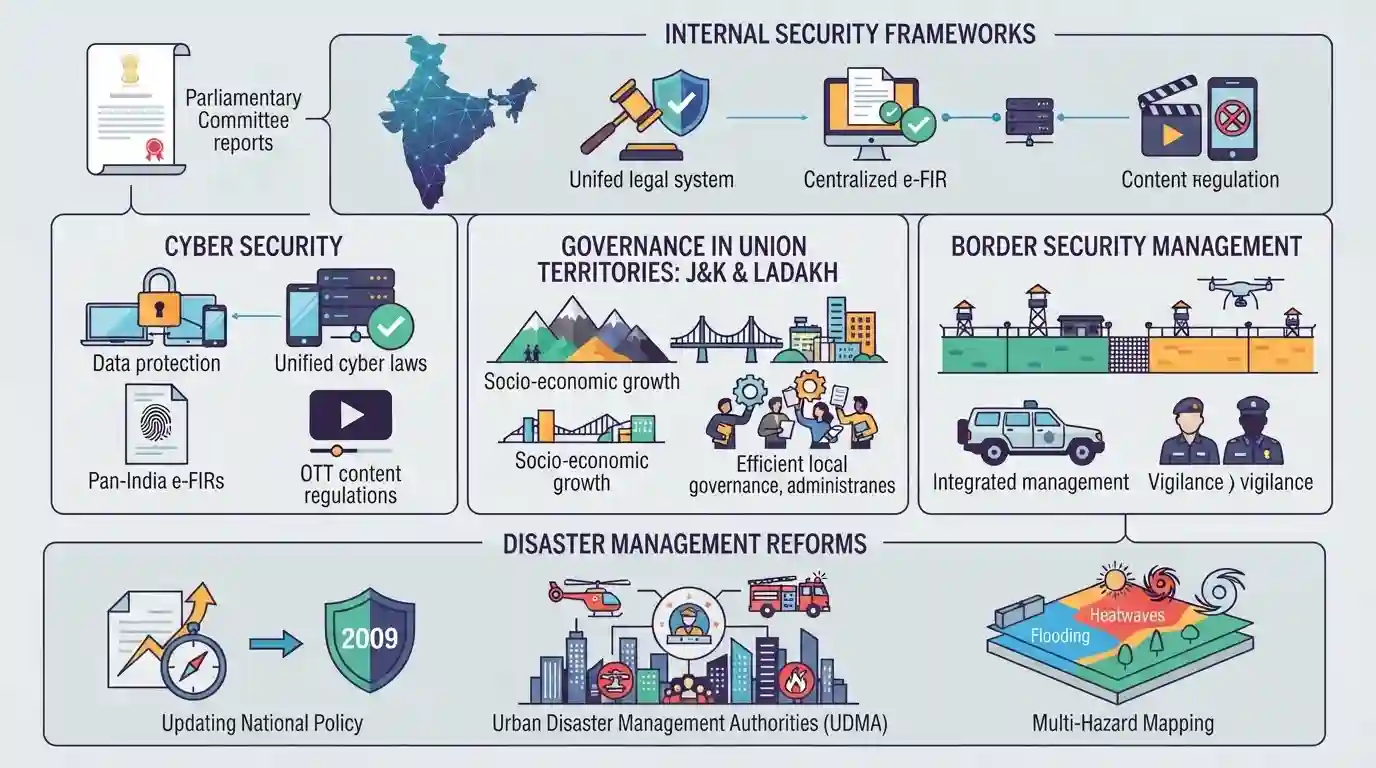
The Department-related Parliamentary Standing Committee on Home Affairs presented its 259th, 260th, and 261st Reports, extensively covering Internal Security and Disaster Management. The reports address cybercrime prevention, highlighting the need for pan-India e-FIRs, strict OTT regulations, and unified cyber laws. They also assess administrative governance, border security management, and socio-economic progress in the Union Territories of Jammu & Kashmir and Ladakh. Furthermore, the disaster management report recommends key structural reforms such as updating the National Policy on Disaster Management 2009, creating Urban Disaster Management Authorities (UDMA), and establishing robust multi-hazard mapping to effectively mitigate modern challenges like urban flooding, heatwaves, and cyclones.
મુખ્ય મુદ્દા
- The 259th Report on Cyber Crime recommends stringent regulation of OTT platforms, unified cyber laws, pan-India e-FIR facilities, and integrating digital literacy into school curricula.
- The 260th Report assesses administrative governance and border security in J&K and Ladakh, highlighting infrastructure growth, multi-dimensional poverty reduction, and the need to address drug abuse and youth empowerment.
- The 261st Report on Disaster Management calls for updating the 2009 National Policy, forming Urban Disaster Management Authorities (UDMA), and ensuring multi-hazard mapping to tackle modern threats like urban floods and heatwaves.
- Across all three reports, the Parliamentary Standing Committee emphasizes building structural and long-term resilience against physical disasters, cross-border security challenges, and digital vulnerabilities.
મહત્વપૂર્ણ શબ્દો
Department-related Parliamentary Standing Committee on Home Affairs

A permanent parliamentary committee consisting of MPs from both Houses. It exercises legislative oversight over the Ministry of Home Affairs by reviewing its bills, budgets, and policies on internal security and administration.
UPSC context
Important for GS-2 (Parliamentary Committees). Tests understanding of legislative checks and balances on executive functions.
National Policy on Disaster Management 2009
A national framework that shifted India's disaster management approach from post-disaster relief to a proactive, technology-driven strategy focusing on prevention, mitigation, and preparedness.
UPSC context
Vital for GS-3 (Disaster Management). The 261st Report recently recommended updating it to tackle modern climate change and urbanisation risks.
Urban Disaster Management Authority (UDMA)
A city-level institutional body mandated for state capitals and major municipal corporations. Led by municipal commissioners, it focuses on localized urban disaster mitigation, risk assessment, and response for urban hazards.
UPSC context
Crucial for GS-3 (Disaster Management) and GS-1 (Urbanisation). Highlights decentralized urban risk mitigation (e.g., urban flooding).
Model Fire and Emergency Service Bill, 2019
A central legislative template circulated to states to modernize and uniform fire safety laws. It transforms state fire departments into multi-hazard emergency response units handling earthquakes, floods, and building collapses.
UPSC context
Relevant for GS-3 (Disaster Management) and GS-2 (Centre-State Relations). Tests knowledge of structural reforms in emergency infrastructure.
State Disaster Response Force (SDRF)
Specialized response forces raised by individual State and UT governments. Serving as the primary first responders to local disasters, they execute rescue and relief operations alongside the central NDRF.
UPSC context
Important for GS-3 (Disaster Management). Tests understanding of the institutional framework and state-level capacity building for disasters.
પ્રિલિમ્સ ટ્રેપ
Heatwaves and lightning are currently classified as nationally notified disasters under the SDRF framework.
Currently, heatwaves and lightning are NOT in the national list of notified disasters. States can only fund relief for them using their discretionary 10% SDRF local-disaster window. The 16th Finance Commission has merely recommended their formal inclusion.
સંલગ્ન સ્થિર ખ્યાલો
What is the composition and constitutional status of Department-related Standing Committees (DRSCs)?
- Total Number: There are 24 DRSCs (16 under Lok Sabha, 8 under Rajya Sabha) to ensure executive accountability.
- Composition: Each committee consists of 31 members: 21 from Lok Sabha (nominated by the Speaker) and 10 from Rajya Sabha (nominated by the Chairman).
- Ministerial Exclusion: A Minister is not eligible to be nominated to these committees. If a member becomes a minister, they cease to be a member.
- Nature of Reports: Their recommendations are advisory in nature and not binding on the Government, though they carry significant persuasive weight.
What is the legal structure of Disaster Management Funds under the DM Act, 2005?
- Dual-Fund Architecture: Constitutes the NDRF (Section 46) and SDRF (Section 48) for emergency response, and NDMF/SDMF for long-term disaster mitigation projects.
- Contribution Ratio: SDRF is the primary fund available with states. The Union contributes 75% for general category states and 90% for Northeast and Himalayan states.
- Nodal Authority: Administered by the Ministry of Home Affairs (MHA), with the National Executive Committee (NEC) deciding on disbursements based on guidelines.
આંતર-વિષય પેટર્ન
Disaster Financing and Cooperative Federalism
The lag in adopting the Model Fire Bill (only 10 states) and reliance on Finance Commission devolution for SDRF allocations highlight structural coordination challenges in federal disaster mitigation.
Cyber Security vs. Decentralized Policing
Unifying local cyber enforcement (pan-India e-FIRs) while regulating transnational OTT platforms highlights the constitutional tension between state-subject policing and union-subject digital jurisdiction.

16th FC recommendations on heatwaves and structural gaps in urban fire safety laws are highly likely themes for GS-3 DM in 2026.
સંલગ્ન PYQ · 5
સંલગ્ન PYQ · 5
- 2020MainsGS3
Discuss different types of cyber crimes and measures required to be taken to fight the menace.
- 2017MainsGS3
Discuss the potential threats of Cyber attack and the security framework to prevent it.
- 2024MainsGS3
India has a long and troubled border with China and Pakistan fraught with contentious issues. Examine the conflicting issues and security challenges along the border. Also give out the development being undertaken in these areas under the Border Area Development Programme (BADP) and Border Infrastructure and Management (BIM) Scheme.
- 2020MainsGS3
For effective border area management, discuss the steps required to be taken to deny local support to militants and also suggest ways to manage favourable perception among locals.
- 2024MainsGS3
What is disaster resilience? How is it determined? Describe various elements of a resilience framework. Also mention the global targets of Sendai Framework for Disaster Risk Reduction (2015–2030).
