Scheduled Castes Representation in Central Services Exceeds Quota
Source:PIB ↗
ఇది ఎందుకు ముఖ్యం
Provides critical data points for Mains answers regarding the efficacy of affirmative action and reservation policies. The 17.14% achievement against a 15% quota is a key metric in assessing administrative inclusion, while the government's stance on a new caste/socio-economic census is highly relevant for polity and social justice topics.
సారాంశం
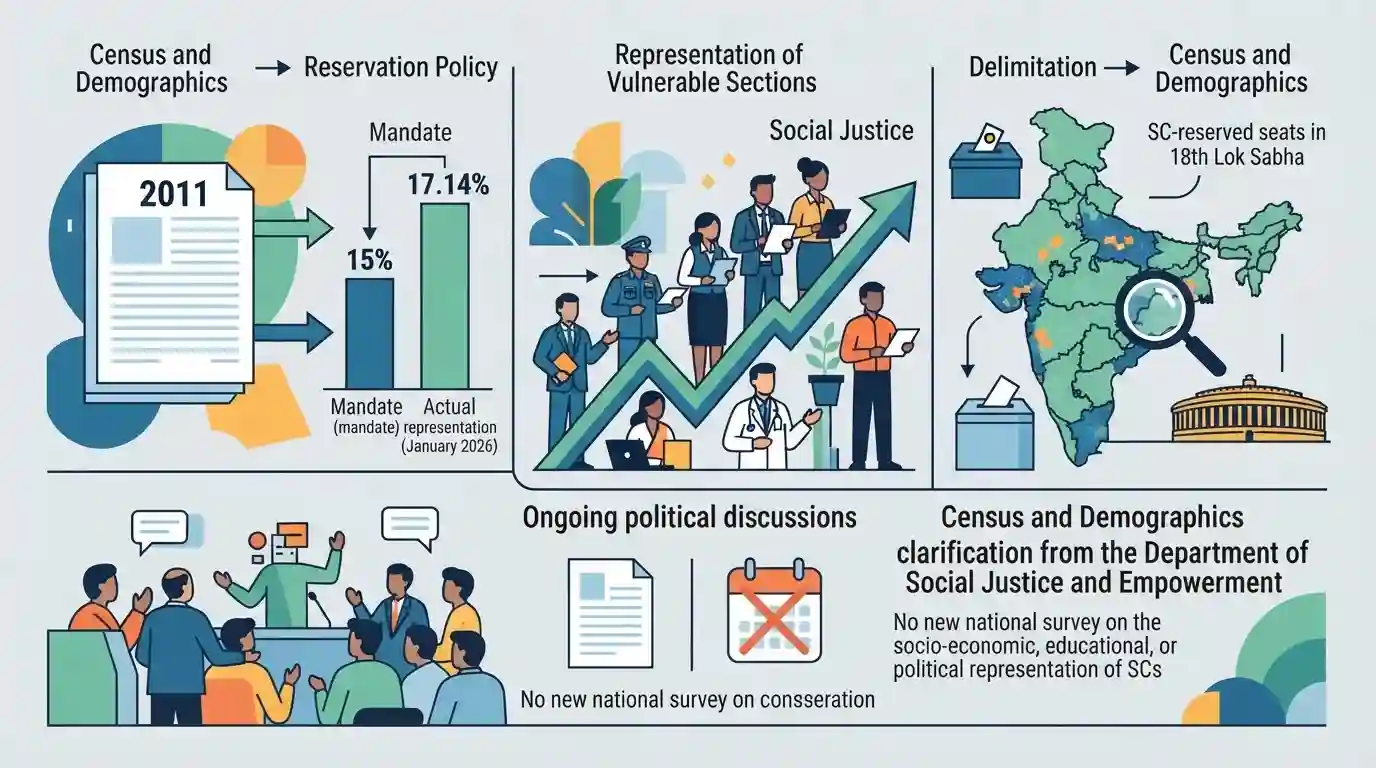
The 2011 Census remains the official source for caste-wise population and educational data for Scheduled Castes (SCs). In the realm of public employment, the Central Government's mandate of 15% reservation for SCs has been fulfilled and exceeded, with overall representation reaching 17.14% as of January 2026. Furthermore, details for SC-reserved constituencies in the 18th Lok Sabha are publicly accessible via the Election Commission. Amidst ongoing political discussions about affirmative action, the Department of Social Justice and Empowerment clarified that no new national survey on the socio-economic, educational, or political representation of SCs is currently under consideration.
ముఖ్య అంశాలు
- The 2011 Census provides the definitive caste-wise population data for Scheduled Castes (SCs), including metrics on educational attendance.
- Information regarding constituencies reserved for SCs in the 18th Lok Sabha is maintained by the Election Commission of India.
- The Central Government mandates a 15% reservation for SCs in its posts and services.
- As of January 1, 2026, the actual representation of SCs in Central Government services stands at 17.14%, exceeding the prescribed quota.
- The Department of Social Justice and Empowerment has no current proposal to conduct a fresh national survey on the socio-economic and political representation of SCs.
ముఖ్యమైన పదాలు
Census 2011

The 15th Indian census and the most recent comprehensive national demographic survey. It remains the official data source for the socio-economic and caste-wise population figures of Scheduled Castes used in welfare schemes.
UPSC context
GS Paper 1 & 2 (Demographics; Social Justice). Tests knowledge of data sources underpinning India's affirmative action and welfare planning.
Department of Social Justice and Empowerment
A central government department under the Ministry of Social Justice and Empowerment, functioning as the nodal agency for the welfare, inclusion, and policy formulation regarding Scheduled Castes and other marginalized communities.
UPSC context
GS Paper 2 (Welfare Schemes; Governance). Tests understanding of institutional mechanisms targeting the upliftment of vulnerable sections.
Election Commission of India
An autonomous constitutional authority responsible for administering election processes in India. It maintains publicly accessible data regarding constituencies reserved for Scheduled Castes and Scheduled Tribes based on delimitation.
UPSC context
GS Paper 2 (Constitutional Bodies; Representation of People's Act). Tests knowledge of electoral management and political representation rules.
ప్రిలిమ్స్ ఉచ్చు
The delimitation and reservation of Lok Sabha seats for Scheduled Castes are currently frozen on the basis of the 2011 Census.
Constituency boundaries are actually frozen using the 2001 Census (87th Amendment, 2003), while total seats are frozen based on the 1971 Census, not the 2011 Census.
అనుసంధానమైన స్థిర భావనలు
What is the relationship between Article 335 and reservation policies?
- Constitutional balancing: Article 335 states that claims of SCs/STs shall be taken into consideration consistently with the maintenance of efficiency of administration.
- No explicit definition: The term 'efficiency of administration' is not defined anywhere in the Constitution of India.
- Judicial evolution: The Supreme Court in M. Nagaraj linked efficiency to a holistic view, emphasizing that inclusion itself can enhance administrative efficiency.
What is the composition and mandate of the Committee on Welfare of SCs and STs?
- Joint committee: It consists of 30 members: 20 elected from the Lok Sabha and 10 from the Rajya Sabha.
- Election method: Members are elected annually via proportional representation by means of a single transferable vote.
- Ministerial bar: A Minister cannot be elected to the committee; if a member becomes a Minister, they cease to be a member.
అంతర-అంశ నమూనాలు
Delimitation, federalism, and demographic divergence
The upcoming post-2026 delimitation risks penalizing states with successful population control while altering reserved SC/ST seat distributions based on shifting migration and demographic trends.
Sub-categorization of SCs vs administrative efficiency
The recent Supreme Court ruling permitting sub-classification within SCs directly links to Article 16(4) and Article 335, transforming representation arguments from aggregate figures to targeted micro-quotas.

Statements testing Article 335's 'efficiency' definition, 2001 census base for seat allocation, and SC sub-categorization likely in 2026.
అనుసంధాన PYQలు · 4
అనుసంధాన PYQలు · 4
- 2018MainsGS2
Whether National Commission for Scheduled Castes (NCSC) can enforce the implementation of constitutional reservation for the Scheduled Castes in the religious minority institutions? Examine.
- 2026PrelimsGS1
Consider the following statements about the provisions pertaining to the Scheduled Castes and the Scheduled Tribes in India : 1. Provisions regarding the administration of the Tribal Areas in the States of Assam, Meghalaya, Tripura and Mizoram are given in the Fifth Schedule of the Constitution of India. 2. Some tribes of India are entitled to exemption from paying Income Tax on certain incomes. 3. The Constitution of India provides for reservation of seats in Panchayats for women belonging to the Scheduled Castes and the Scheduled Tribes. Which one of the following conclusions based on the above statements is correct ?
- 2026PrelimsGS1
Consider the following statements about the Committee on the Welfare of Scheduled Castes and Scheduled Tribes of the Parliament of India : 1. Although members of this Committee are elected from both Houses of Parliament, the Chairperson of this Committee is appointed by the Chairman of the Rajya Sabha. 2. Twenty members are elected by the Rajya Sabha and ten members by the Lok Sabha. 3. No Minister, except for the Union Minister of Social Justice and Empowerment, is eligible to be a member of this Committee. 4. Members are elected for a fixed term of two years from the date they enter their office. Which one of the following conclusions based on the above statements is correct ?
- 2024PrelimsGS1
Consider the following statements regarding 'Nari Shakti Vandan Adhiniyam' : 1. Provisions will come into effect from the 18th Lok Sabha. 2. This will be in force for 15 years after becoming an Act. 3. There are provisions for the reservation of seats for Scheduled Castes Women within the quota reserved for the Scheduled Castes. Which of the statements given above are correct?
