Jammu drug de-addiction infrastructure and NCORD framework review
Source:PIB ↗
ఇది ఎందుకు ముఖ్యం
Border states like Jammu & Kashmir face a dual challenge of drug addiction and narco-terrorism. Understanding both the demand-reduction strategies (NAPDDR) and law enforcement coordination frameworks (NCORD) is crucial for addressing internal security and socio-economic vulnerabilities.
సారాంశం
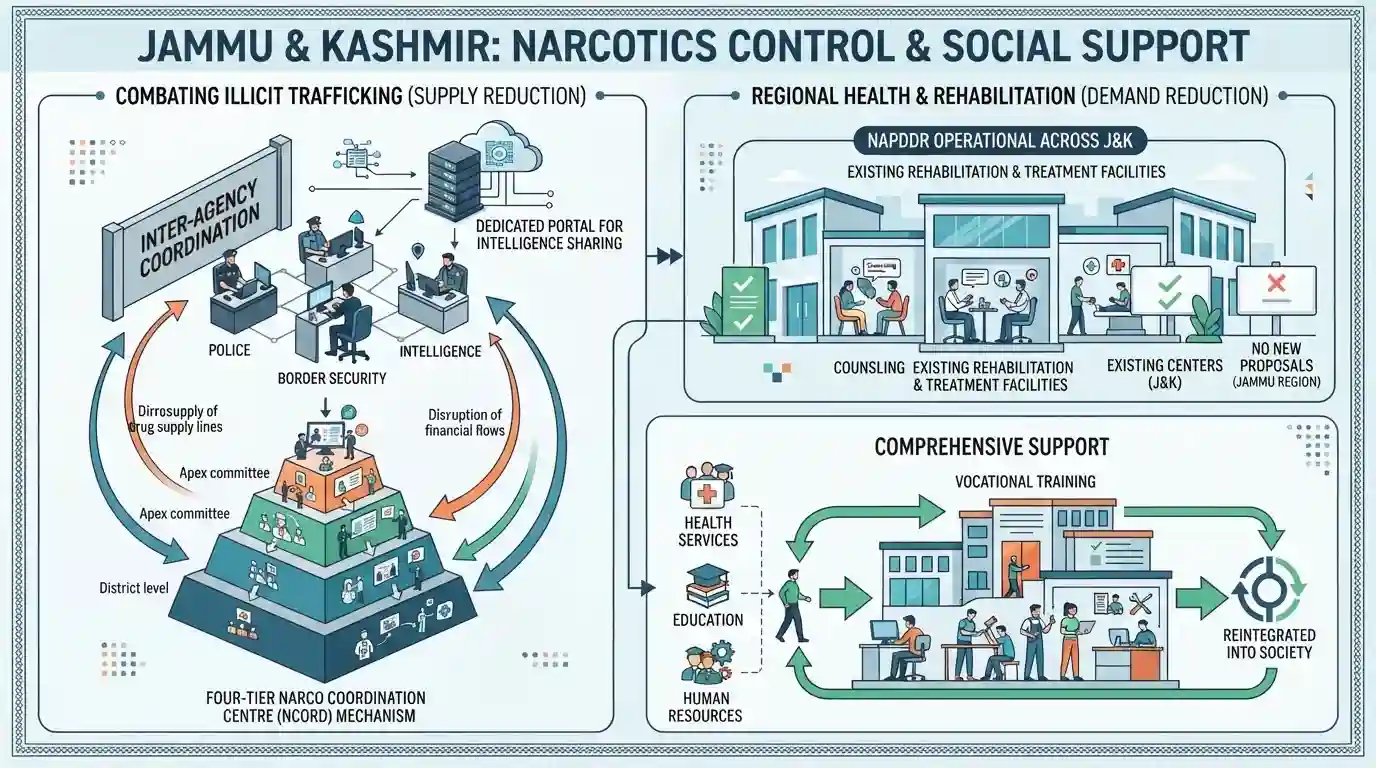
The government has clarified that there is no active proposal to set up new integrated drug de-addiction and vocational training centers in the Jammu region. However, under the National Action Plan for Drug Demand Reduction (NAPDDR), numerous rehabilitation and treatment facilities are currently operational across Jammu & Kashmir. To tackle the supply side and illicit drug trafficking, the Ministry of Home Affairs has deployed the four-tier Narco Coordination Centre (NCORD) mechanism along with a dedicated portal, enhancing inter-agency coordination and intelligence sharing.
ముఖ్య అంశాలు
- The government currently has no proposal to establish new integrated drug de-addiction and vocational training centers in the Jammu region.
- Jammu & Kashmir already has several operational facilities under the National Action Plan for Drug Demand Reduction (NAPDDR), including 1 IRCA, 6 DDACs, and 21 Addiction Treatment Facilities (ATFs).
- The Ministry of Home Affairs has established the Narco Coordination Centre (NCORD) as a four-tier mechanism (Apex, Executive, State/UT, and District levels) to combat drug trafficking effectively.
- The NCORD Portal serves as an integrated knowledge management platform to facilitate coordination between various agencies in narcotics control and anti-drug abuse initiatives.
ముఖ్యమైన పదాలు
National Action Plan for Drug Demand Reduction (NAPDDR)

A comprehensive scheme by the Ministry of Social Justice and Empowerment aimed at reducing drug abuse through preventive education, awareness generation, counseling, treatment, and rehabilitation of substance-dependent individuals using a multi-pronged strategy.
UPSC context
GS Paper II (Social Justice). Tests knowledge of government schemes for vulnerable populations and management of health-related social services.
Narco Coordination Centre (NCORD)
A four-tier multi-agency platform established by the Ministry of Home Affairs to strengthen coordination among drug law enforcement agencies. It facilitates intelligence sharing, policy formulation, and joint action against narcotics trafficking.
UPSC context
GS Paper III (Internal Security). Crucial for understanding mechanisms to tackle organized crime, drug trafficking, and challenges posed by non-state actors.
Integrated Rehabilitation Centre for Addicts (IRCA)
Residential facilities supported by the Ministry of Social Justice and Empowerment under NAPDDR. They offer comprehensive services for substance-dependent persons, including detoxification, counseling, and vocational training, ensuring their total socioeconomic recovery.
UPSC context
GS Paper II (Social Justice). Important for evaluating specialized institutional mechanisms and social sector healthcare interventions for rehabilitation.
District De-addiction Centres (DDACs)
Multifunctional district-level facilities established in underserved areas under NAPDDR. They combine in-patient treatment, rehabilitation, community-based peer-led interventions, and drop-in services to provide comprehensive grassroots care and awareness against substance abuse.
UPSC context
GS Paper II (Social Justice). Relevant to decentralized healthcare infrastructure and targeted welfare schemes addressing regional disparities in rehabilitation.
ప్రిలిమ్స్ ఉచ్చు
NAPDDR and NCORD are both initiatives under the Ministry of Home Affairs.
While MHA handles the supply side via NCORD, the National Action Plan for Drug Demand Reduction (NAPDDR) is administered by the Ministry of Social Justice and Empowerment.
అనుసంధానమైన స్థిర భావనలు
How is drug control administratively divided in India?
- Supply Control (MHA): Narcotics Control Bureau (NCB) and NCORD handle anti-trafficking, intelligence sharing, and law enforcement.
- Demand Reduction (MoSJE): NAPDDR focuses on rehabilitation, running Integrated Rehabilitation Centres (IRCAs), ATFs, and awareness campaigns.
- Regulatory (MoF): The Department of Revenue oversees the legal cultivation of opium and manufacture of narcotics for medical use.
What makes India geographically vulnerable to drug trafficking?
- Golden Crescent: Proximity to the major illicit opium hubs of Iran, Afghanistan, and Pakistan on the western border.
- Golden Triangle: Bordering the intersection of Myanmar, Laos, and Thailand on the eastern border, acting as a transit hub.
- Narco-terrorism: Transnational networks use drug proceeds to fund insurgent and terror activities in vulnerable border states.
అంతర-అంశ నమూనాలు
Narco-terrorism & Non-State Actors
Drug proceeds from across the border fund terror outfits in J&K, bridging Social Justice (addiction) with Internal Security (organized crime nexus).
Federalism in Law Enforcement
NCORD's 4-tier mechanism (down to the district level) reflects a cooperative federal approach, essential for tackling organized crime across jurisdictions.

Expect a Prelims pairing of NAPDDR/NCORD with their ministries, or a Mains question on the narco-terror nexus in J&K and Punjab.
అనుసంధాన PYQలు · 3
అనుసంధాన PYQలు · 3
- 2018MainsGS3
India's proximity to two of the world's biggest illicit opium-growing states has enhanced her internal security concerns. Explain the linkages between drug trafficking and other illicit activities such as gunrunning, money laundering and human trafficking. What counter-measures should be taken to prevent the same?
- 2020MainsGS3
Analyze internal security threats and transborder crimes along Myanmar, Bangladesh and Pakistan borders including Line of Control (LoC). Also discuss the role played by various security forces in this regard.
- 2022MainsGS3
Discuss the types of organised crimes. Describe the linkages between terrorists and organised crime that exist at the national and transnational levels.
