DGFT Integrates Startups into Source from India Trade Platform
Source:PIB ↗
આ શા માટે મહત્વનું છે
Highlights the government's digital initiatives to integrate MSMEs and start-ups into global value chains, an important aspect of economic growth, export diversification, and start-up ecosystem support covered in GS Paper 3.
સારાંશ
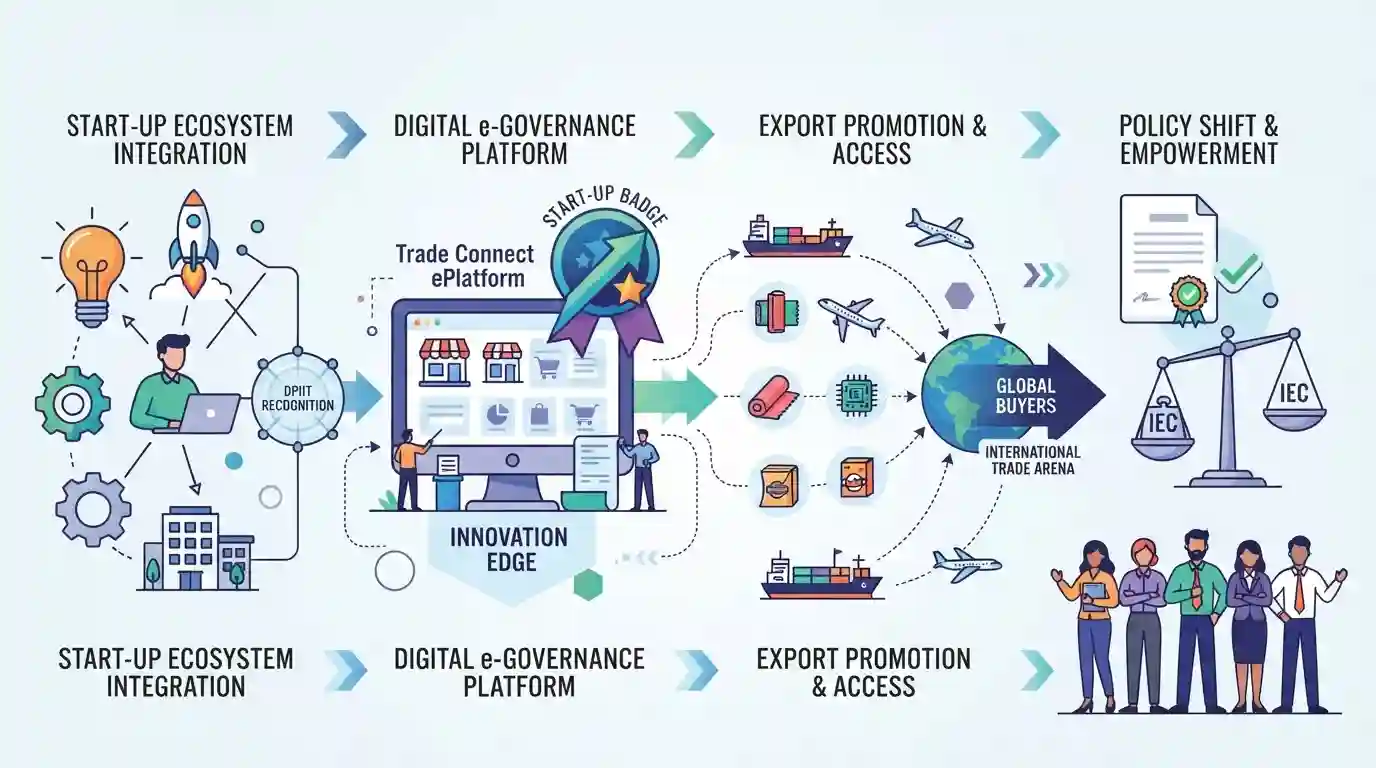
The Directorate General of Foreign Trade (DGFT) has expanded the "Source from India" feature on its Trade Connect ePlatform to include DPIIT-recognised Start-ups. This initiative provides these startups with a digital storefront to showcase their products and services to global buyers, complete with a distinctive "Start-up Badge" to highlight their innovative edge. Notably, early-stage start-ups possessing an active Import Export Code (IEC) can join the platform without meeting conventional export performance benchmarks, provided they are not on the Denied Entity List. This policy shift by the Ministry of Commerce and Industry is designed to boost export diversification, integrate Indian innovation into global supply chains, and empower MSMEs and start-ups in the international trade arena.
મુખ્ય મુદ્દા
- The DGFT has integrated DPIIT-recognised Startups into the 'Source from India' feature of the Trade Connect ePlatform to boost their global visibility.
- Eligible start-ups will receive a unique "Start-up Badge" on their profiles to signal innovation and quality to international buyers.
- Early-stage start-ups with an active Import Export Code (IEC) can create profiles without meeting traditional export performance criteria, provided they are not on the Denied Entity List.
- The initiative aims to diversify India's export basket, promote technology-led products, and empower MSMEs and start-ups to become globally competitive.
મહત્વપૂર્ણ શબ્દો
Trade Connect ePlatform

A comprehensive digital hub launched by the DGFT to connect Indian exporters with global trade information, international buyers, trade events, and institutional support.
UPSC context
GS-3 (Economy/E-Governance); tests digital initiatives for MSME export promotion and integration into global supply chains.
Source from India
A flagship feature on the Trade Connect ePlatform providing a digital storefront for verified Indian exporters and start-ups to showcase products to international buyers.
UPSC context
GS-3 (Economy); relevant for evaluating government measures to boost export diversification and MSME global visibility.
Import Export Code (IEC)
A mandatory, lifetime-valid 10-digit business identification number issued by the DGFT for entities engaging in commercial import and export activities in India.
UPSC context
GS-3 (Economy); factual basis for foreign trade policy, customs compliance, and export regulatory frameworks.
Denied Entity List (DEL)
A database maintained by the DGFT identifying IEC holders temporarily or permanently barred from trade privileges due to non-compliance or unfulfilled export obligations.
UPSC context
GS-3 (Economy); highlights regulatory enforcement mechanisms, trade compliance, and the Foreign Trade Policy framework.
Directorate General of Foreign Trade (DGFT)
An attached office of the Ministry of Commerce and Industry responsible for formulating and implementing India's Foreign Trade Policy to promote exports.
UPSC context
GS-3 (Economy) & GS-2 (Statutory Bodies); frequently tested regarding trade facilitation and export control.
Department for Promotion of Industry and Internal Trade (DPIIT)
A department under the Ministry of Commerce and Industry that formulates policies for industrial growth, FDI, and acts as the nodal agency for Start-up India.
UPSC context
GS-2/GS-3; vital for questions on industrial policy, the start-up ecosystem, intellectual property, and foreign investment.
પ્રિલિમ્સ ટ્રેપ
An Importer-Exporter Code (IEC) is issued once and remains valid indefinitely without any requirement for periodic updating.
While IEC is a permanent number linked to PAN, it must be updated electronically every year between April and June. Failure leads to deactivation.
સંલગ્ન સ્થિર ખ્યાલો
What is the Importer-Exporter Code (IEC) and what are its key exemptions?
- Mandatory ID: A 10-digit number issued by DGFT, now linked to PAN, which is essential for cross-border commercial trade.
- Annual Update: It must be updated electronically on the DGFT portal every year between April and June to remain active.
- Exemptions: Government departments, personal non-commercial trade, and specified limited border trade (e.g., with Nepal/Myanmar) are exempt.
- SCOMET Exception: No IEC exemptions apply when exporting dual-use or sensitive items listed under the SCOMET categories.
What are the core criteria for DPIIT Startup recognition?
- Age Limit: The entity must be within 10 years of its incorporation date (extended to 20 years for DeepTech startups).
- Turnover Cap: Annual turnover must not exceed ₹200 crore for regular startups (₹300 crore for DeepTech).
- Entity Type: Must be incorporated as a Private Limited Company, Limited Liability Partnership (LLP), Registered Partnership, or Cooperative Society.
આંતર-વિષય પેટર્ન
FTP 2023 & e-Commerce exports
Linking DPIIT-startups to DGFT platforms directly executes the Foreign Trade Policy 2023 mandate to push e-commerce exports and integrate MSMEs into global supply chains.
Deep-tech startups & SCOMET rules
As Indian startups export more innovative tech, they increasingly intersect with SCOMET regulations governing dual-use and sensitive technologies, an area tightly monitored by DGFT.

A Prelims question merging DPIIT startup criteria with the strict annual renewal rules of the Importer-Exporter Code (IEC) is highly likely.
સંલગ્ન PYQ · 4
સંલગ્ન PYQ · 4
- 2023MainsGS3
Faster economic growth requires increased share of the manufacturing sector in GDP, particularly of MSMEs. Comment on the present policies of the Government in this regard.
- 2023MainsGS3
What is the status of digitalization in the Indian economy? Examine the problems faced in this regard and suggest improvements.
- 2017MainsGS3
Account for the failure of manufacturing sector in achieving the goal of labour-intensive exports. Suggest measures for more labour-intensive rather than capital-intensive exports.
- 2023PrelimsGS1
Consider the following statements: Statement-I: India accounts for 3.2% of global export of goods. Statement-II: Many local companies and some foreign companies operating in India have taken advantage of India's 'Production-linked Incentive' scheme. Which one of the following is correct in respect of the above statements?
