BIOFACH INDIA Promotes Certified Organic Exports and Market Access
Source:PIB ↗
Why It Matters
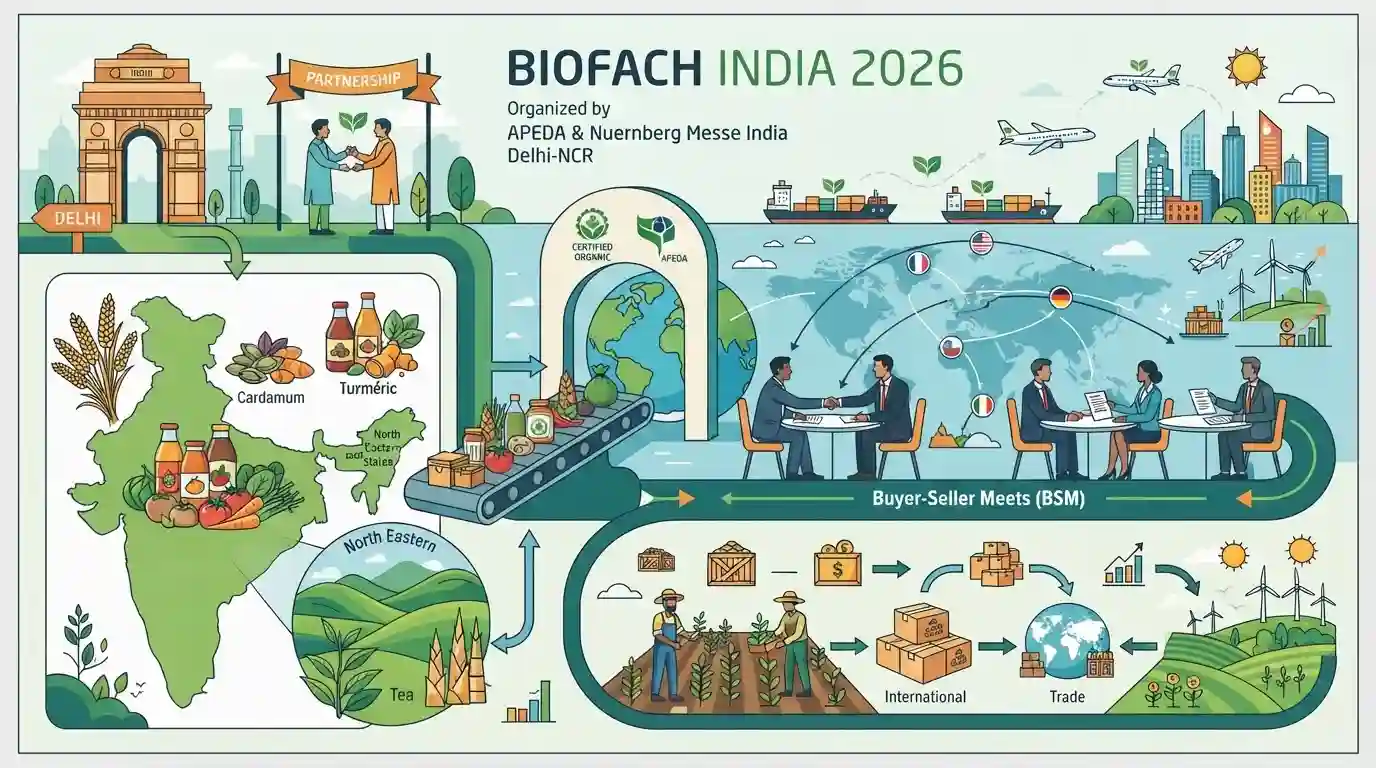
It illustrates India's institutional efforts through APEDA to capitalize on the growing global demand for organic products. The event addresses crucial GS3 themes like agricultural marketing, supply chain management, export promotion, and the integration of sustainable farming practices into global value chains, specifically benefiting FPOs and the North Eastern Region.
Summary
The article details the organization of BIOFACH INDIA 2026 by APEDA in collaboration with Nuernberg Messe India in Delhi-NCR. The event aims to promote India's certified organic products and expand their global market access. It showcases a diverse array of organic goods—ranging from millets and spices to processed foods—from various Indian states, particularly highlighting the potential of the North Eastern region. By facilitating Buyer-Seller Meets (BSMs) with international buyers from 13 countries, the event focuses on enhancing business linkages, promoting organic certification, and driving sustainable agricultural exports.
Key Points
- APEDA, in collaboration with Nuernberg Messe India, organized BIOFACH INDIA 2026 to enhance global market access for India's certified organic products.
- The event features over 200 exhibiting companies, including FPOs, FPCs, and startups, emphasizing grassroots agricultural enterprise.
- A wide range of certified organic products, such as millets, spices, tea, and processed foods, are showcased from diverse states, with a special focus on the North East.
- Buyer-Seller Meets (BSMs) were organized involving over 35 international buyers from 13 key markets like Japan, Australia, and South Korea to foster global business linkages.
- The initiative highlights the strategic role of organic certification, traceability, and sustainability in expanding India's agricultural export footprint.
Important Terms
Agricultural and Processed Food Products Export Development Authority (APEDA)

A statutory body under the Ministry of Commerce and Industry, established in 1986. It develops, promotes, and regulates the export of scheduled agricultural and processed food products to international markets.
UPSC context
Highly relevant for GS Paper 3 (Agriculture) regarding agricultural exports, food processing, and initiatives for doubling farmers' income.
BIOFACH INDIA
India's largest international trade fair and conference for the organic industry. It connects organic stakeholders, promotes certified organic products, and facilitates global market access for sustainable agricultural goods.
UPSC context
Relevant for GS Paper 3 (Agriculture) concerning organic farming promotion, sustainable agriculture trends, and export-oriented agricultural marketing.
Ministry of DoNER
The Ministry of Development of North Eastern Region is a unique territorial ministry that coordinates the planning, execution, and monitoring of development schemes and infrastructure projects across India's Northeast.
UPSC context
Crucial for GS Paper 2 (Governance) and GS 3 (Economy) covering regional development, North-East infrastructure, and inclusive growth strategies.
Farmer Producer Organisations (FPOs)
Collectives formed by primary producers, primarily small and marginal farmers. FPOs pool resources, enhance bargaining power, and help members achieve economies of scale for better market and credit access.
UPSC context
A core GS Paper 3 (Agriculture) topic, central to issues of agricultural marketing, smallholder empowerment, and rural development.
Farmer Producer Companies (FPCs)
A specific legal form of an FPO registered under the Companies Act. FPCs operate as a hybrid between cooperative societies and private limited companies, ensuring professional management for farmer-owners.
UPSC context
Important for GS Paper 3 (Agriculture) regarding institutional reforms, agricultural supply chain integration, and capacity building for farmers.
Prelims Trap
India ranks first globally in both the total number of organic producers and the total land area under organic farming.
India has the highest number of organic farmers globally, but Australia leads in total land area under organic agriculture.
Static Concepts Connected
How do NPOP and PGS-India organic certification frameworks differ?
- NPOP authority: Administered by Ministry of Commerce & Industry (APEDA); primarily focused on export markets using third-party certification bodies.
- PGS-India authority: Administered by Ministry of Agriculture & Farmers Welfare; relies on peer-group reviews for domestic certification.
- Export validity: NPOP standards are globally recognized (EU, US), whereas PGS-India certified products are currently not accepted for major exports.
What is the WTO Agreement on Sanitary and Phytosanitary (SPS) Measures?
- Core objective: Protects human, animal, or plant health from food-borne risks, pests, and diseases while preventing unjustified trade barriers.
- Scientific justification: Requires member nations to base their SPS restrictions on international standards or sound scientific risk assessments.
Cross-Topic Patterns
MOVCDNER + Act East diplomacy
Leveraging the North East's organic potential under MOVCDNER serves as a strategic economic gateway to high-value markets in East and Southeast Asia.
Organic standards + WTO technical barriers
Domestic certification under NPOP helps smallholders navigate the complex, often protectionist, Sanitary and Phytosanitary (SPS) rules of developed nations.

Expect a comparative question distinguishing NPOP (Commerce Ministry) and PGS-India (Agriculture Ministry) certification frameworks in 2026.
Linked PYQs · 2
Linked PYQs · 2
- 2018PrelimsGS1
With reference to organic farming in India, consider the following statements: 1. 'The National Programme for Organic Production' (NPOP) is operated under the guidelines and directions of the Union Ministry of Rural Development. 2. 'The Agricultural and Processed Food Products Export Development Authority' (APEDA) functions as the Secretariat for the implementation of NPOP. 3. Sikkim has become India's first fully organic State. Which of the statements given above is/are correct?
- 2022MainsGS3
What are the main bottlenecks in upstream and downstream process of marketing of agricultural products in India?
