VCF-ST Scheme Expands Incubation Support for Tribal Entrepreneurs
Source:PIB ↗
ఇది ఎందుకు ముఖ్యం
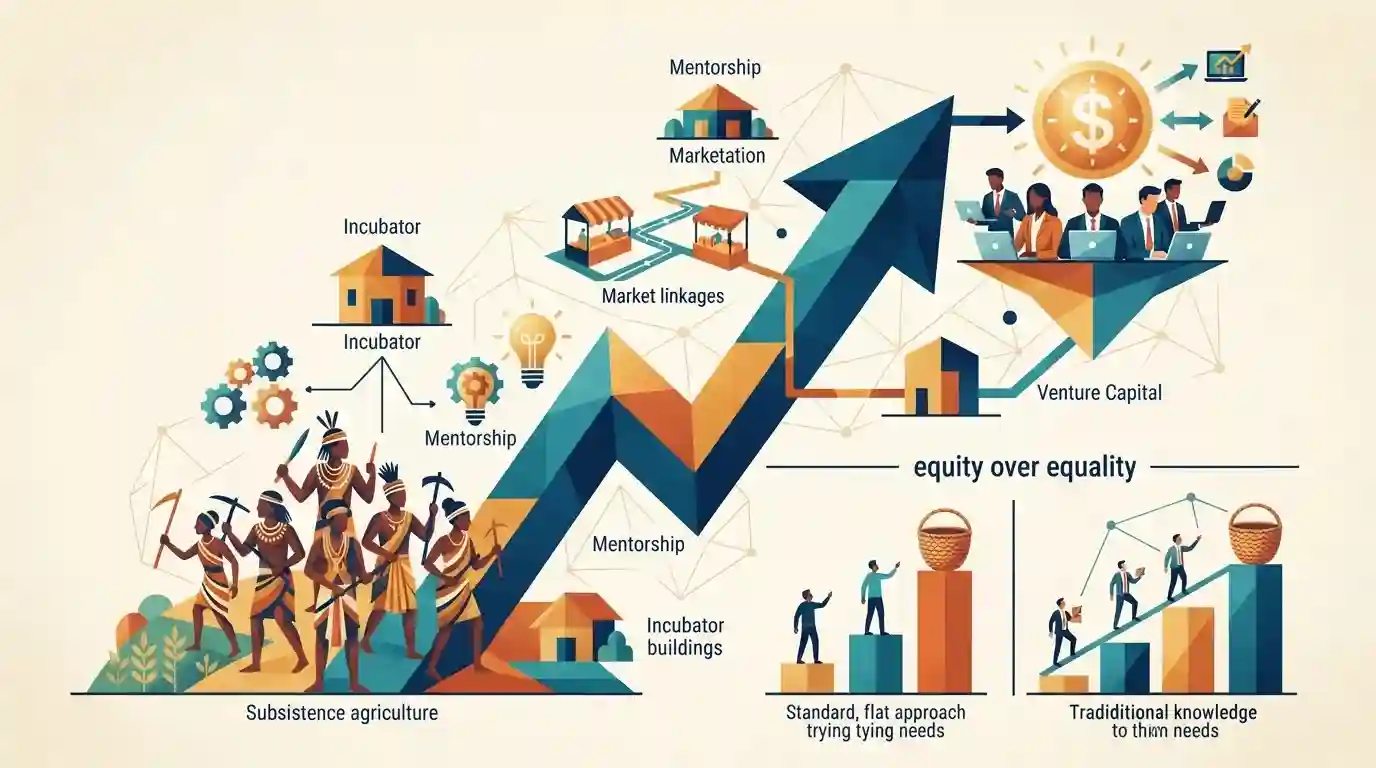
The article illustrates a critical shift in tribal welfare policies—from basic sustenance and poverty alleviation to fostering high-end entrepreneurship and wealth creation. It is highly relevant for GS2 (Welfare Schemes) and GS3 (Inclusive Growth and Startups), showcasing the practical application of 'equity over equality' in governance.
సారాంశం
The Ministry of Tribal Affairs (MoTA) has partnered with 10 Technology Business Incubators across India under the Venture Capital Fund for Scheduled Tribes (VCF-ST) scheme. This collaboration is designed to provide mentorship, market linkages, and funding to approximately 1,000 Scheduled Tribe (ST) entrepreneurs, with at least 100 being directly incubated and funded. The initiative focuses on moving tribal communities from subsistence livelihoods to aspirational entrepreneurship, aiming to create job creators rather than job seekers. Crucially, the policy framework embodies the concept of 'equity over equality,' recognizing the need for specialized support structures to integrate traditional tribal knowledge into the modern commercial ecosystem.
ముఖ్య అంశాలు
- The Ministry of Tribal Affairs (MoTA) signed MoUs with 10 Technology Business Incubators (TBIs) to support Scheduled Tribe (ST) entrepreneurs under the Venture Capital Fund for Scheduled Tribes (VCF-ST).
- The initiative aims to reach approximately 1,000 ST entrepreneurs, providing structural capacity building, mentorship, and market linkages, with a minimum of 100 enterprises to be funded and incubated.
- The program is designed to transform tribal youth from 'job seekers' to 'job creators' by helping them establish commercially viable and scalable enterprises.
- Officials stressed the principle of 'equity over equality', acknowledging that tribal startups require specialized, hand-holding support because they often start from a different baseline compared to mainstream entrepreneurs.
ముఖ్యమైన పదాలు
Venture Capital Fund for Scheduled Tribes (VCF-ST)

A Central Sector Scheme by the Ministry of Tribal Affairs providing risk capital (₹10 lakh to ₹5 crore) and incubation funding to Scheduled Tribe entrepreneurs to promote innovation and business ownership.
UPSC context
GS-2 (Social Justice) & GS-3 (Inclusive Growth). Highlights targeted financial inclusion and the shift from subsistence to "equity over equality."
Ministry of Tribal Affairs (MoTA)
The nodal Central Government ministry responsible for the policy, planning, and coordination of programs designed to empower and comprehensively develop India's Scheduled Tribes.
UPSC context
GS-2 (Government Policies & Welfare Schemes). Tests knowledge of administrative frameworks dedicated to the systemic upliftment of vulnerable sections.
T-Hub Foundation
A prominent Hyderabad-based innovation hub and startup incubator (a Section 8 company) that partners with government bodies and corporations to mentor, fund, and scale entrepreneurial ventures.
UPSC context
GS-3 (Start-up Ecosystem & Innovation). Relevant for evaluating successful public-private incubator models fostering youth entrepreneurship.
Kerala Startup Mission
The nodal agency of the Government of Kerala for entrepreneurship development and incubation activities, actively supporting local startups through seed funding, mentorship, and strategic infrastructure.
UPSC context
GS-3 (Economic Development). Showcases state-level initiatives and policy models crucial for building robust regional innovation ecosystems.
ప్రిలిమ్స్ ఉచ్చు
VCF-ST is administered by the Ministry of Social Justice and Empowerment (MoSJE).
MoSJE administers the Venture Capital Fund for Scheduled Castes (VCF-SC). The VCF-ST is specifically administered by the Ministry of Tribal Affairs (MoTA).
అనుసంధానమైన స్థిర భావనలు
What is the constitutional basis for 'Equity over Equality' in India?
- Article 15(4) & 16(4): Empowers the State to make special provisions for the advancement of backward classes, shifting from formal equality to substantive equity.
- Article 46 (DPSP): Directs the State to promote the educational and economic interests of weaker sections, particularly SCs and STs, protecting them from social injustice.
What are Technology Business Incubators (TBIs) and Venture Capital Funds?
- TBIs: Institutional mechanisms (traditionally promoted by DST) that help tech-driven startups survive early stages by providing workspace, mentorship, and seed funding.
- Venture Capital (VC): Funds that provide risk capital (equity or soft loans) to early-stage startups with high growth potential, rather than traditional non-repayable government grants.
అంతర-అంశ నమూనాలు
Tribal Knowledge + Commercial IP
Integrating tribal knowledge into tech incubators bridges traditional socio-economic welfare with modern Intellectual Property Rights, complementing TRIFED's 'Tech for Tribals' initiatives.
Stand-Up India + Specialized VCs
VCF-ST complements Stand-Up India by providing specialized venture capital and incubation hand-holding, directly addressing the unique market-entry and structural barriers faced by ST entrepreneurs.

Expect a Prelims question contrasting VCF-ST (Tribal Affairs) with VCF-SC (Social Justice), focusing on equity/debt funding models.
అనుసంధాన PYQలు · 5
అనుసంధాన PYQలు · 5
- 2025PrelimsGS1
With reference to investments, consider the following: I. Bonds II. Hedge Funds III. Stocks IV. Venture Capital How many of the above are treated as Alternative Investment Funds?
- 2026PrelimsGS1
Consider the following statements about the provisions pertaining to the Scheduled Castes and the Scheduled Tribes in India : 1. Provisions regarding the administration of the Tribal Areas in the States of Assam, Meghalaya, Tripura and Mizoram are given in the Fifth Schedule of the Constitution of India. 2. Some tribes of India are entitled to exemption from paying Income Tax on certain incomes. 3. The Constitution of India provides for reservation of seats in Panchayats for women belonging to the Scheduled Castes and the Scheduled Tribes. Which one of the following conclusions based on the above statements is correct ?
- 2020PrelimsGS1
Which part of the Constitution of India declares the ideal of Welfare State?
- 2019MainsGS3
It is argued that the strategy of inclusive growth is intended to meet the objectives of inclusiveness and sustainability together. Comment on this statement.
- 2021MainsGS3
“Investment in infrastructure is essential for more rapid and inclusive economic growth.” Discuss in the light of India's experience.
