National Means-cum-Merit Scholarship Deadline Set for August
Source:PIB ↗
ఇది ఎందుకు ముఖ్యం
The NMMSS directly addresses secondary school dropout rates, a critical challenge in India's education sector. The scheme highlights digital governance and targeted service delivery via the National Scholarship Portal and Direct Benefit Transfer (DBT). The 2026-27 policy tweak allowing access to multiple scholarships demonstrates a shift towards more comprehensive support for marginalized students.
సారాంశం
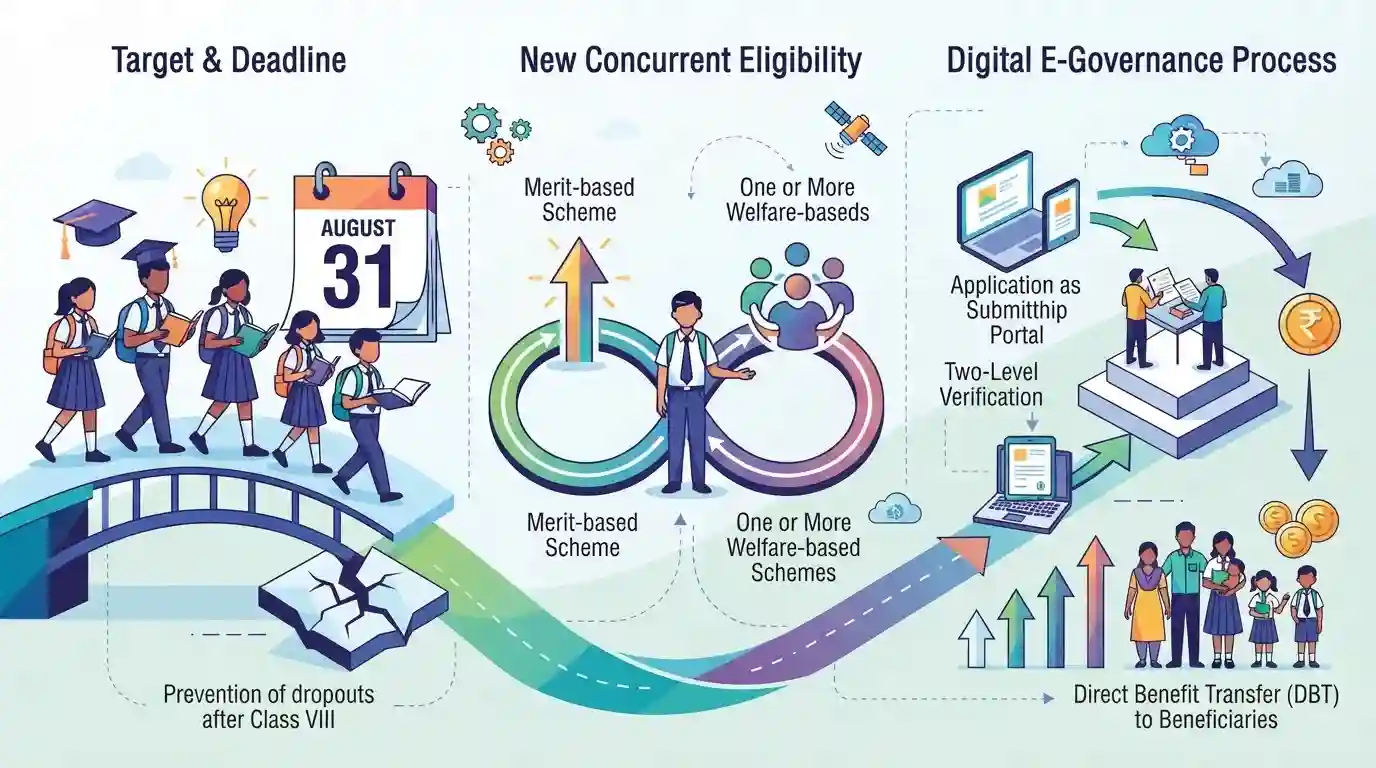
The Ministry of Education has announced that the application deadline for the National Means-cum-Merit Scholarship Scheme (NMMSS) for the 2026-27 academic year is August 31, 2026. This Central Sector Scheme awards one lakh scholarships annually to meritorious students from economically weaker sections to prevent dropouts after Class VIII. For the first time, starting in 2026-27, eligible students are allowed to apply concurrently for one merit-based scheme and one or more welfare-based schemes. The entire process, from application to two-level verification, is handled digitally through the National Scholarship Portal, with funds transferred directly to beneficiaries via Direct Benefit Transfer.
ముఖ్య అంశాలు
- The National Means-cum-Merit Scholarship Scheme (NMMSS) provides one lakh fresh scholarships annually to meritorious students from economically weaker sections entering Class IX.
- The scheme's primary objective is to arrest the dropout rate at the secondary education level (Class VIII to XII) for vulnerable students.
- A significant policy update for the academic year 2026-27 allows students to apply for one merit-based scholarship alongside one or more welfare-based scholarship schemes.
- Scholarships are disbursed directly into bank accounts via Direct Benefit Transfer (DBT) using the Public Financial Management System (PFMS) following a two-tier verification process on the National Scholarship Portal (NSP).
ముఖ్యమైన పదాలు
National Means-cum-Merit Scholarship Scheme (NMMSS)

A Central Sector Scheme launched in 2008 by the Ministry of Education to award 1 lakh annual scholarships of ₹12,000 to meritorious EWS students, aiming to arrest school dropouts after Class VIII.
UPSC context
GS Paper II: Social Sector/Education; tests student welfare policies, equity in education, and dropout reduction strategies.
National Scholarship Portal (NSP)
A digitized one-stop portal under the National e-Governance Plan that simplifies, verifies, and automates the application and disbursement of central and state scholarships directly to students.
UPSC context
GS Paper II: E-governance; tests digital delivery models, transparency in public administration, and eradication of middlemen.
Direct Benefit Transfer (DBT)
A major governance reform launched in 2013 that directly transfers subsidies, scholarships, and social benefits into beneficiaries' bank accounts, leveraging the JAM Trinity to plug leakages.
UPSC context
GS Paper III: Indian Economy/Inclusive Growth; tests fiscal accountability, administrative efficiency, and technology-driven social welfare distribution.
Public Financial Management System (PFMS)
A web-based application developed by the Controller General of Accounts for real-time fund tracking, expenditure accounting, and managing secure Direct Benefit Transfer payments across ministries.
UPSC context
GS Paper III: Public Finance/GS Paper II: Governance; tests fiscal transparency, tracking of public expenditure, and administrative efficiency.
ప్రిలిమ్స్ ఉచ్చు
Students from all government schools, including Kendriya Vidyalayas and Jawahar Navodaya Vidyalayas, are eligible for NMMSS.
NMMSS specifically excludes KVS, JNV, Sainik, and private schools because these institutions already provide heavily subsidized or fully residential education to their students.
అనుసంధానమైన స్థిర భావనలు
What distinguishes a Central Sector Scheme from a Centrally Sponsored Scheme?
- Funding: Central Sector Schemes are 100% funded by the Union government, whereas Centrally Sponsored Schemes have a shared funding ratio between the Centre and States.
- Implementation: Central Sector Schemes are typically implemented directly by Central Ministries/agencies, while Centrally Sponsored Schemes are implemented by State Governments.
What is the Public Financial Management System (PFMS)?
- Administration: It is a web-based online software application developed and implemented by the Controller General of Accounts (CGA) under the Ministry of Finance.
- Core Function: It tracks fund releases across government schemes and ensures end-to-end Direct Benefit Transfers (DBT) directly into verified beneficiary bank accounts.
అంతర-అంశ నమూనాలు
Unbundling Merit and Welfare
The 2026 shift allowing simultaneous merit and welfare scholarships reflects a broader governance trend toward comprehensive social security, moving away from restrictive single-benefit rules.
PFMS as the DBT backbone
Like PM-KISAN and MGNREGA, digitizing education welfare via PFMS curtails ghost beneficiaries, making e-governance leakage-prevention a recurrent UPSC theme across sectors.

A 2026 prelims statement will likely test NMMSS exclusions (KVs/JNVs) and the new concurrent dual-scholarship (merit + welfare) rule.
అనుసంధాన PYQలు · 2
అనుసంధాన PYQలు · 2
- 2020MainsGS2
National Education Policy 2020 is in conformity with the Sustainable Development Goal-4 (2030). It intends to restructure and reorient education system in India. Critically examine the statement.
- 2019MainsGS2
Performance of welfare schemes that are implemented for vulnerable sections is not so effective due to absence of their awareness and active involvement at all stages of policy process. Discuss.
