GOBARdhan Scheme Overhauled into National Circular Bioenergy Scheme
Source:PIB ↗
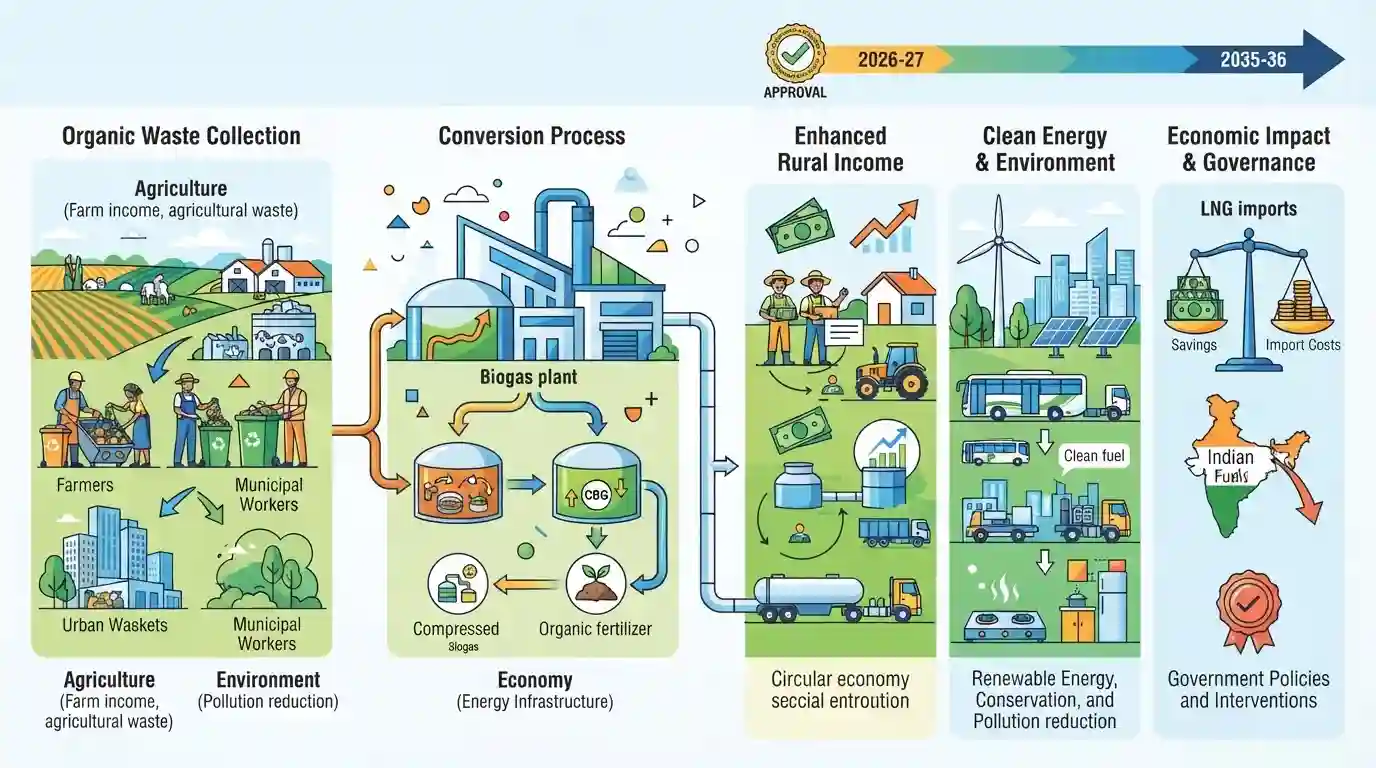
આ શા માટે મહત્વનું છે
Highlights India's strategic push towards energy security, circular economy, and waste management. It serves as a prime example of multi-sectoral integration, combining rural development (Swachh Bharat) with national energy goals (SATAT, CBG) and forex savings.
સારાંશ
The Union Cabinet has approved the GOBARdhan scheme, now consolidated as the National Circular Bioenergy Scheme under the Ministry of Petroleum and Natural Gas, with a massive outlay of ₹23,731 crore for FY 2026-27 to FY 2035-36. Aimed at transforming India's organic waste into clean energy, the scheme introduces six key components: assured CBG offtake, stable pricing at ₹105/kg, capital assistance, pipeline infrastructure, credit guarantee support for MSMEs, and a CBG Ecosystem Challenge Fund. The initiative will boost domestic Compressed Biogas (CBG) production tenfold, enhance rural incomes through a circular bioeconomy, and save over ₹40,000 crore in foreign exchange by lowering LNG imports.
મુખ્ય મુદ્દા
- The ₹23,731 crore GOBARdhan scheme is now centralized under the Ministry of Petroleum and Natural Gas to unify the Compressed Biogas (CBG) ecosystem.
- Features a stable CBG pricing framework of ₹105 per kilogram and guaranteed offtake obligations for City Gas Distribution networks (starting at 3% in FY27).
- Extends capital assistance up to ₹2 crore per ton per day of installed CBG capacity and offers 85% credit guarantee coverage for eligible MSME loans.
- Expected to displace 10 MMT of fossil fuel use, save over ₹40,000 crore in forex, and create 1.5 lakh jobs across the rural bioeconomy value chain.
- The scheme shifts agricultural residue and cattle dung into a 'waste-to-wealth' economic model, significantly mitigating greenhouse gas emissions.
મહત્વપૂર્ણ શબ્દો
GOBARdhan

Galvanizing Organic Bio-Agro Resources Dhan, consolidated as the National Circular Bioenergy Scheme, is India's unified framework to convert organic waste into Compressed Biogas (CBG) and organic manure, fostering a circular bioeconomy.
UPSC context
GS Paper III (Energy, Environment, Agriculture). Tests waste-to-wealth policies, clean energy transitions, and rural income diversification.
SATAT Initiative
Sustainable Alternative Towards Affordable Transportation is a flagship initiative of the Ministry of Petroleum and Natural Gas (MoPNG) to promote the production and automotive/industrial utilization of Compressed Biogas (CBG).
UPSC context
GS Paper III (Infrastructure, Energy, Environment). Tests knowledge of clean transport fuels, import substitution, and bioenergy models.
National Bioenergy Programme
A flagship scheme of the Ministry of New and Renewable Energy (MNRE) supporting bioenergy project setup (biomass power, waste-to-energy, and biogas) through Central Financial Assistance to reduce fossil fuel dependence.
UPSC context
GS Paper III (Energy, Science & Technology). Relates to renewable energy targets, climate change mitigation, and net-zero emissions.
Market Development Assistance (MDA) Scheme
A scheme under the Ministry of Chemicals and Fertilizers providing financial assistance of ₹1,500/MT on the sale of organic fertilizers (like Fermented Organic Manure) produced from GOBARdhan-registered biogas plants.
UPSC context
GS Paper III (Agriculture, Environment). Tests sustainable farming policies, balanced fertilizer usage, and organic waste commercialization.
Biomass Aggregation Machinery (BAM) Scheme
A MoPNG-administered financial assistance scheme supporting Compressed Biogas (CBG) producers with subsidies up to ₹9 crore per project for acquiring machinery to harvest and aggregate crop residues.
UPSC context
GS Paper III (Agriculture, Infrastructure). Focuses on agricultural residue management, stubble burning, and supply-chain solutions.
Development of Pipeline Infrastructure (DPI) Scheme
A central scheme providing financial support to connect Compressed Biogas (CBG) plants to City Gas Distribution (CGD) networks via pipelines, reducing transportation costs and avoiding gas flaring.
UPSC context
GS Paper III (Infrastructure, Energy). Evaluates energy grid integration, transportation infrastructure bottlenecks, and clean energy distribution networks.
પ્રિલિમ્સ ટ્રેપ
GOBARdhan scheme is administered by the Ministry of Jal Shakti.
While originally launched under Jal Shakti (SBM-G), it is now restructured and consolidated as the National Circular Bioenergy Scheme under the Ministry of Petroleum and Natural Gas.
સંલગ્ન સ્થિર ખ્યાલો
What is Compressed Biogas (CBG) and its primary composition?
- Production: Produced via the anaerobic digestion of biomass sources like agricultural waste, cattle dung, and municipal solid waste.
- Purification: Raw biogas is purified to remove hydrogen sulphide (H2S), carbon dioxide (CO2), and water vapor.
- Composition: Purified CBG contains over 90% Methane, giving it a calorific value and properties highly similar to commercial Compressed Natural Gas (CNG).
How does an Administered Pricing Mechanism (APM) function in India's energy sector?
- Definition: A government-dictated pricing framework historically applied to domestic natural gas to shield vital sectors from global market volatility.
- Investment Utility: For CBG, setting a fixed APM provides long-term revenue predictability (minimum 10 years), guaranteeing returns to attract private and MSME investments.
આંતર-વિષય પેટર્ન
Stubble burning meets energy security
Monetizing crop residue for CBG production converts a severe pollution source (North Indian stubble burning) into an import-substitution asset, directly linking air quality management with forex savings.
Organic manure & fertilizer subsidies
CBG production yields Fermented Organic Manure (FOM). Promoting FOM reduces dependence on imported chemical fertilizers, aiding the Department of Fertilizers in trimming the national fertilizer subsidy bill.

Expect a prelims statement mixing GOBARdhan's shift to MoPNG with the mandatory CBG blending targets for City Gas Distribution networks.
સંલગ્ન PYQ · 3
સંલગ્ન PYQ · 3
- 2018MainsGS3
“Access to affordable, reliable, sustainable and modern energy is the sine qua non to achieve Sustainable Development Goals (SDGs).” Comment on the progress made in India in this regard.
- 2025PrelimsGS1
Consider the following statements : Statement I: Circular economy reduces the emissions of greenhouse gases. Statement II: Circular economy reduces the use of raw materials as inputs. Statement III : Circular economy reduces wastage in the production process. Which one of the following is correct in respect of the above statements?
- 2019MainsGS3
Define the concept of carrying capacity of an ecosystem as relevant to an environment. Explain how understanding this concept is vital while planning for sustainable development of a region.
