Strategic Forces Command successful test launch of Agni 4 missile
Source:PIB ↗
Why It Matters
The operational validation of Agni-4 is crucial for India's nuclear triad and strategic posture. For the UPSC exam, understanding the classification of missiles (ballistic vs. cruise), propellants (solid vs. liquid), and the role of the Strategic Forces Command (SFC) is highly relevant for both GS Prelims and Mains (S&T and Internal Security).
Summary
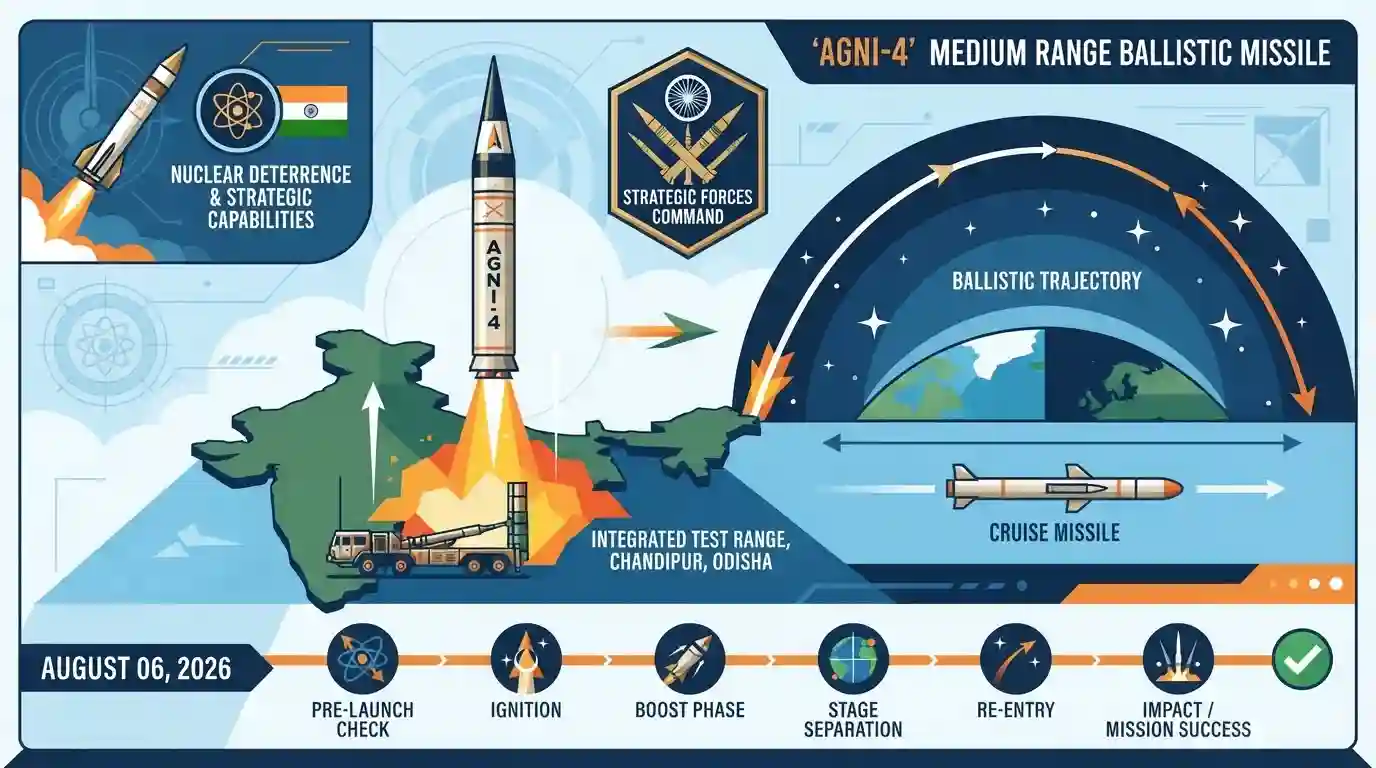
India successfully test-fired the 'Agni-4' Medium Range Ballistic Missile from the Integrated Test Range in Chandipur, Odisha, on August 06, 2026. Conducted under the Strategic Forces Command, the test validated all operational and technical parameters, strengthening the nation's nuclear deterrence and strategic capabilities.
Key Points
- India successfully test-fired the 'Agni-4' ballistic missile from the Integrated Test Range (ITR) in Chandipur, Odisha, on August 06, 2026.
- The launch successfully validated all operational and technical parameters under the aegis of the Strategic Forces Command (SFC).
- Agni-4 is a strategic surface-to-surface ballistic missile with a range of around 4,000 km, featuring a two-stage solid propellant engine.
- This test reaffirms India's credible minimum deterrence posture and ensures the high reliability of its strategic nuclear second-strike capabilities.
Important Terms
Strategic Forces Command

A joint, tri-service command of the Indian Armed Forces established in 2003, responsible for managing, administering, and operationalizing India's tactical and strategic nuclear weapons stockpile under the Nuclear Command Authority.
UPSC context
GS Paper III (Security & Defense). Tests understanding of India's strategic command structure, nuclear deterrence capabilities, and tri-service integration.
Integrated Guided Missile Development Programme (IGMDP)
India's indigenous missile development initiative launched in 1983 under Dr. A.P.J. Abdul Kalam, aimed at achieving self-reliance in guided missile technology, resulting in Agni, Prithvi, Akash, Trishul, and Nag systems.
UPSC context
GS Paper III (Science & Technology). Tests knowledge of India's historical milestones in defense indigenization, strategic autonomy, and indigenous weaponry programs.
Nuclear Command Authority (NCA)
The apex constitutional and administrative body responsible for command, control, and operational decisions regarding India's nuclear weapons stockpile. It consists of a Political Council (headed by the PM) and an Executive Council.
UPSC context
GS Paper III (Security) & Paper II (Governance). Tests understanding of civilian control over the military, strategic deterrence, and nuclear command structure.
Integrated Test Range (ITR)
A state-of-the-art missile testing and evaluation facility operated by the DRDO along the Odisha coast, comprising complexes at Chandipur and Dr. APJ Abdul Kalam Island to track and validate missile flights.
UPSC context
GS Paper III (Science & Technology). Tests knowledge of national defense infrastructure, test range locations, and experimental testing facilities.
Ballistic Missile
A rocket-propelled strategic weapon that follows a high-arching, unpowered projectile trajectory (governed by gravity and air resistance) to deliver single or multiple warheads to a distant target.
UPSC context
GS Paper III (Science & Technology). Tests ability to classify defense systems, comparing ballistic versus cruise missiles and their respective trajectories.
Prelims Trap
"Agni-IV uses a mix of solid and liquid propellants and is classified as an Intercontinental Ballistic Missile (ICBM)."
Agni-IV is an Intermediate-Range Ballistic Missile (3,500-4,000 km, not >5,500 km for ICBMs) and is powered entirely by a two-stage solid propellant motor.
Static Concepts Connected
What are the key differences between Ballistic and Cruise missiles?
- Propulsion & Trajectory: Ballistic missiles are rocket-powered only during the initial phase, following an unguided parabolic trajectory. Cruise missiles are jet-propelled and powered throughout their flight.
- Atmospheric Flight: Ballistic missiles exit the Earth's atmosphere and re-enter. Cruise missiles remain within the atmosphere, flying at lower altitudes to evade radar.
- Examples: Agni and Prithvi are ballistic. BrahMos and Nirbhay are cruise missiles.
How is India's Nuclear Command Authority (NCA) structured?
- Political Council: Headed by the Prime Minister. It is the sole body authorized to order a nuclear strike.
- Executive Council: Headed by the National Security Advisor (NSA). It provides inputs for decision-making and executes directives given by the Political Council.
- Strategic Forces Command (SFC): A tri-service military command that manages and administers the strategic nuclear weapons stockpile and executes the actual launch.
Cross-Topic Patterns
Missile tech + Nuclear Doctrine
Agni-IV's mobile, solid-fueled nature ensures quick reaction times, directly reinforcing India's 'No First Use' policy by guaranteeing a survivable and robust second-strike capability.
Solid propellants vs ISRO rockets
Military missiles prioritize solid propellants for prolonged storage and rapid deployment. Conversely, ISRO's civilian launch vehicles utilize liquid/cryogenic stages for better specific impulse and precise thrust control.

Expect a prelims question contrasting Agni-IV's solid propellant and ballistic trajectory against BrahMos' ramjet cruise capabilities.
Linked PYQs · 2
Linked PYQs · 2
- 2014PrelimsGS1
With reference to Agni-IV Missile, which of the following statements is/are correct? 1. It is a surface-to-surface missile. 2. It is fuelled by liquid propellant only. 3. It can deliver one-tonne nuclear warheads about 7500 km away. Select the correct answer using the code given below.
- 2023PrelimsGS1
Consider the following statements: 1. Ballistic missiles are jet-propelled at subsonic speeds throughout their flights, while cruise missiles are rocket-powered only in the initial phase of flight. 2. Agni-V is a medium-range supersonic cruise missile, while BrahMos is a solid-fuelled intercontinental ballistic missile. Which of the statements given above is/are correct?
