Namo Bharat regional rapid transit system infrastructure development
Source:PIB ↗
ఇది ఎందుకు ముఖ్యం
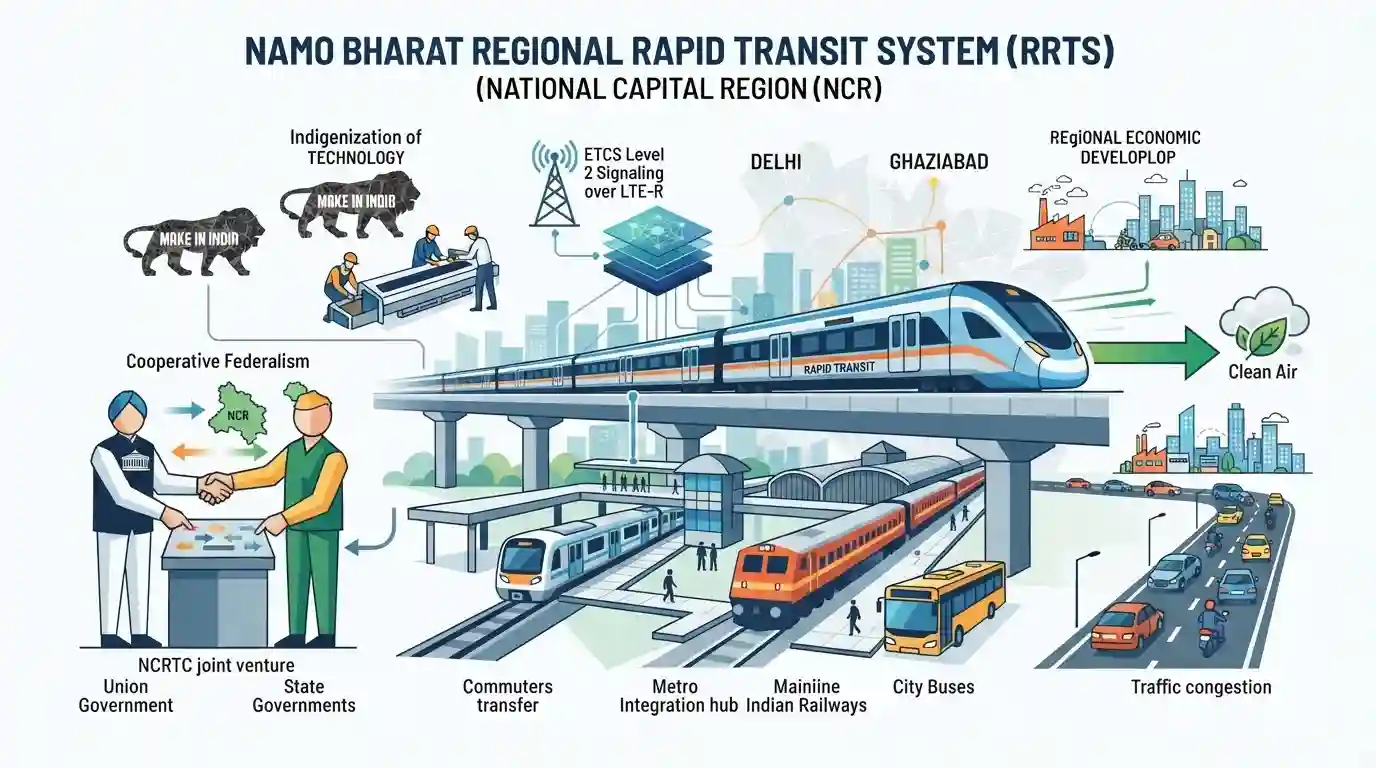
RRTS is a flagship infrastructure development that highlights modern urban transport solutions, cooperative federalism through inter-state joint ventures, and technological advancement under Make in India, all critical areas for GS2 and GS3 syllabus.
సారాంశం
The Namo Bharat Regional Rapid Transit System (RRTS) represents a transformative milestone in India's urban transport infrastructure, aimed at revolutionizing regional mobility in the National Capital Region (NCR). Implemented by the National Capital Region Transport Corporation (NCRTC)—a joint venture exemplifying cooperative federalism between the Centre and multiple states—the system bridges critical transit gaps. The flagship Delhi-Ghaziabad-Meerut corridor showcases indigenous 'Make in India' manufacturing through its state-of-the-art trainsets and introduces the advanced ETCS Level 2 signalling system over an LTE-R network globally. Focused on multi-modal integration, the RRTS links with metro lines, railway stations, and bus depots to provide a seamless commuter experience. The project serves broader goals of accelerating regional economic development, decongesting the national capital, and offering a sustainable, lower-emission alternative to private vehicular transport.
ముఖ్య అంశాలు
- The Namo Bharat Regional Rapid Transit System (RRTS) is a semi-high-speed commuter rail network designed to enhance regional connectivity across the National Capital Region (NCR).
- The flagship Delhi-Ghaziabad-Meerut corridor spans 82 km, significantly reducing travel time and easing congestion.
- The project is implemented by NCRTC, a joint venture between the Government of India and the states of Delhi, Haryana, Rajasthan, and Uttar Pradesh, serving as a model of cooperative federalism.
- The 'Namo Bharat' trainsets are manufactured indigenously in Savli, Gujarat, advancing the 'Make in India' initiative.
- The RRTS employs globally pioneering technologies such as ETCS Level 2 signalling over an LTE-R network, ensuring safe and high-frequency operations.
- Multi-modal integration is a key feature, with stations seamlessly connecting to local Metro networks, inter-state bus terminals (ISBTs), and Indian Railway stations.
ముఖ్యమైన పదాలు
National Capital Region Transport Corporation (NCRTC)

A joint venture company of the Centre (MoHUA and Railways) and states (Delhi, Haryana, Rajasthan, UP), mandated to design, construct, and operate the Regional Rapid Transit System networks across the NCR.
UPSC context
Tests knowledge of cooperative federalism, urban infrastructure bodies, and multi-state joint ventures under GS Papers 2 and 3.
PM Gati Shakti
A National Master Plan for multi-modal connectivity aiming to integrate infrastructure planning. In the RRTS, it ensures seamless integration with metros, railways, and bus depots, breaking departmental silos to enhance mobility.
UPSC context
Highly relevant for GS Paper 3 (Infrastructure). Tests the understanding of integrated planning and multi-modal transport strategies.
National Urban Transport Policy
A policy framework prioritizing the movement of people over vehicles. It advocates for investments in high-capacity public transport, integrated land use, and non-motorized transport to achieve sustainable, decongested urban mobility.
UPSC context
Essential for GS Paper 1 and 3 (Urbanization, Infrastructure). Tests sustainable urban planning and mobility frameworks.
Make in India
A flagship government initiative aimed at boosting domestic manufacturing. The RRTS project exemplifies this, with 100% of its trainsets and advanced track technologies being indigenously produced, fostering national self-reliance.
UPSC context
Crucial for GS Paper 3 (Economic Development, Indigenization of Technology), testing national manufacturing policies and self-reliance.
Ministry of Housing and Urban Affairs (MoHUA)
The nodal central ministry responsible for urban transport policies and smart city initiatives. It holds a significant equity stake alongside the Ministry of Railways and state governments in the NCRTC joint venture.
UPSC context
Relevant for GS Paper 2 (Governance). Tests knowledge of the administrative structure and ministerial responsibilities in urban mass transit.
Alstom
A multinational rolling stock manufacturer that designed and built the 100% indigenous Namo Bharat trainsets and deployed the world's first ETCS Level 2 over LTE-R signalling system for the RRTS.
UPSC context
Relevant for GS Paper 3 (Infrastructure, Technology), illustrating private sector participation and foreign tech-transfer in domestic manufacturing.
ప్రిలిమ్స్ ఉచ్చు
The Namo Bharat RRTS is legally governed and operated under the Indian Railways Act of 1989.
Despite functioning as a high-speed regional rail, the RRTS is legally executed under the Metro Railways Acts of 1978 and 2002.
అనుసంధానమైన స్థిర భావనలు
What are the levels of the European Train Control System (ETCS)?
- Level 1: Uses trackside spot beacons (balises) to transmit signaling information to the train cabin intermittently.
- Level 2: Utilizes continuous radio communication (GSM-R or LTE-R) to transmit signals; physical track-circuits still monitor track occupancy.
- Level 3 (Hybrid): Replaces physical trackside detection with train-based self-location (moving/virtual blocks), significantly increasing track capacity.
How is cooperative federalism structured in urban transit joint ventures?
- Equity sharing: The Union and participating states share equity (typically 50:50) to co-fund capital-intensive projects and share financial risks.
- Inter-state coordination: Special Purpose Vehicles (SPVs) like NCRTC facilitate cross-border land acquisition and unified regulatory approvals across state boundaries.
అంతర-అంశ నమూనాలు
Transit-Oriented Development & Sprawl
RRTS enables high-density, low-carbon corridor development, directly addressing GS-1 urbanization challenges and GS-3 climate mitigation goals.
Make in India & Tech Sovereignty
Shifting high-tech rail design and manufacturing to domestic hubs showcases tech transfer and import substitution under GS-3 manufacturing goals.

Questions on modern transport will likely test the technological distinction between Kavach (indigenous) and ETCS systems used in RRTS.
అనుసంధాన PYQలు · 3
అనుసంధాన PYQలు · 3
- 2021MainsGS3
“Investment in infrastructure is essential for more rapid and inclusive economic growth.” Discuss in the light of India's experience.
- 2022MainsGS3
Why is Public Private Partnership (PPP) required in infrastructural projects ? Examine the role of PPP model in the redevelopment of Railway Stations in India.
- 2015MainsGS2
The concept of cooperative federalism has been increasingly emphasized in recent years. Highlight the drawbacks in the existing structure and the extent to which cooperative federalism would answer the shortcomings.
