Regulatory Framework and Water Use Norms for AI Data Centres
Source:PIB ↗
কেন এটি গুরুত্বপূর্ণ
With the explosive growth of AI, data centres are becoming major consumers of energy and water resources. Understanding how existing environmental frameworks (like EIA, Water Act) and new guidelines (BEE District Cooling) apply to this modern infrastructure is crucial for questions on sustainable development, ecological impact of new technologies, and water security.
সারসংক্ষেপ
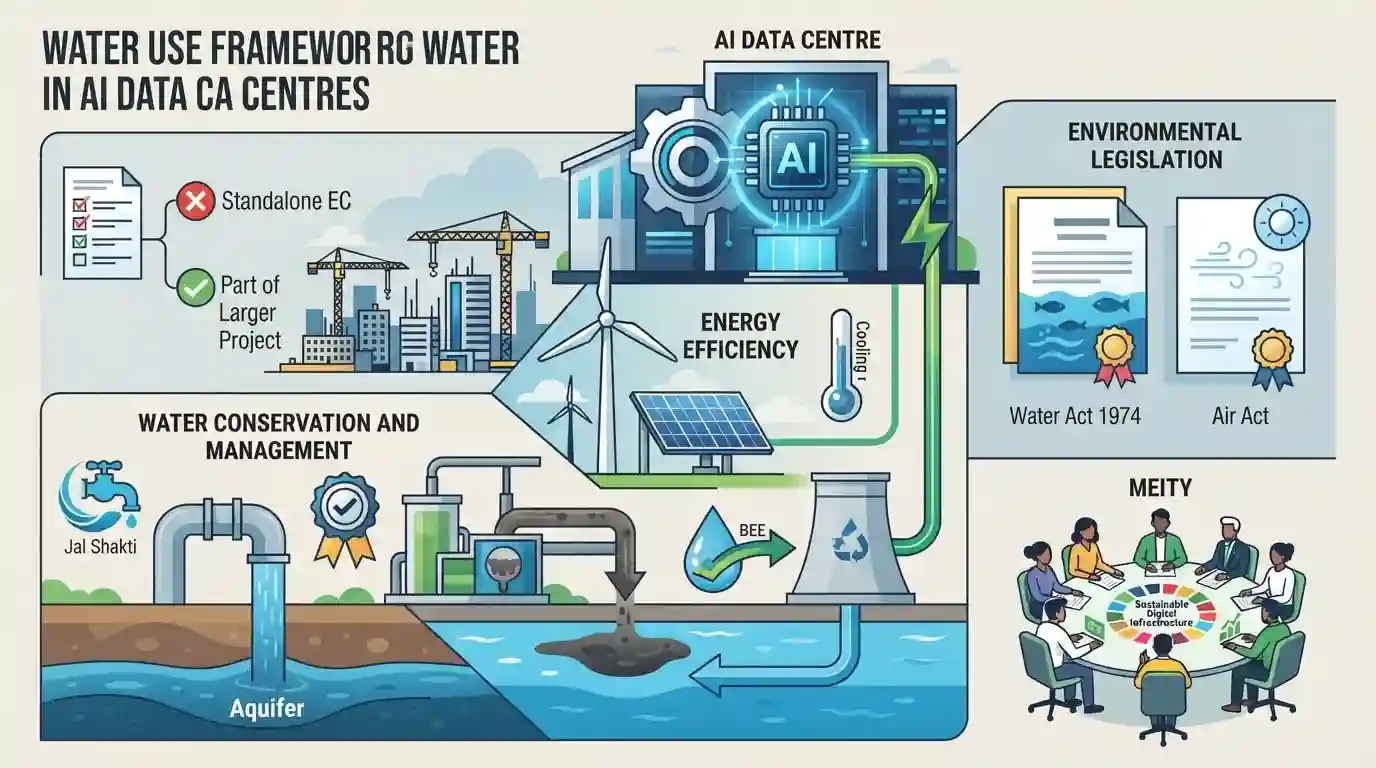
The Ministry of Environment, Forest and Climate Change clarified the regulatory framework for water use in AI Data Centres. While these centres do not need standalone Environmental Clearance (EC) under the EIA Notification 2006, they do if part of a larger construction project. Water discharge is governed by the Water Act of 1974, and groundwater use is strictly regulated by the Jal Shakti Ministry. To address the massive cooling requirements of data centres, the BEE's District Cooling Guidelines, 2023 recommend utilizing treated wastewater instead of fresh water. Additionally, MeitY is focusing on sustainable digital infrastructure through a dedicated working group.
মূল বিষয়
- Standalone AI Data Centres do not require Environmental Clearance (EC) under the EIA Notification 2006 as they are not listed in its schedule.
- Data Centres require EC from SEIAA if proposed as part of a larger Building and Construction Project (> 20,000 sq.m) or Township and Area Development Project.
- Water usage and discharge during construction and operation are regulated under the Water (Prevention and Control of Pollution) Act, 1974, monitored by SPCBs or PCCs.
- Groundwater extraction is regulated under the Ministry of Jal Shakti guidelines, requiring No Objection Certificates (NOC).
- The Bureau of Energy Efficiency (BEE) issued District Cooling Guidelines, 2023, recommending the use of treated water as make-up water in cooling towers to reduce freshwater consumption.
- A working group on 'Resilience, Innovation & Efficiency' has been set up by MeitY to explore energy and water management in AI digital infrastructure.
গুরুত্বপূর্ণ শব্দ
District Cooling Guidelines, 2023

Issued by the Bureau of Energy Efficiency, these guidelines promote sustainable cooling practices—such as using treated wastewater in cooling towers—to reduce freshwater dependence and energy intensity in large cooling facilities like data centres.
UPSC context
GS-3 (Environment/Energy). Relevant to sustainable infrastructure, urban planning, and energy efficiency policies in India.
EIA Notification 2006
A framework under the Environment (Protection) Act, 1986, mandating prior environmental clearance for specified projects. It categorises projects into A (Central clearance) and B (State clearance) based on scale and potential environmental impact.
UPSC context
GS-3 (Environment). Crucial for understanding regulatory frameworks for infrastructure, industrial development, and environmental clearances.
Water (Prevention and Control of Pollution) Act, 1974
India's foundational water pollution law that established the Central and State Pollution Control Boards. It requires industries and commercial entities to obtain 'consent to establish' and 'consent to operate' before discharging effluents.
UPSC context
GS-3 (Environment). Core legislation for water conservation, industrial compliance, and pollution regulation in India.
Bureau of Energy Efficiency (BEE)
A statutory body under the Ministry of Power, established under the Energy Conservation Act, 2001. It formulates policies and programmes, such as standards and labelling, to reduce the energy intensity of the economy.
UPSC context
GS-3 (Infrastructure/Energy). Important for topics on energy conservation mandates, efficiency labelling, and climate change mitigation.
State Pollution Control Board (SPCB)
Statutory bodies constituted under the Water Act, 1974, responsible for implementing environmental laws at the state level. They monitor compliance, enforce effluent standards, and issue operational consents to industries and facilities.
UPSC context
GS-3 (Environment). Key to understanding decentralized environmental governance, compliance mechanisms, and localized pollution control.
প্রিলিমস ফাঁদ
Standalone AI Data Centres mandatorily require Environmental Clearance (EC) under the EIA Notification 2006.
Data centres are not explicitly listed in the EIA schedule. They only need EC (from SEIAA, not MoEFCC) if part of a broader construction project exceeding 20,000 sq.m.
সংযুক্ত স্থির ধারণা
What are the clearance categories under the EIA Notification 2006?
- Category A: Appraised at the national level by MoEFCC on recommendations of the Expert Appraisal Committee (EAC). Includes major projects like nuclear power and large mining.
- Category B: Appraised at the state level by SEIAA. Further divided into B1 (requires EIA report) and B2 (exempted from preparing EIA report).
What is the statutory backing and mandate of the Central Ground Water Authority (CGWA)?
- Statutory Backing: Constituted under Section 3(3) of the Environment (Protection) Act, 1986. It is a classic trap to associate it with the Water Act.
- Mandate: Regulates and controls groundwater development and management across India, including granting No Objection Certificates (NOC) for industrial and infrastructure extraction.
আন্তঃবিষয় প্যাটার্ন
AI's Water Footprint & Urban Water Stress
AI server cooling demands massive freshwater, directly compounding urban water crises in IT hubs like Bengaluru and Chennai, linking digital infrastructure growth to geographical water stress.
BEE's shift to the Energy-Water Nexus
Traditionally focused on power savings, BEE (under Energy Conservation Act) is now bridging the energy-water nexus by mandating treated wastewater in cooling towers via its 2023 District Cooling Guidelines.

Expect a 2026 prelims statement mixing CGWA's parent act (EPA 1986) with the specific EIA 2006 exemptions for standalone AI Data Centres.
সংযুক্ত PYQ · 4
সংযুক্ত PYQ · 4
- 2022PrelimsGS1
Which one of the following has been constituted under the Environment (Protection) Act, 1986?
- 2020MainsGS3
How does the draft Environment Impact Assessment (EIA) Notification, 2020 differ from the existing EIA Notification, 2006?
- 2024MainsGS3
What role do environmental NGOs and activists play in influencing Environmental Impact Assessment (EIA) outcomes for major projects in India? Cite four examples with all important details.
- 2014MainsGS3
Environmental Impact Assessment studies are increasingly undertaken before a project is cleared by the Government. Discuss the environmental impacts of coal-fired thermal plants located at coal pitheads.
