India Denies Concessions on US Ethanol Imports for Fuel Blending
Source:PIB ↗
কেন এটি গুরুত্বপূর্ণ
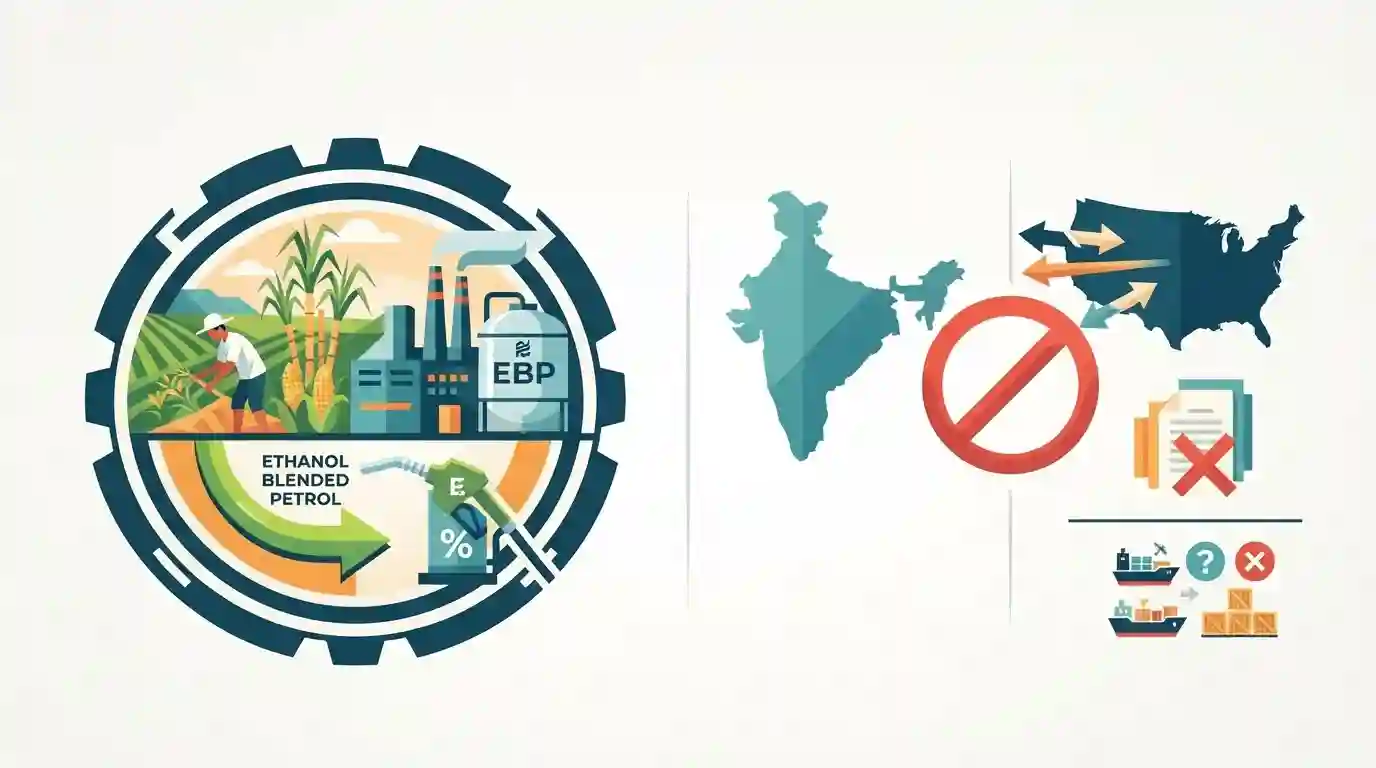
This clarification underscores the strategic intersection of India's agricultural policy, energy security, and international trade. By restricting biofuel imports, India protects domestic sugarcane and grain farmers, preserves valuable foreign exchange, and advances domestic self-reliance (Atmanirbhar Bharat) despite trade pressure from the US, which is the world's largest producer of corn-based ethanol.
সারসংক্ষেপ
The Ministry of Commerce and Industry clarified that India has made no commitments or concessions to import ethanol from the United States for fuel blending, reiterating that all ethanol for the Ethanol Blended with Petrol (EBP) Programme is sourced entirely from domestic producers under India's national biofuel policies.
মূল বিষয়
- The Ministry of Commerce and Industry clarified that media claims regarding India intending to import large quantities of ethanol from the United States for fuel blending are completely baseless and incorrect.
- Under India's domestic policy framework, all ethanol utilized for the Ethanol Blended with Petrol (EBP) Programme must be sourced entirely from domestic producers.
- India has made no concessions or commitments during India-US bilateral trade discussions to permit or promote the import of US-produced ethanol for fuel blending.
- The United States is the world's largest producer of ethanol, primarily using corn as its feedstock, and has continuously sought market access in India; however, India maintains import restrictions on fuel-grade biofuels to protect domestic farmers and boost domestic agro-industries.
- India's biofuel procurement and EBP targets (such as achieving 20% ethanol blending, or E20, by 2025-26) remain governed solely by domestic raw materials like sugarcane, heavy molasses, and damaged food grains to support domestic agricultural value chains.
গুরুত্বপূর্ণ শব্দ
Ethanol Blended with Petrol (EBP) Programme

A government initiative aiming to blend ethanol (targeting 20% by 2025-26) with petrol. It reduces crude oil imports, cuts carbon emissions, and provides alternative revenue streams for farmers by utilizing domestic agricultural feedstocks.
UPSC context
GS-3 (Energy, Environment). Crucial for questions on energy security, agricultural diversification, and emission mitigation strategies.
National Policy on Biofuels
A 2018 policy framework designed to mainstream biofuels. It categorizes biofuels (1G, 2G, 3G) and permits ethanol production from sugarcane, damaged food grains, and surplus crops to reduce fossil fuel dependency and promote rural development.
UPSC context
GS-3 (Environment). Tests knowledge of renewable energy transitions, waste-to-wealth initiatives, and India's strategy for achieving climate targets.
Ministry of Commerce and Industry
A key Government of India ministry responsible for formulating foreign trade policies, participating in international trade negotiations, and promoting domestic industrial growth aligned with self-reliance goals like Atmanirbhar Bharat.
UPSC context
GS-2 (International Relations) & GS-3 (Economy). Relevant for understanding India's bilateral trade agreements, market protection, and economic diplomacy.
প্রিলিমস ফাঁদ
India strictly prohibits all imports of denatured ethanol to protect domestic farmers and support the Atmanirbhar Bharat initiative.
India only prohibits ethanol imports for fuel blending. It legally permits the import of denatured ethanol for non-fuel industrial applications like chemicals, beverages, and pharmaceuticals.
সংযুক্ত স্থির ধারণা
What are the permitted feedstocks under the National Policy on Biofuels, 2018?
- Sugarcane derivatives: Includes B-heavy/C-heavy molasses, sugarcane juice, and sugar syrup.
- Damaged food grains: Broken rice, unfit wheat, and rotten potatoes can be utilized.
- Surplus crops: Maize and cassava are allowed, but edible pulses and oilseeds are strictly excluded to protect food security.
How does the Ethanol Blended with Petrol (EBP) Programme function?
- E20 Target: Achieve 20% ethanol blending in petrol (E20) by 2025-26, advanced from the original 2030 deadline.
- Nodal administration: Coordinated by the Ministry of Petroleum and Natural Gas (MoPNG); procurement is done by Oil Marketing Companies (OMCs).
- Administered Pricing: The government fixes remunerative prices for ethanol based on the specific raw material (e.g., higher prices for juice vs. C-heavy molasses).
আন্তঃবিষয় প্যাটার্ন
Ethanol Strategy & WTO Sugarcane Disputes
India's domestic ethanol drive heavily relies on sugarcane, a crop that has triggered WTO disputes where the US and Brazil challenge India's Fair and Remunerative Price (FRP) as trade-distorting subsidies.
Food vs. Fuel Inflation Dynamics
Accelerating the E20 target to 2025-26 increases reliance on maize and damaged rice, sparking a 'food vs. fuel' debate as grain diversion can impact domestic food inflation and PDS stock limits.

EBP feedstocks (allowed vs banned) + dual-use import policy (fuel vs industrial ethanol) likely to form a tough multi-statement 2026 Q.
সংযুক্ত PYQ · 3
সংযুক্ত PYQ · 3
- 2025PrelimsGS1
Consider the following statements : Statement I: Of the two major ethanol producers in the world, i.e., Brazil and the United States of America, the former produces more ethanol than the latter. Statement II: Unlike in the United States of America where corn is the principal feedstock for ethanol production, sugarcane is the principal feedstock for ethanol production in Brazil. Which one of the following is correct in respect of the above statements?
- 2020PrelimsGS1
According to India's National Policy on Biofuels, which of the following can be used as raw materials for the production of biofuels ? 1. Cassava 2. Damaged wheat grains 3. Groundnut seeds 4. Horse gram 5. Rotten potatoes 6. Sugar beet Select the correct answer using the code given below:
- 2019MainsGS2
‘What introduces friction into the ties between India and the United States is that Washington is still unable to find for India a position in its global strategy, which would satisfy India's national self-esteem and ambitions.’ Explain with suitable examples.
