Civil Aviation Ministry Awards Letters of Intent for New FTOs
Source:PIB ↗
কেন এটি গুরুত্বপূর্ণ
The civil aviation sector requires a robust pipeline of skilled human resources (pilots) to match its rapid infrastructure growth. This article covers crucial policy efforts to domesticate pilot training, save foreign exchange, improve regulatory transparency via digital tools, and promote indigenous trainer aircraft.
সারসংক্ষেপ
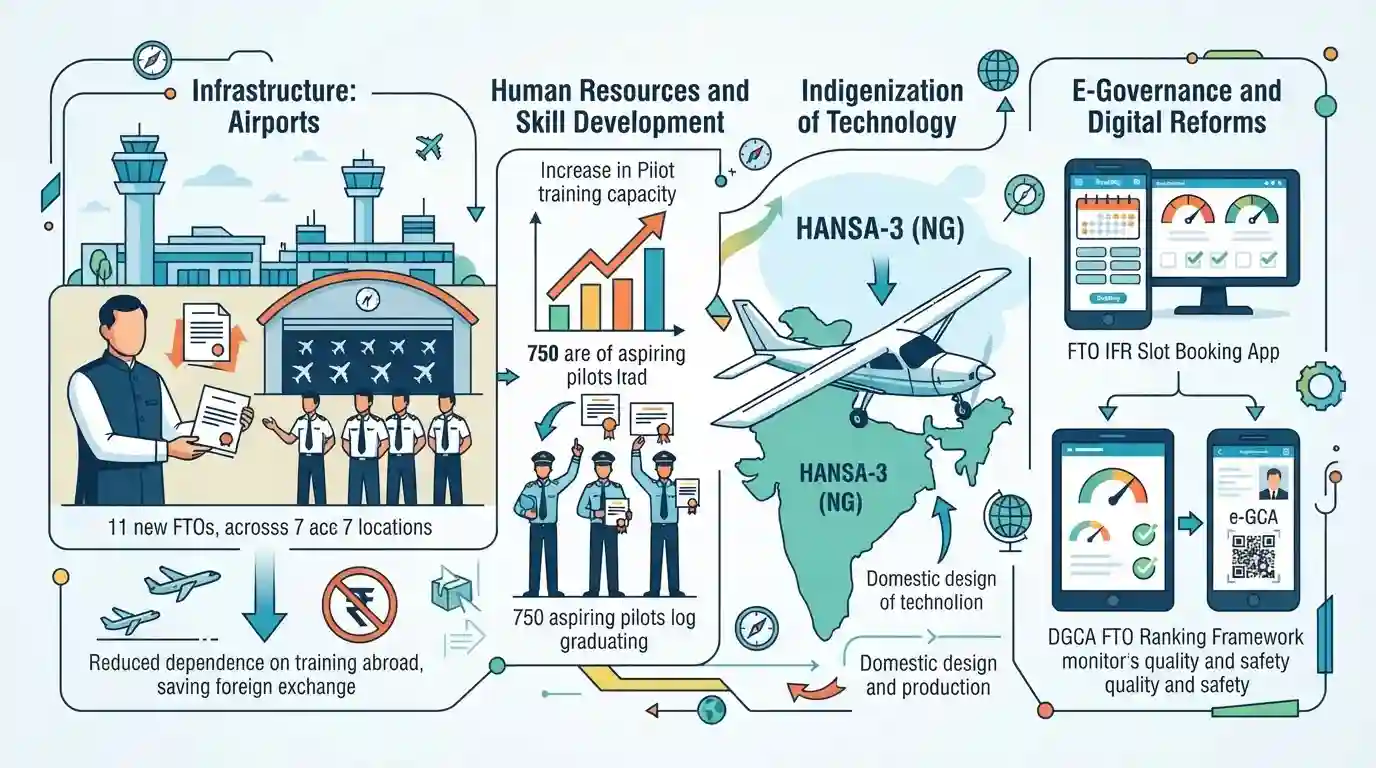
Civil Aviation Minister Ram Mohan Naidu has awarded Letters of Intent for establishing 11 new Flying Training Organisations (FTOs) across seven AAI airports, a significant step toward self-reliance in the aviation sector under the 'Train in India, Fly in India' initiative. This expansion will increase the annual pilot training capacity by up to 750 cadets, helping to mitigate the foreign exchange outflow and high costs associated with training abroad. The Ministry introduced digital and regulatory reforms including the FTO IFR Slot Booking App for efficient resource allocation and an FTO Ranking Framework designed by the DGCA to monitor quality and safety. Further highlighting technological indigenization, the development of the domestic trainer aircraft HANSA-3 (NG) and the issuance of e-licenses (e-GCA) position India as a modernising hub for civil aviation human resource development.
মূল বিষয়
- The Ministry of Civil Aviation awarded Letters of Intent for 11 new Flying Training Organisations (FTOs) across seven AAI airports, boosting pilot training capacity by up to 750 cadets annually.
- The initiative aligns with the 'Train in India, Fly in India' vision, aiming to retain foreign exchange and make domestic pilot training more affordable and accessible.
- To enhance transparency and efficiency, the FTO IFR Slot Booking App was launched alongside a DGCA-designed FTO Ranking Framework to improve training standards and safety.
- India has become the second country globally to issue Electronic Licenses (e-GCA) for pilots.
- The development of the indigenous HANSA-3 (NG) trainer aircraft is being promoted to build self-reliance in aviation training infrastructure.
গুরুত্বপূর্ণ শব্দ
Train in India, Fly in India

A Ministry of Civil Aviation initiative aimed at building a robust, self-reliant domestic pilot training ecosystem, reducing the foreign exchange outflow and costs associated with cadet training abroad.
UPSC context
GS Paper III (Aviation & Skill Development); tests policies promoting self-reliance, local skill acquisition, and service indigenization.
HANSA-3 (NG)
India's first fully indigenous, two-seater, next-generation all-composite trainer aircraft, designed by CSIR-National Aerospace Laboratories (CSIR-NAL) for commercial and private pilot license training.
UPSC context
GS Paper III (Indigenization of Technology); tests understanding of homegrown technology, aviation manufacturing, and import substitution.
e-GCA
An online e-governance platform implemented by the DGCA to automate and digitize services like pilot licensing, medical examinations, and aircraft registration, improving transparency and ease of doing business.
UPSC context
GS Paper II (E-governance); tests understanding of digital transformation in regulatory administration and public service delivery.
FTO Ranking Framework
A bi-annual performance-based evaluation system introduced by the DGCA to rank Flying Training Organisations (FTOs), aimed at improving training standards, transparency, safety, and operational efficiency in India.
UPSC context
GS Paper III (Infrastructure, Regulatory Bodies); tests regulatory oversight mechanisms, transparency in professional education, and safety compliance.
FTO IFR Slot Booking App
A mobile application developed to facilitate digital booking of Instrument Flight Rules (IFR) training slots, providing visibility of available runway/airspace infrastructure at AAI airports.
UPSC context
GS Paper III (Aviation Infrastructure); tests application of mobile-governance and digital resource optimization in civil aviation.
Directorate General of Civil Aviation (DGCA)
The statutory regulatory body under the Ministry of Civil Aviation responsible for formulating and enforcing safety regulations, airworthiness standards, and licensing in India's civil aviation sector.
UPSC context
GS Paper II (Regulatory Bodies); tests knowledge of institutional architecture, safety governance, and international standards alignment.
প্রিলিমস ফাঁদ
India is the first country globally to issue Electronic Personnel Licenses (EPL) for commercial pilots.
India is actually the second country globally, after China, to implement this, conforming to ICAO's Amendment 178 to Annex 1.
সংযুক্ত স্থির ধারণা
What is the statutory and regulatory status of the Directorate General of Civil Aviation (DGCA)?
- Statutory Origin: It gained statutory status under the Aircraft (Amendment) Act, 2020, operating under the Ministry of Civil Aviation.
- Primary Mandate: It regulates civil aviation safety, registers civil aircraft, licenses pilots and maintenance engineers, and enforces airworthiness standards.
- Global Alignment: It acts as the nodal agency to implement standards set by the International Civil Aviation Organization (ICAO).
What is the CSIR-National Aerospace Laboratories (CSIR-NAL)?
- Institutional Status: Established in 1959, it is India’s only government-funded aerospace R&D laboratory under the Council of Scientific and Industrial Research.
- Civil Aviation Focus: Unlike DRDO which focuses on defense, NAL primarily designs and develops small and medium-sized civil aircraft like SARAS and HANSA.
আন্তঃবিষয় প্যাটার্ন
Civil aviation + Forex preservation
Expanding domestic flying schools serves as an import-substitution strategy, preventing substantial capital flight of foreign exchange from cadets training overseas.
Indigenous aerospace + Private manufacturing
The CSIR-NAL partnership with private entities for HANSA-3 (NG) reflects India's evolving technology-transfer model to boost local manufacturing in aerospace.

2026 Prelims may test aviation indigenization (HANSA-3 NG) alongside regulatory reforms like e-GCA and AAI's liberalized FTO policy.
সংযুক্ত PYQ · 1
সংযুক্ত PYQ · 1
- 2017MainsGS3
Examine the development of Airports in India through joint ventures under Public-Private Partnership (PPP) model. What are the challenges faced by the authorities in this regard?
