NITI Aayog Report Outlines Strategies for Empowering Caregivers
Source:PIB ↗
কেন এটি গুরুত্বপূর্ণ
The care economy is emerging as a critical component of social infrastructure and economic growth. Formalizing this sector addresses the double burden on women, provides geriatric care for an aging population, and creates vast employment opportunities, tapping into India's demographic dividend.
সারসংক্ষেপ
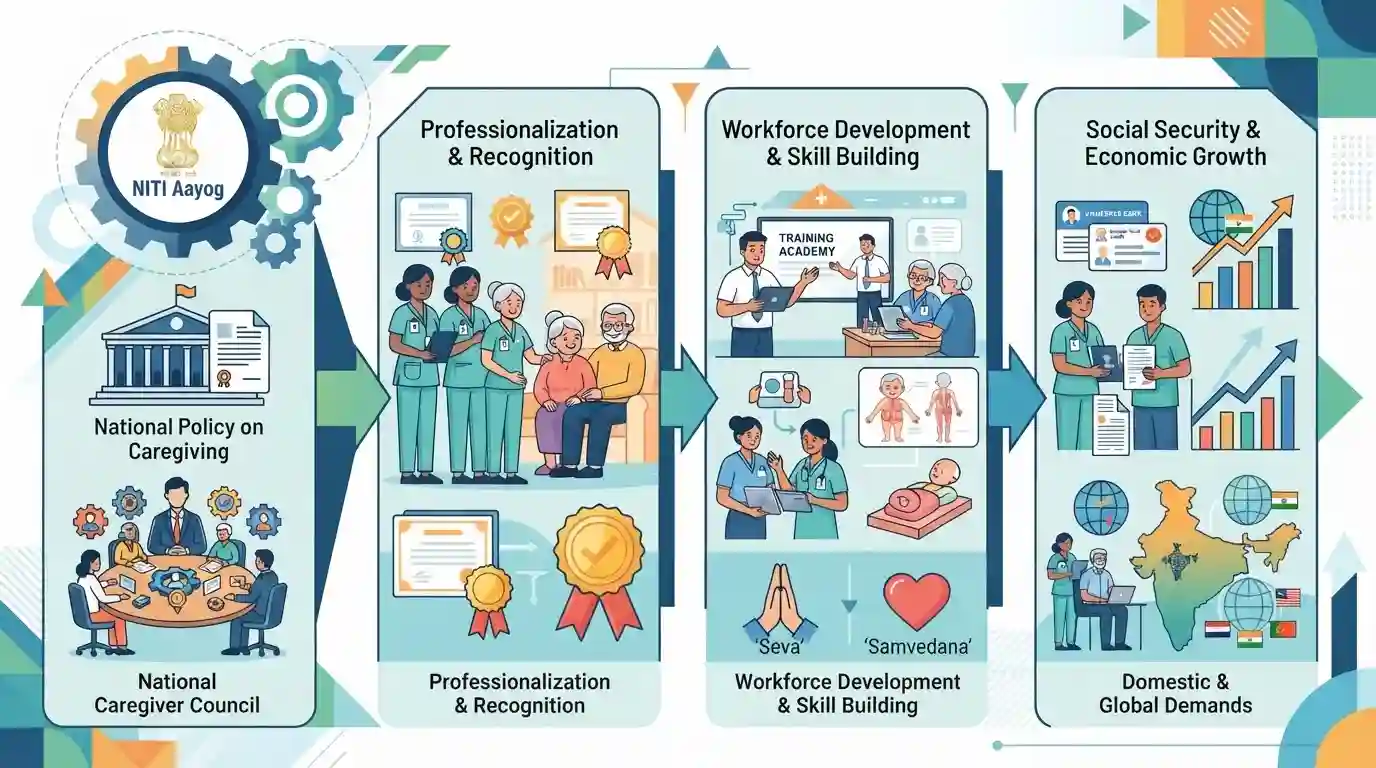
NITI Aayog has unveiled a landmark report titled 'Reimagining Care: Strategies for Empowering Caregivers in Viksit Bharat@2047', aimed at formalizing and professionalizing India's caregiving ecosystem. The report outlines strategic pillars including policy frameworks, professional recognition, workforce development, and social security for caregivers. It proposes the creation of a National Policy on Caregiving and a National Caregiver Council. By recognizing caregiving as a dignified profession, the initiative seeks to meet domestic and global demands, generate significant employment opportunities, and establish India as a global leader in caregiving, integrating traditional values like 'Seva' and 'Samvedana'.
মূল বিষয়
- NITI Aayog released the report 'Reimagining Care: Strategies for Empowering Caregivers in Viksit Bharat@2047' to formalize and organize the caregiving ecosystem.
- The report advocates recognizing caregiving as a skilled and dignified profession, emphasizing professional recognition, social security, and workforce welfare.
- Key recommendations include formulating a National Policy on Caregiving and establishing a National Caregiver Council to regulate and support the sector.
- The initiative aims to address the rising demand for care (due to an aging population), generate employment, and position India as a global leader in professional caregiving.
গুরুত্বপূর্ণ শব্দ
National Policy on Caregiving

A NITI Aayog-proposed framework to formalize India’s caregiving ecosystem by granting professional recognition, standardizing certifications, and expanding social security and fair wages for the care workforce.
UPSC context
Important for GS Paper 2 (Social Justice), highlighting policy interventions needed for India’s growing elderly population and care economy.
National Caregiver Council (NCC)
A proposed apex regulatory body to accredit caregivers, standardize training and certification, oversee workforce planning, and facilitate the international mobility of Indian care professionals.
UPSC context
Relevant for GS Paper 2 (Governance/Regulatory Bodies) and GS Paper 3 (Skill Development) in standardizing the unorganized care sector.
NITI Aayog
The premier policy think tank of the Indian government. It recently launched the "Reimagining Care" report, offering strategic recommendations to transform India into a global caregiving hub.
UPSC context
Core to GS Paper 2 (Governance), emphasizing the institution's role in formulating transformative socio-economic strategies and national planning.
World Health Organization (WHO)
The UN's specialized health agency. Its projections of a global shortage of 11 million health and care workers by 2030 underscore the massive employment opportunity for Indian caregivers.
UPSC context
Key for GS Paper 2 (Health, Global Institutions), linking global healthcare deficits to India's demographic dividend and workforce potential.
International Labour Organization (ILO)
A UN agency focused on advancing social justice and decent work. Its frameworks are vital for formalizing the care economy, ensuring fair labor standards, and protecting caregivers' rights.
UPSC context
Vital for GS Paper 2 (International Organizations) and GS Paper 3 (Employment) regarding labor standards and recognizing unpaid care work.
United Nations Population Fund (UNFPA)
The UN agency addressing population dynamics. It helps formulate responses to India's demographic transition, such as the rapid increase in the ageing population that necessitates structured caregiving services.
UPSC context
Essential for GS Paper 1 (Population Issues) and GS Paper 2 (Social Justice), highlighting the structural challenges of an ageing demographic.
প্রিলিমস ফাঁদ
The National Caregiver Council is an existing statutory body under the Ministry of Health and Family Welfare regulating professional caregivers.
The Council is currently only a proposed body recommended by NITI Aayog's 2026 report, not an established statutory regulator.
সংযুক্ত স্থির ধারণা
What is the "Care Economy" and its significance?
- Definition: It encompasses both paid and unpaid caregiving activities, including childcare, geriatric care, and household domestic services.
- Gender aspect: Unpaid care work is disproportionately performed by women, severely limiting their participation in the formal labor market.
- Demographic pressure: India's rapid demographic transition means the elderly population is expected to double by 2050, escalating healthcare demands.
What is the ILO's 5R Framework for decent care?
- Recognize & Reduce: Acknowledge the economic value of unpaid care work and reduce its burden through public infrastructure and technology.
- Redistribute: Share care work more equitably between men and women, and between households and the state.
- Reward & Represent: Guarantee fair wages, social security, safe working conditions, and collective bargaining rights for professional care workers.
আন্তঃবিষয় প্যাটার্ন
Care infrastructure and the gender dividend
Converting unpaid care work into a formalized, paid sector directly addresses low female labor force participation by reducing women's double-burden of household chores.
Silver economy and demographic shifts
Formalizing geriatric care is critical as India transitions from a demographic dividend to an aging society, preventing household-level catastrophic healthcare expenditures.

Mains 2026 is highly likely to link the care economy's formalization with boosting female labor force participation and aging security.
সংযুক্ত PYQ · 3
সংযুক্ত PYQ · 3
- 2020MainsGS2
In order to enhance the prospects of social development, sound and adequate health care policies are needed particularly in the fields of geriatric and maternal health care. Discuss.
- 2023MainsGS2
Skill development programmes have succeeded in increasing human resources supply to various sectors. In the context of the statement analyse the linkages between education, skill and employment.
- 2016MainsGS2
Demographic Dividend in India will remain only theoretical unless our manpower becomes more educated, aware, skilled and creative." What measures have been taken by the government to enhance the capacity of our population to be more productive and employable?
