Single All India License Introduced for Container Train Operators
Source:PIB ↗
Why It Matters
The reform is critical for GS3 candidates studying India's logistics landscape. Historically, Indian Railways has lost freight share to roadways. Simplifying the Model Concession Agreement (MCA) leverages private sector participation to increase rail freight share, directly addressing high logistics costs in the economy and fulfilling climate commitments via modal shifts from road to rail.
Summary
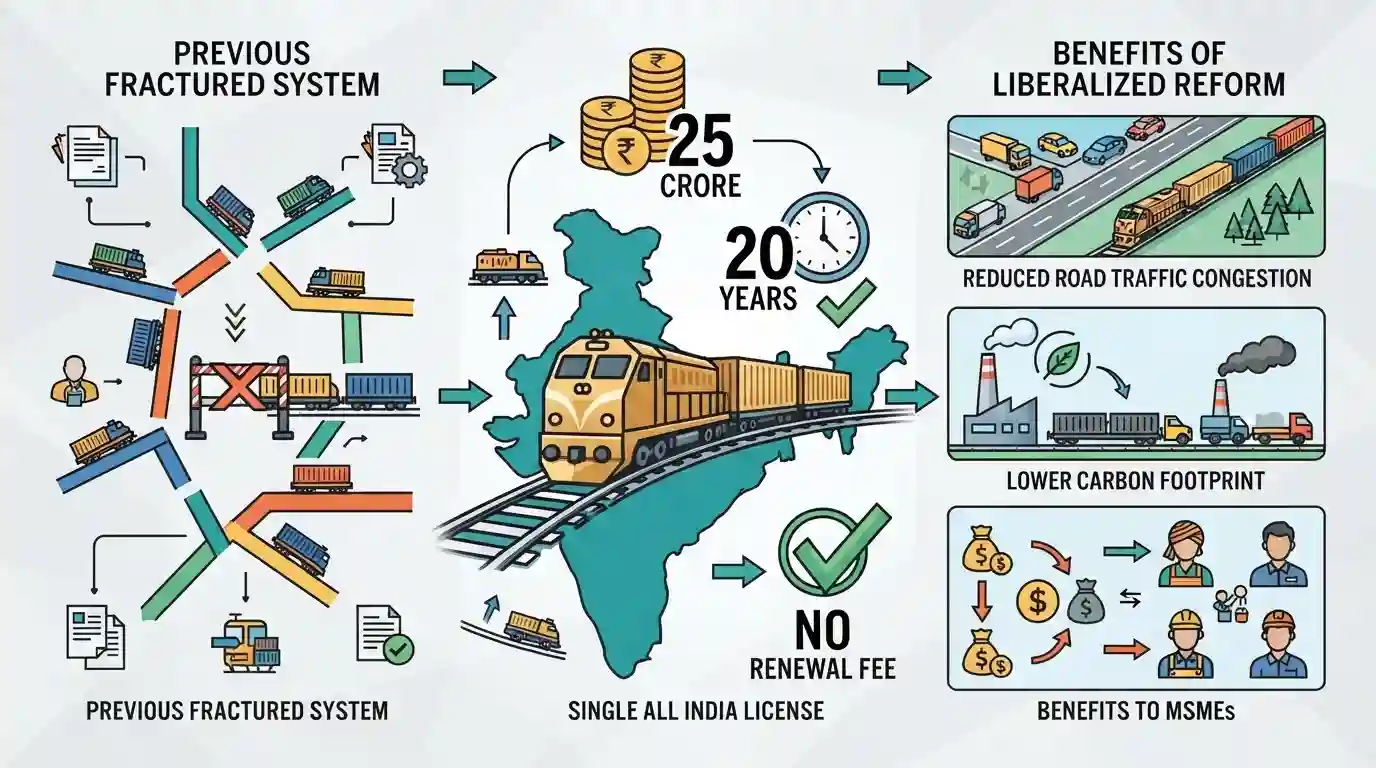
The Indian Railways has overhauled its licensing framework for Container Train Operators (CTOs) by amending the Model Concession Agreement. Moving away from a fractured, route-specific permission system, CTOs can now operate seamlessly across all railway routes via a single All India license for a flat ₹25 crore registration fee. Notably, there will be no renewal fees upon the expiry of the 20-year concession. Transition pathways have also been provided for existing category-specific operators. By simplifying regulatory hurdles and promoting rail freight, this reform supports the National Logistics Policy's aim of cutting supply chain costs (benefiting MSMEs) and mitigating road traffic congestion and carbon footprints.
Key Points
- Indian Railways has amended the Model Concession Agreement to allow Container Train Operators (CTOs) to run on all routes under a single All India license.
- The reform replaces the previous system of route-wise categorization and separate fees, introducing a uniform registration fee of ₹25 crore.
- After the initial 20-year concession period, licenses can be extended without any additional renewal fee, subject to satisfactory performance.
- Existing operators (Categories II, III, and IV) can either continue under their current agreements or pay the fee difference (₹15 crore) to migrate to the new all-route license early.
- This deregulation intends to boost ease of doing business, reduce overall logistics costs for MSMEs, and promote a modal shift of freight from road to rail, subsequently reducing carbon emissions.
Important Terms
Container Train Operators (CTOs)

Private or public entities licensed by the Indian Railways to run container trains, managing cargo logistics and utilizing railway tracks and haulage services to transport goods.
UPSC context
GS Paper III (Infrastructure: Railways); tests transport reforms, private-sector participation, and rail freight efficiency.
Model Concession Agreement (MCA)
A standardized benchmark contractual agreement used in public-private partnership (PPP) projects, defining the roles, risk allocation, and rights of the government and the private operator.
UPSC context
GS Paper III (Investment Models); tests understanding of PPP frameworks and easing private-sector entry in public infrastructure.
National Logistics Policy (NLP)
A government initiative launched in 2022 to reduce transaction and logistics costs, digitize processes, and seamlessly integrate diverse transport modes to boost global competitiveness.
UPSC context
GS Paper III (Infrastructure); tests policies reducing supply-chain bottlenecks and improving multi-modal transport efficiency.
MSMEs
Micro, Small, and Medium Enterprises, classified by investment and turnover under the MSMED Act, 2006, serving as core drivers of grassroots employment and exports.
UPSC context
GS Paper III (Indian Economy); tests knowledge of industrial growth, job creation, and targeted government financial assistance.
Prelims Trap
All existing private container train operators must compulsorily pay a differential fee of ₹15 crore to continue their logistics operations.
Migration is voluntary; existing operators can choose to run under their current terms. Category I operators do not pay any migration or renewal fees.
Static Concepts Connected
What is a Model Concession Agreement (MCA) and how does it facilitate PPPs?
- Definition: A standardized contract baseline establishing terms, risk-sharing, and financial structures between a government entity and private concessionaires.
- Objective: Reduces transaction costs, shortens procurement timelines, and minimizes legal disputes by providing regulatory predictability across infrastructure sectors.
- Risk Allocation: Allocates commercial, financial, and operational risks logically between the public authority and the private partner.
What are the primary targets of the National Logistics Policy (NLP)?
- Cost Reduction: Aims to reduce logistics costs in India from approximately 13-14% of GDP to a competitive single-digit level by 2030.
- Global Ranking: Strives to place India among the top 25 countries in the World Bank's Logistics Performance Index (LPI).
- Modal Shift: Promotes a systemic modal shift from road-dominated transport (~65%) to rail (~27%) and inland waterways.
Cross-Topic Patterns
Logistics costs and MSME export margins
High domestic logistics costs act as an indirect tariff on MSMEs. Standardizing container rail transit directly enhances MSME cost-competitiveness and boosts global export integration.
Modal shift and net-zero goals
Shifting freight from road to rail lowers emissions by nearly 70% per ton-km, serving as a core structural lever for India's Panchamrit climate commitments.

Amendments to PPP concession models (like CTO licensing) will likely be integrated with National Logistics Policy objectives in the 2026 exam.
Linked PYQs · 3
Linked PYQs · 3
- 2022MainsGS3
Why is Public Private Partnership (PPP) required in infrastructural projects ? Examine the role of PPP model in the redevelopment of Railway Stations in India.
- 2023MainsGS3
Faster economic growth requires increased share of the manufacturing sector in GDP, particularly of MSMEs. Comment on the present policies of the Government in this regard.
- 2021MainsGS3
“Investment in infrastructure is essential for more rapid and inclusive economic growth.” Discuss in the light of India's experience.
