Light-Activated Nanobots for Targeted Breast Cancer Therapy
Source:PIB ↗
কেন এটি গুরুত্বপূর্ণ
It provides a concrete, indigenous example of nanotechnology applied to healthcare, specifically targeted drug delivery and cancer treatment. This is highly relevant for GS3 Science & Technology questions on the applications and benefits of nanotechnology in medicine.
সারসংক্ষেপ
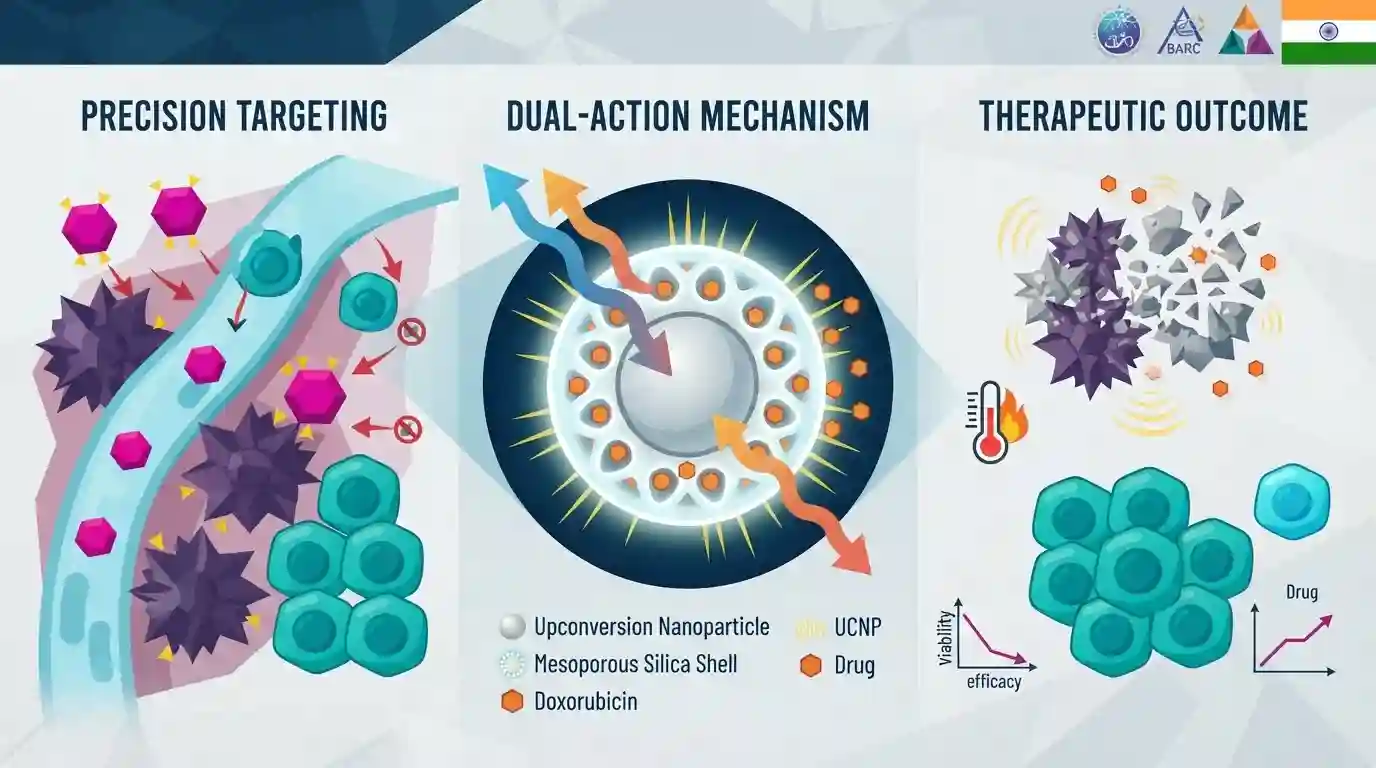
Indian scientists have developed light-activated nanobots for targeted breast cancer therapy, showcasing a major leap in precision medicine. Developed jointly by researchers from INST Mohali and BARC Mumbai, these nanobots use Upconversion Nanoparticles (UCNPs) wrapped in a hollow mesoporous silica shell. They are engineered to convert near-infrared (NIR) light into localized heat (photothermal therapy) while simultaneously delivering the chemotherapy drug doxorubicin. By functionalizing the nanobots with folic acid, they specifically target breast cancer cells, thereby maximizing therapeutic efficacy while minimizing adverse effects on healthy tissues.
মূল বিষয়
- Scientists from INST Mohali and BARC Mumbai have developed light-driven nanobots for targeted breast cancer therapy.
- The nanobots incorporate Upconversion Nanoparticles (UCNPs) that convert near-infrared (NIR) light into heat, enabling localized photothermal therapy and driving directional movement.
- A hollow mesoporous silica shell acts as a carrier to deliver doxorubicin, a standard chemotherapy drug, directly to the tumor.
- The nanobots are surface-functionalized with folic acid, which allows them to recognize and selectively target breast cancer cells, demonstrating precision medicine principles.
- This dual-action mechanism (photothermal and chemotherapy) minimizes damage to surrounding healthy tissues and highlights the practical application of nanotechnology in healthcare.
গুরুত্বপূর্ণ শব্দ
Institute of Nano Science and Technology (INST) Mohali

An autonomous research institution of the Department of Science and Technology under India's Nano Mission, focusing on R&D in nanoscience and nanotechnology.
UPSC context
GS Paper III (Science & Technology); tests knowledge of key national research bodies and policies like the Nano Mission.
Bhabha Atomic Research Centre (BARC) Mumbai
India's premier nuclear research facility, operating under the Department of Atomic Energy, engaged in the peaceful applications of nuclear science, energy, and medicine.
UPSC context
GS Paper III (Science & Technology / Energy Security); tests understanding of India's nuclear energy framework and key scientific institutions.
Nanotechnology
The branch of science and engineering dealing with the design, manipulation, and application of materials and devices on a scale of 1 to 100 nanometers.
UPSC context
GS Paper III (Science & Technology); tests fundamental concepts of nanoscale materials, key scientific policies, and sectoral applications.
Precision Medicine
An innovative medical approach that tailors disease prevention and treatment based on individual variability in genetics, environment, and lifestyle, rather than a one-size-fits-all model.
UPSC context
GS Paper III (Healthcare & Technology); tests understanding of modern biomedical breakthroughs, customized diagnostics, and advanced therapy trends.
Photothermal Therapy (PTT)
A minimally invasive medical treatment that utilizes light-absorbing nanoparticles to convert near-infrared light into localized heat, selectively destroying diseased cells such as cancerous tissue.
UPSC context
GS Paper III (Science & Technology); tests applications of nanotechnology in healthcare, particularly advanced non-invasive cancer therapies.
Targeted Drug Delivery
A pharmaceutical method that selectively transports therapeutic agents directly to diseased tissues, maximizing therapeutic efficacy while minimizing systemic side effects on healthy organs.
UPSC context
GS Paper III (Science & Technology); tests applications of nanotechnology, novel biotechnology, and healthcare sector innovations.
প্রিলিমস ফাঁদ
Nanobots designed for photothermal cancer therapy require high-energy ultraviolet (UV) or visible light to penetrate biological tissues and destroy cells.
UV light is highly phototoxic and has poor tissue penetration. This breakthrough utilizes non-invasive Near-Infrared (NIR) light, which penetrates deeper into tissues safely using upconversion.
সংযুক্ত স্থির ধারণা
What are Upconversion Nanoparticles (UCNPs) and their key optical feature?
- Anti-Stokes emission: UCNPs absorb multiple low-energy, long-wavelength photons (like NIR) and emit a single higher-energy photon (like visible/UV), reversing normal fluorescence.
- High tissue penetration: Because they operate using Near-Infrared light, they can bypass biological tissue barriers without causing phototoxic damage or background interference.
How do Mesoporous Silica Nanoparticles (MSNs) act as advanced drug delivery vectors?
- High porosity: MSNs feature honeycomb-like structures with large surface areas, allowing high-capacity storage of therapeutic drugs inside their nanoscale cavities.
- Controlled release: Their surface can be modified with gatekeepers or targeting ligands to release drugs only in response to specific triggers like pH, heat, or light.
আন্তঃবিষয় প্যাটার্ন
Nuclear tech for civilian healthcare
Collaborations with BARC emphasize India's strategic push to leverage atomic research, nuclear isotopes, and radiation-derived materials for affordable cancer treatment and public health initiatives.
Nanotechnology and IPR barriers
Developing indigenous nanomedicine requires navigating India's Patent Act Section 3(d), requiring clear proof of enhanced therapeutic efficacy to prevent evergreening while securing global drug patents.

Questions on nanotechnology in 2026 will likely test the specific role of Near-Infrared light and nano-carriers over toxic UV methods.
সংযুক্ত PYQ · 2
সংযুক্ত PYQ · 2
- 2015PrelimsGS1
With reference to the use of nano-technology in health sector, which of the following statements is/are correct? 1. Targeted drug delivery is made possible by nanotechnology. 2. Nanotechnology can largely contribute to gene therapy. Select the correct answer using the code given below.
- 2020MainsGS3
What do you understand by nanotechnology and how is it helping in health sector?
