Competition Commission Approves Merger Involving InterGlobe Hotels
Source:PIB ↗
ఇది ఎందుకు ముఖ్యం
This development serves as a practical example of the Competition Commission of India's (CCI) regulatory function in assessing corporate 'combinations'. For UPSC aspirants, understanding how statutory bodies balance the facilitation of business restructuring with the prevention of market monopolies and anti-competitive practices is highly relevant to GS2 (Statutory, Regulatory and various Quasi-judicial Bodies) and GS3 (Economic Growth and Investment Models).
సారాంశం
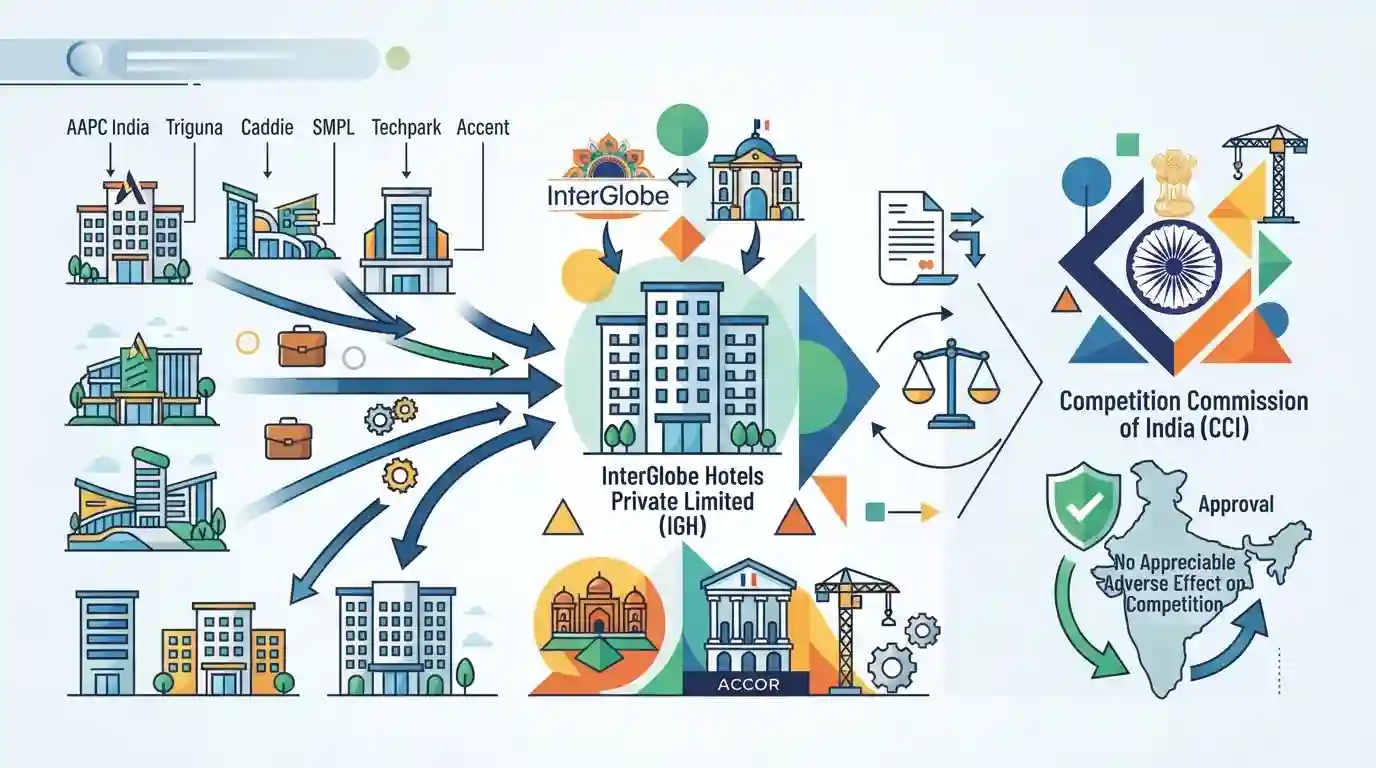
The Competition Commission of India (CCI) has approved a proposed combination involving share acquisitions and the merger of several hospitality-related entities—including AAPC India, Triguna, Caddie, SMPL, Techpark, and Accent—into InterGlobe Hotels Private Limited (IGH). IGH is a significant hospitality venture originally formed between InterGlobe Enterprises and the French multinational Accor to develop hotel brands in India. The consolidation restructures their joint venture portfolio, streamlining the ownership and operations of hotel assets across India under one entity to enhance operational synergies. The CCI cleared the transaction under the Competition Act, 2002, determining that the corporate restructuring does not cause an Appreciable Adverse Effect on Competition (AAEC) within the relevant Indian markets.
ముఖ్య అంశాలు
- The CCI has approved the merger and share acquisitions involving multiple entities, including AAPC India, Triguna, Caddie, SMPL, Techpark, and Accent, into InterGlobe Hotels (IGH).
- InterGlobe Hotels operates as a major joint venture framework between India's InterGlobe Enterprises and the French hospitality multinational Accor, focusing largely on mid-market brands like ibis.
- The restructuring aims to consolidate scattered joint ventures and hotel operating assets (such as Caddie, which owns prominent hotels in Aerocity, New Delhi) into a single centralized entity to streamline management and boost operational efficiencies.
- Under the Competition Act, 2002, the CCI is mandated to review corporate 'combinations' (mergers, amalgamations, and acquisitions) to ensure they do not cause an Appreciable Adverse Effect on Competition (AAEC) in the market.
- The clearance of this large-scale consolidation demonstrates India's maturing regulatory environment for M&A activities and ease of corporate restructuring in the hospitality and tourism sectors.
ముఖ్యమైన పదాలు
Competition Commission of India (CCI)

A statutory body established under the Competition Act, 2002, responsible for promoting fair competition, preventing anti-competitive agreements, and regulating corporate mergers to protect consumer welfare.
UPSC context
GS Paper II (Statutory Bodies) & GS Paper III (Economy). Tests corporate regulatory framework and market governance.
Competition Act, 2002
The primary Indian legislation designed to prevent practices having an adverse impact on market competition, prohibit abuse of dominance, and regulate mergers and acquisitions.
UPSC context
GS Paper II & III. Core legislative framework governing antitrust issues, consumer protection, and ease of doing business.
Appreciable Adverse Effect on Competition (AAEC)
The statutory benchmark under India's competition law used to assess whether market agreements, corporate mergers, or acquisitions significantly distort fair market competition.
UPSC context
GS Paper III (Economy). Tests conceptual clarity on antitrust regulations, market distortions, and corporate consolidations.
InterGlobe Hotels Private Limited (IGH)
An Indian hospitality venture established as a joint venture between InterGlobe Enterprises and France's Accor, focusing on developing and owning mid-market hotel brands.
UPSC context
GS Paper III (Economy). Illustrates foreign joint ventures, service sector growth, and corporate consolidation strategies.
InterGlobe Enterprises
A major Indian conglomerate with extensive operations in aviation, hospitality, logistics, and travel commerce, serving as the parent group for Indigo Airlines and IGH.
UPSC context
GS Paper III (Infrastructure & Services). Examines domestic corporate giants, aviation-led diversification, and FDI integration in hospitality.
Accor
A French multinational hospitality company that owns, manages, and franchises global hotel brands, working via joint ventures to develop business hotels across India.
UPSC context
GS Paper III (Economy/FDI). Represents foreign multinational investment, global brand franchising, and hospitality sector development in India.
ప్రిలిమ్స్ ఉచ్చు
Appeals against decisions of the Competition Commission of India (CCI) lie before the National Company Law Tribunal (NCLT).
Appeals do not go to the primary tribunal (NCLT) or the High Courts; they go directly to the Appellate body (NCLAT), and subsequently to the Supreme Court. Furthermore, CCI is under the Ministry of Corporate Affairs, not Commerce and Industry.
అనుసంధానమైన స్థిర భావనలు
The Raghavan Committee (2000) and the shift from MRTP to Competition Act
- Core Philosophy: Shifted India's regulatory philosophy from penalizing market dominance based on sheer corporate size to promoting healthy market competition.
- Legislative Shift: Repealed the Monopolies and Restrictive Trade Practices (MRTP) Act, 1969, replacing it with the Competition Act, 2002.
- Institutional Result: Established the Competition Commission of India (CCI) as a quasi-judicial statutory body under the Ministry of Corporate Affairs.
What are the three pillars of regulation under the Competition Act, 2002?
- Anti-Competitive Agreements: Section 3 prohibits horizontal (cartels) and vertical agreements that cause an appreciable adverse effect on competition (AAEC).
- Abuse of Dominance: Section 4 prevents dominant enterprises from abusing their market position to exploit consumers or exclude competitors.
- Combination Regulation: Sections 5 & 6 mandate CCI review and approval for mergers, acquisitions, and amalgamations that cross specified financial thresholds.
అంతర-అంశ నమూనాలు
CCI scrutiny vs. Digital Killer Acquisitions
The shift from asset-based thresholds to Deal Value Thresholds shows how regulatory architecture is adapting to prevent big-tech 'killer acquisitions' of asset-light startups.
FDI in Tourism + Corporate Restructuring
100% FDI under the automatic route for tourism, coupled with fast-tracked CCI merger clearances, allows rapid consolidation of international joint-venture hotel portfolios.

2026 Prelims may test the 2023 Deal Value Threshold criteria alongside the exact appellate hierarchy (NCLAT and Supreme Court).
అనుసంధాన PYQలు · 1
అనుసంధాన PYQలు · 1
- 2023MainsGS2
Discuss the role of the Competition Commission of India in containing the abuse of dominant position by the Multi-National Corporations in India. Refer to the recent decisions.
