Central Assistance for SC-ST Atrocities Act Implementation in UP
Source:PIB ↗
આ શા માટે મહત્વનું છે
Highlights the administrative and financial mechanisms of a critical piece of social justice legislation—the SC/ST (Prevention of Atrocities) Act. It exemplifies how Center-State relations operate in the domain of social welfare, delineating the Central assistance model for State-administered law enforcement and victim compensation.
સારાંશ
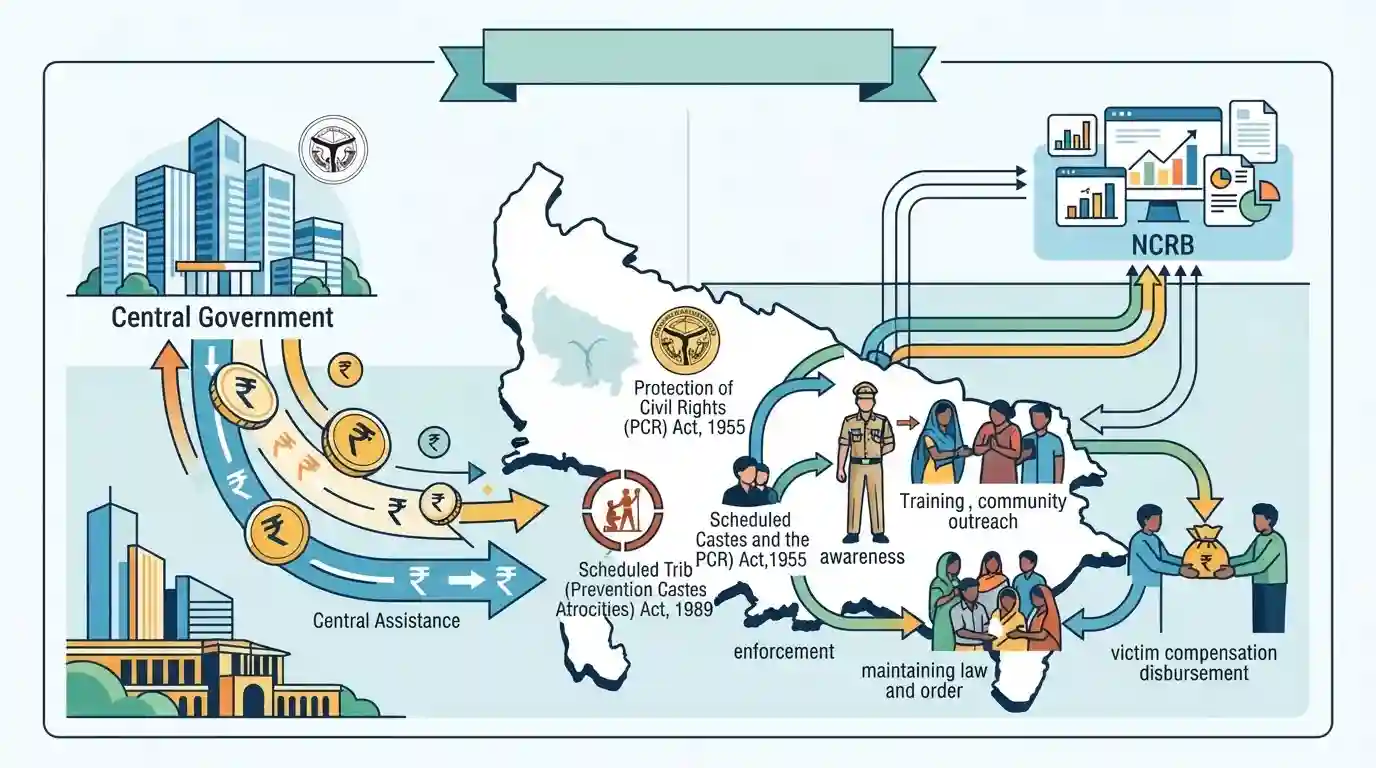
The Ministry of Social Justice and Empowerment has provided central assistance of over ₹747 crore to Uttar Pradesh since 2019-20 to support the enforcement of the Protection of Civil Rights (PCR) Act, 1955, and the Scheduled Castes and the Scheduled Tribes (Prevention of Atrocities) Act, 1989. While the Central Government offers financial aid through a Centrally Sponsored Scheme for victim compensation and awareness, the core responsibility of implementation, maintaining law and order, and direct compensation disbursement lies with the State Governments. The NCRB compiles the broader data on atrocities, reflecting the shared but distinct federal responsibilities in protecting vulnerable sections.
મુખ્ય મુદ્દા
- The Ministry of Social Justice & Empowerment has released ₹747.17 Crore to Uttar Pradesh since 2019-20 under the Centrally Sponsored Scheme for the enforcement of the PCR Act, 1955 and SC/ST (PoA) Act, 1989.
- Police and Public Order are State subjects; thus, the primary responsibility for implementing the PCR and PoA Acts, including security, arrest, and prosecution, lies with the State Governments.
- The Central Government assists States/UTs through a Centrally Sponsored Scheme, covering expenses like incentive for inter-caste marriages, awareness generation, and relief compensation for atrocity victims.
- Relief amounts for atrocity victims range from ₹85,000 to ₹8,25,000 depending on the nature of the offense.
- State/UT Governments disburse this compensation directly to the victims' bank accounts; the Centre does not maintain data on district-wise individual disbursement.
મહત્વપૂર્ણ શબ્દો
Scheduled Castes and the Scheduled Tribes (Prevention of Atrocities) Act, 1989

A landmark Indian law enacted to prevent caste-based discrimination, violence, and atrocities against SC and ST communities, ensuring speedy justice, victim rehabilitation, and prohibiting anticipatory bail for offenders.
UPSC context
GS Paper II (Polity & Social Justice); tests knowledge of legal protections and constitutional safeguards for vulnerable sections.
Protection of Civil Rights (PCR) Act, 1955
A federal Indian statute enacted to enforce Article 17 of the Constitution by prescribing punishments for preaching or practicing "untouchability" and imposing social or religious disabilities on any person.
UPSC context
GS Paper II (Polity & Social Justice); checks understanding of fundamental rights and statutory provisions against untouchability.
Centrally Sponsored Scheme for Implementation of the PCR and SC/ST (PoA) Acts
A joint central-state funding initiative to ensure effective enforcement of civil rights and anti-atrocity acts, providing victim relief, supporting special courts, and incentivizing inter-caste marriages.
UPSC context
GS Paper II (Welfare Schemes & Governance); tests knowledge of central funding mechanisms and institutional support for marginalized communities.
National Crime Records Bureau (NCRB)
A central agency under the Ministry of Home Affairs responsible for compiling, analyzing, and publishing annual nationwide crime data, serving as a critical repository for public safety policy.
UPSC context
GS Paper II (Governance & Statutory Bodies); tests analysis of crime statistics and institutional frameworks for law enforcement.
Ministry of Social Justice and Empowerment
The nodal Ministry of the Government of India responsible for welfare, social justice, and empowerment of marginalized sections, including Scheduled Castes, OBCs, and persons with disabilities.
UPSC context
GS Paper II (Welfare Schemes & Ministries); assesses understanding of government machinery tasked with securing social justice.
પ્રિલિમ્સ ટ્રેપ
The Central Government maintains a centralized, district-wise database of individual beneficiary compensation disbursements under the SC/ST (PoA) Act.
Direct compensation is disbursed by State/UT governments. The Central government acts as a funding facilitator under a CSS and does not maintain micro-level individual transaction logs.
સંલગ્ન સ્થિર ખ્યાલો
What is the constitutional link between Article 17 and Article 35?
- Article 17: Abolishes 'untouchability' and declares its practice in any form as a punishable offence.
- Article 35(a)(ii): Restricts the power to make laws prescribing punishment for Article 17 violations exclusively to Parliament, denying it to state legislatures.
- Enabling Statutes: Passed by Parliament under this exclusive authority to give teeth to the constitutional prohibition of caste discrimination.
How does the SC/ST (PoA) Act divide federal administrative duties?
- State Responsibility: Core enforcement, including registering FIRs, investigation, arrests, and physical distribution of compensation, belongs to States since 'Police' is a State subject.
- Central Responsibility: Acts as a policy facilitator, compiling nationwide data via NCRB and funding administrative machinery through a 50:50 Centrally Sponsored Scheme.
- Committed Liability: States bear recurring administrative costs, while non-recurring costs (e.g., victim compensation, inter-caste incentives) are shared dynamically.
આંતર-વિષય પેટર્ન
Fiscal Federalism + Social Welfare Funding
Shared-cost Centrally Sponsored Schemes (CSS) for civil rights protection highlight fiscal tension, where poorer states struggle with matching funding (50:50) for constitutional welfare mandates.
Administrative Discretion vs. Civil Rights Laws
The judicial requirement of an administrative enquiry before prosecuting public servants under Section 4 balances strict penal enforcement of social welfare laws with civil service protection.

Constitutional questions on Art 35 legislative monopoly combined with Section 4 procedural safeguards under SC/ST Act likely in 2026.
સંલગ્ન PYQ · 4
સંલગ્ન PYQ · 4
- 2023MainsGS2
“Development and welfare schemes for the vulnerable, by its nature, are discriminatory in approach.” Do you agree? Give reasons for your answer.
- 2019MainsGS2
Performance of welfare schemes that are implemented for vulnerable sections is not so effective due to absence of their awareness and active involvement at all stages of policy process. Discuss.
- 2024MainsGS2
What changes has the Union Government recently introduced in the domain of Centre-State relations ? Suggest measures to be adopted to build the trust between the Centre and the States and for strengthening federalism.
- 2026PrelimsGS1
Consider the following statements about the provisions pertaining to the Scheduled Castes and the Scheduled Tribes in India : 1. Provisions regarding the administration of the Tribal Areas in the States of Assam, Meghalaya, Tripura and Mizoram are given in the Fifth Schedule of the Constitution of India. 2. Some tribes of India are entitled to exemption from paying Income Tax on certain incomes. 3. The Constitution of India provides for reservation of seats in Panchayats for women belonging to the Scheduled Castes and the Scheduled Tribes. Which one of the following conclusions based on the above statements is correct ?
