Nationwide Survey Reports Complete Eradication of Manual Scavengers
Source:PIB ↗
Why It Matters
The eradication of manual scavenging is a defining parameter for social justice and human dignity in India, heavily linked to the abolition of untouchability (Article 17) and the Right to Life (Article 21). UPSC repeatedly tests candidates on schemes aimed at vulnerable sections and the distinction between dry latrine scavenging and hazardous sewer cleaning, making the NAMASTE scheme and PEMSR Act highly relevant for GS Paper 2.
Summary
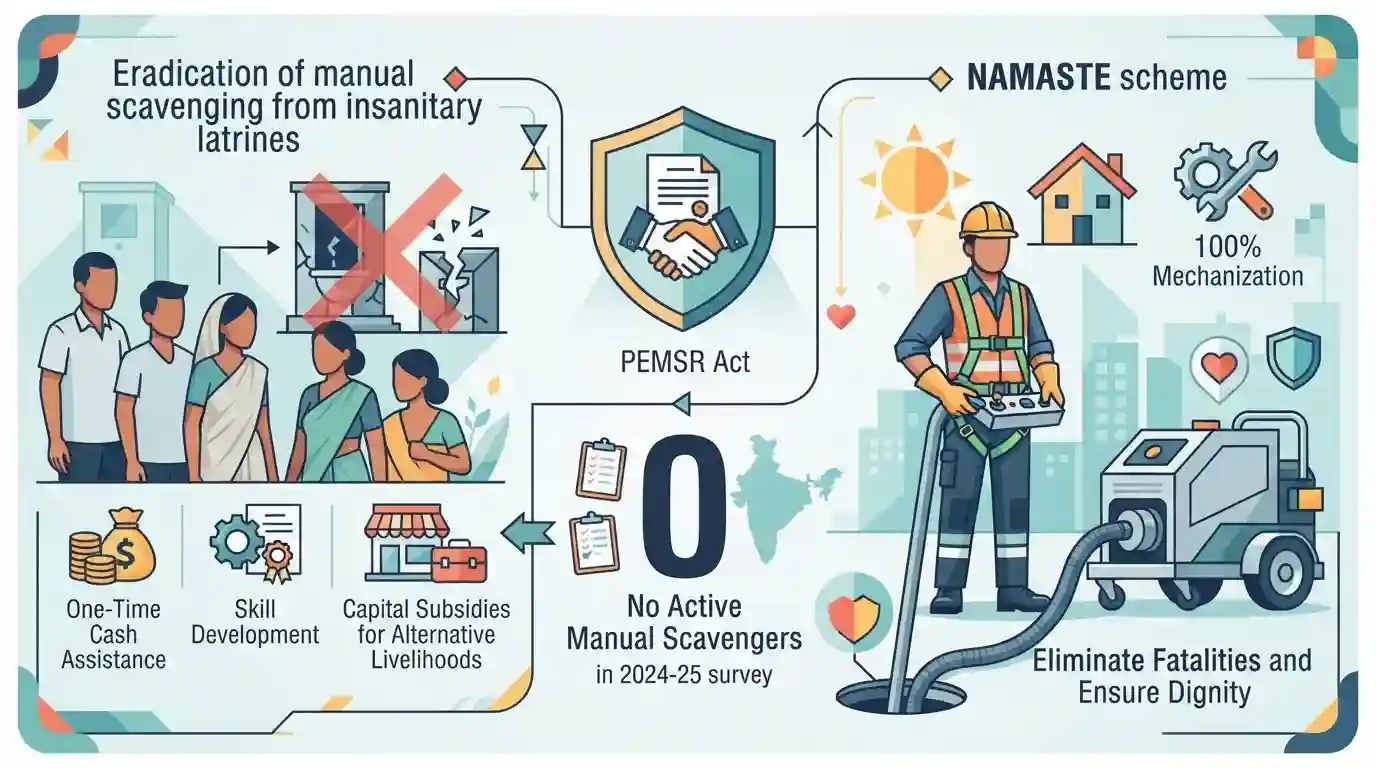
The Ministry of Social Justice and Empowerment has announced that a fresh nationwide survey conducted during 2024-25 found no active manual scavengers across India. This aligns with the government's persistent efforts to eradicate the dehumanizing practice, enforced legally through the Prohibition of Employment as Manual Scavengers and their Rehabilitation Act, 2013 (PEMSR Act). The 58,098 manual scavengers identified in earlier surveys (2013 and 2018) have been provided with comprehensive rehabilitation, including One-Time Cash Assistance, skill development, and capital subsidies for alternative livelihoods. Having addressed manual scavenging from insanitary latrines, the government has launched the NAMASTE scheme to tackle the parallel issue of hazardous cleaning of sewers and septic tanks. By promoting 100% mechanization and equipping sanitation workers (Safai Mitras) with safety gear and machines, NAMASTE aims to eliminate fatalities and ensure dignity for sanitation workers.
Key Points
- A fresh nationwide survey conducted in 2024-25 has found zero active manual scavengers in India, marking a milestone in the government's eradication efforts.
- The Prohibition of Employment as Manual Scavengers and their Rehabilitation Act, 2013 (PEMSR Act) strictly bans the manual cleaning of insanitary latrines.
- Previously identified manual scavengers (58,098 identified in 2013 and 2018) have been fully rehabilitated with One-Time Cash Assistance (OTCA) of ₹40,000, skill training, and capital subsidies.
- The government's focus has transitioned to the NAMASTE scheme, a joint initiative of MoSJE and MoHUA, which replaced the older SRMS program.
- NAMASTE aims to achieve zero fatalities in sanitation work by ensuring the complete mechanization of the hazardous cleaning of sewers and septic tanks.
Important Terms
Prohibition of Employment as Manual Scavengers and their Rehabilitation Act, 2013 (PEMSR Act)

An Indian statute that criminalizes manual scavenging and hazardous cleaning of sewers and septic tanks without protective gear, while mandating the comprehensive identification and socio-economic rehabilitation of affected sanitation workers and their families.
UPSC context
GS Paper II: Social Justice and Governance. Tests understanding of statutory mechanisms protecting vulnerable sections, human rights, and social rehabilitation policies.
National Action for Mechanised Sanitation Ecosystem (NAMASTE) Scheme
A joint Central Sector Scheme of MoSJE and MoHUA aimed at eliminating hazardous manual cleaning of sewers/septic tanks, promoting 100% mechanization, and providing safety gear, health insurance, and alternative livelihood support to sanitation workers.
UPSC context
GS Paper II & III: Welfare schemes, Urban Infrastructure. Tests knowledge of technological interventions in sanitation, worker safety, and social security.
Self-Employment Scheme for Rehabilitation of Manual Scavengers (SRMS)
A Central Sector Scheme under MoSJE designed to rehabilitate identified manual scavengers and their dependents in alternative occupations through one-time cash assistance, capital subsidies, skill development training, and concessional loans.
UPSC context
GS Paper II: Welfare Schemes for Vulnerable Sections. Tests understanding of rehabilitation strategies, financial inclusion, and occupational transitions for marginalized communities.
National Safai Karamcharis Finance and Development Corporation (NSKFDC)
A Section 8 not-for-profit government company under MoSJE acting as the nodal agency for socio-economic upliftment of Safai Karamcharis, waste pickers, and manual scavengers by offering concessional loans, skill training, and capital subsidies.
UPSC context
GS Paper II: Statutory, regulatory, and quasi-judicial bodies. Tests institutional mechanisms for the economic empowerment and welfare of marginalized sanitation communities.
Ministry of Social Justice and Empowerment
The nodal ministry of the Government of India responsible for welfare, social justice, and empowerment of disadvantaged and marginalized sections, including Scheduled Castes, OBCs, persons with disabilities, and sanitation workers.
UPSC context
GS Paper II: Governance and Social Justice. Tests knowledge of administrative structures, executive policies, and social welfare programs targeting vulnerable groups.
Ministry of Housing and Urban Affairs
The nodal ministry of the Government of India responsible for formulation of policies, administration of schemes, and development of urban infrastructure, housing, and city-level sanitation systems across the nation.
UPSC context
GS Paper II & III: Government policies and Urbanization. Tests understanding of municipal governance, urban sanitation, and mechanization of public utilities.
Prelims Trap
The 2024-25 survey indicates India has completely eliminated the hazardous cleaning of sewers and septic tanks.
The survey found zero manual scavengers (cleaning insanitary latrines). It does not claim an end to hazardous sewer/septic tank cleaning, which the NAMASTE scheme aims to mechanize.
Static Concepts Connected
How does the PEMSR Act distinguish manual scavenging from hazardous cleaning?
- Manual Scavenging: Lifting human excreta manually from insanitary latrines, railway tracks, or open drains. This practice is entirely prohibited under the Act.
- Hazardous Cleaning: Entering sewers or septic tanks without prescribed protective gear or cleaning devices. It is severely restricted but legally permitted if safety protocols apply.
Which Fundamental Rights directly protect individuals from practices like manual scavenging?
- Article 17: Abolishes untouchability and its practice in any form. Manual scavenging is structurally rooted in traditional caste-based untouchability.
- Article 21: Guarantees the right to life with human dignity. The Supreme Court has repeatedly cited this to condemn the degrading nature of manual scavenging.
- Article 23: Prohibits forced labor and beggar. This is relevant as marginalized communities are often socially coerced into continuing this occupation.
Cross-Topic Patterns
Mechanization of urban sanitation
The NAMASTE scheme bridges Social Justice (caste rehabilitation) with Urban Affairs (Swachh Bharat/AMRUT), transforming urban local bodies' approach to municipal sanitation via mandatory mechanization.
Shift from cleanliness to human dignity
While the 1993 Act viewed manual scavenging primarily as a sanitation issue, the 2013 PEMSR Act treats it as a fundamental human rights violation requiring mandatory economic rehabilitation.

Expect a Prelims question contrasting the PEMSR Act's strict ban on manual scavenging with NAMASTE's focus on mechanizing sewer cleaning.
Linked PYQs · 2
Linked PYQs · 2
- 2016PrelimsGS1
'Rashtriya Garima Abhiyaan' is a national campaign to
- 2014MainsGS2
Do government's schemes for up-lifting vulnerable and backward communities by protecting required social resources for them, lead to their exclusion in establishing businesses in urban economies ?
