Economically Weaker Sections Reservation Criteria and Objectives
Source:PIB ↗
কেন এটি গুরুত্বপূর্ণ
The EWS reservation signifies a paradigm shift in India's affirmative action framework, recognizing economic backwardness as a standalone criterion for state support. Clarity on the eligibility thresholds is critical for minimizing inclusion/exclusion errors, effectively delivering social welfare, and navigating the ongoing debates around the 50% reservation cap and the Constitution's basic structure.
সারসংক্ষেপ
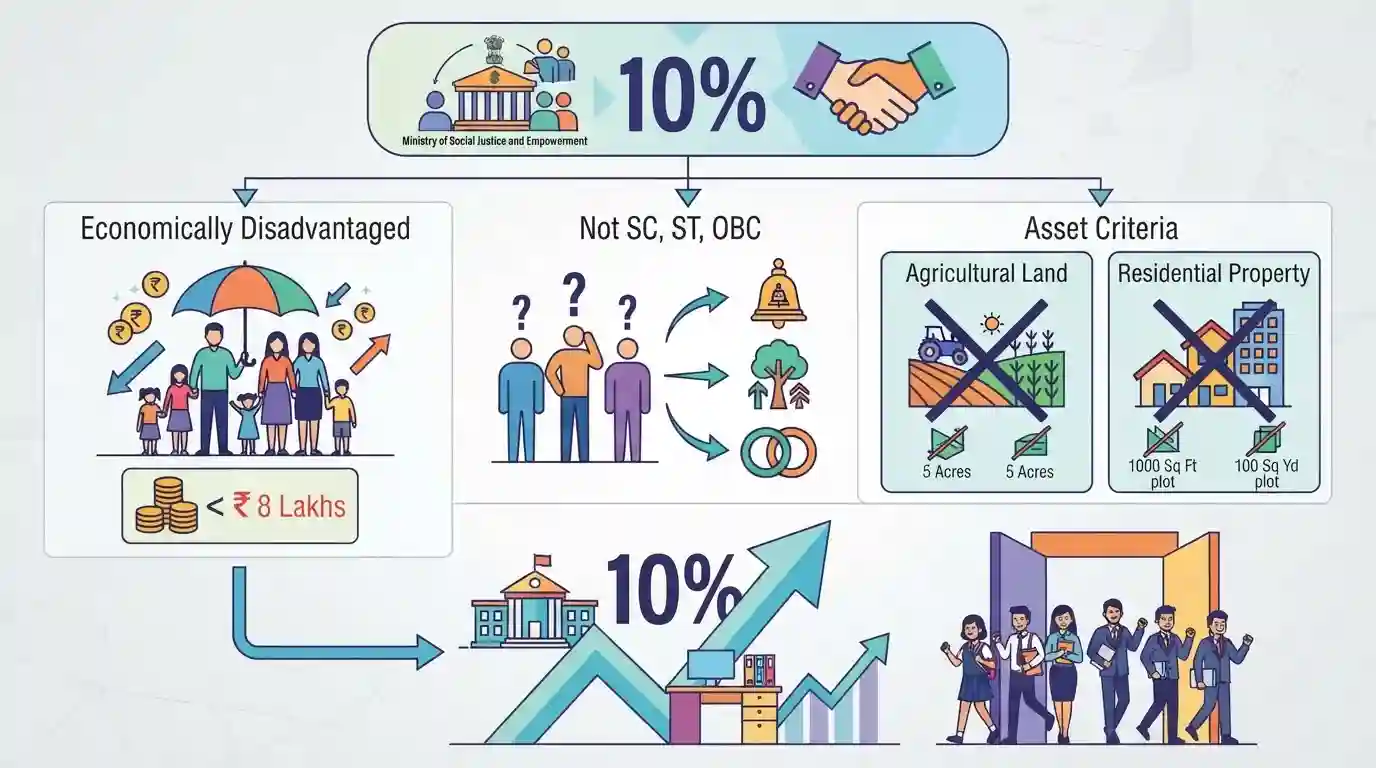
The Ministry of Social Justice and Empowerment has clarified the objective and eligibility criteria for the 10% reservation designated for Economically Weaker Sections (EWS). The policy targets economically disadvantaged individuals who do not fall under the existing SC, ST, or OBC quotas. Eligibility is primarily determined by a family income threshold of under Rs. 8 lakh per annum, alongside strict asset-based exclusion criteria involving agricultural land ownership and residential property size to ensure the benefits reach the genuinely marginalized.
মূল বিষয়
- The EWS reservation provides a 10% quota in educational institutions and public employment for individuals not covered under SC, ST, or OBC categories.
- Eligibility requires the gross annual family income from all sources to be below Rs. 8 lakh.
- Exclusion criteria apply irrespective of income, disqualifying families that own 5 or more acres of agricultural land, residential flats of 1000 sq ft and above, or residential plots exceeding specified limits (100 sq yards in notified municipalities, 200 sq yards in other areas).
- The reservation is constitutionally backed by the 103rd Amendment Act, which inserted Articles 15(6) and 16(6) into the Constitution of India.
গুরুত্বপূর্ণ শব্দ
Economically Weaker Sections (EWS) Reservation

A policy providing a 10% quota in government jobs and educational institutions for financially disadvantaged General Category citizens whose family income is below ₹8 lakh annually, and who are not covered under SC/ST/OBC quotas.
UPSC context
GS Paper II (Polity and Social Justice); tests knowledge of welfare mechanisms, reservation policies, and socioeconomic equity measures in India.
103rd Constitutional Amendment Act
A 2019 legislation that amended Articles 15 and 16 of the Constitution of India, empowering the state to provide up to 10% reservation in jobs and educational admissions for the Economically Weaker Sections.
UPSC context
GS Paper II (Polity and Constitution); tests understanding of constitutional amendments, fundamental rights, and key Supreme Court landmark judgments.
Ministry of Social Justice and Empowerment
The central ministry in India responsible for welfare, social justice, and empowerment of marginalized groups, including Scheduled Castes, Other Backward Classes, Economically Weaker Sections, and persons with disabilities.
UPSC context
GS Paper II (Welfare Schemes); tests knowledge of administrative mechanisms, government ministries, and policies for vulnerable sections of society.
প্রিলিমস ফাঁদ
Any Indian citizen earning less than Rs. 8 lakh annually is eligible for the 10% EWS reservation quota.
SC, ST, and OBC candidates are strictly excluded from the EWS category, regardless of their low income, to prevent overlapping reservation benefits.
সংযুক্ত স্থির ধারণা
What did the 103rd Constitutional Amendment Act change?
- Articles Added: Inserted Articles 15(6) and 16(6) to enable up to 10% reservation for economically weaker sections in education and public employment.
- Scope: Applies to admissions in educational institutions, including private aided or unaided institutions, but specifically excludes minority educational institutions.
- New Metric: Introduced purely economic criteria (income and assets) for reservation, independent of traditional social and educational backwardness.
What was the significance of the Janhit Abhiyan v. Union of India (2022) ruling?
- Basic Structure: A 5-judge Supreme Court bench ruled 3:2 that the 10% EWS quota does not violate the Basic Structure of the Constitution.
- 50% Limit Breached: The Court clarified that the 50% ceiling established in the Indira Sawhney case (1992) is not inflexible and applies only to SC/ST/OBC reservations.
- Exclusion Validated: Upheld the exclusion of SCs, STs, and OBCs from EWS, as they already enjoy benefits under other constitutional provisions.
আন্তঃবিষয় প্যাটার্ন
Affirmative action vs. Poverty alleviation
Using reservations as a tool for poverty alleviation shifts the traditional, historical remedial role of affirmative action (social justice) toward basic economic welfare.
Cooperative Federalism in quotas
States maintain the authority to determine their own EWS criteria for state services, showcasing decentralization within national welfare frameworks.

Expect a 2026 Mains question analyzing if EWS reservation dilutes the original compensatory discrimination model based on social backwardness.
সংযুক্ত PYQ · 2
সংযুক্ত PYQ · 2
- 2019MainsGS2
Performance of welfare schemes that are implemented for vulnerable sections is not so effective due to absence of their awareness and active involvement at all stages of policy process. Discuss.
- 2025MainsGS2
Indian Constitution has conferred the amending power on the ordinary legislative institutions with a few procedural hurdles. In view of this statement, examine the procedural and substantive limitations on the amending power of the Parliament to change the Constitution.
