UGC Regulations and Prevention of Misleading EdTech Platforms
Source:PIB ↗
Why It Matters
This highlights the critical governance challenge of regulating the rapidly expanding digital education sector. It is highly relevant for GS Paper 2 (Issues relating to the development and management of Social Sector/Services relating to Education) as it underscores the balance between promoting online learning under NEP 2020 and protecting students from commercial exploitation and academic fraud.
Summary
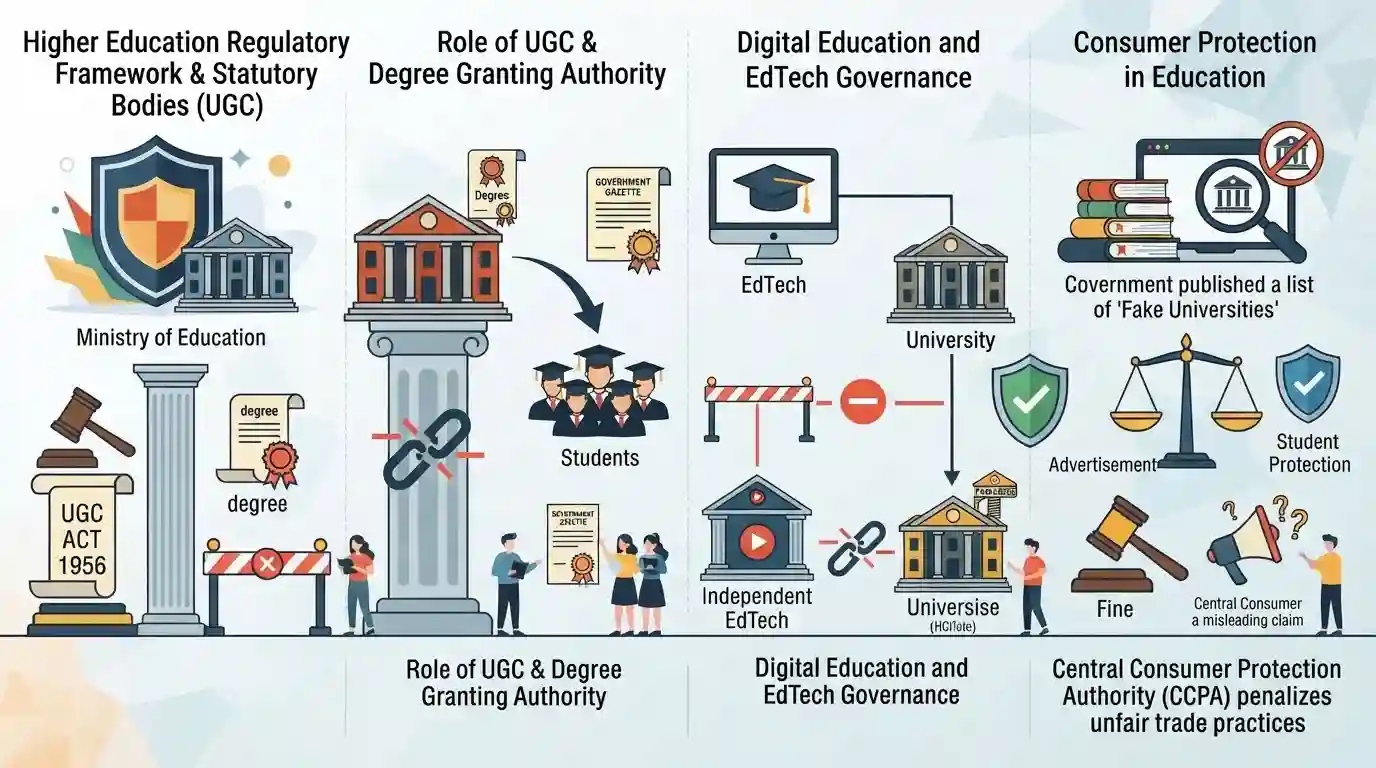
The Ministry of Education and the University Grants Commission (UGC) have reinforced regulatory boundaries to curb the proliferation of misleading EdTech platforms and fake universities. The government has clarified that under the UGC Act, 1956, only statutory universities or deemed-to-be universities hold the authority to grant degrees. EdTech companies are barred from awarding degrees independently or functioning under franchise arrangements with Higher Educational Institutions (HEIs). Furthermore, HEIs permitted to offer online learning cannot franchise their programs. To safeguard students, the government actively publishes lists of fake universities and leverages the Consumer Protection Act, utilizing the Central Consumer Protection Authority (CCPA) to penalize EdTech platforms employing misleading advertisements and unfair trade practices.
Key Points
- Under Section 22 of the UGC Act, 1956, the right to confer degrees is restricted to universities established by Central, State, or Provincial Acts, or institutions deemed to be universities.
- EdTech companies are strictly prohibited from offering degrees or diplomas either independently or through franchise agreements with Higher Educational Institutions (HEIs).
- HEIs that are recognized by the UGC to offer online programs must do so directly and cannot outsource or franchise academic delivery to EdTech platforms.
- The Ministry of Education and UGC regularly issue advisories and publish lists of 'Fake Universities' to warn students against unrecognised institutions.
- Misleading advertisements and predatory marketing by EdTech platforms fall under unfair trade practices, with enforcement driven by the Central Consumer Protection Authority (CCPA) under the Consumer Protection Act.
Important Terms
University Grants Commission Act, 1956

An Act of Parliament that established the UGC as a statutory body responsible for the coordination, determination, and maintenance of standards in university education in India.
UPSC context
GS Paper II (Polity & Governance). Key for questions on higher education regulations, statutory bodies, and university autonomy.
Consumer Protection Act, 2019
A comprehensive legislation replacing the 1986 Act, designed to safeguard consumer rights in the digital age, covering e-commerce, misleading advertisements, and product liability.
UPSC context
GS Paper II (Governance) & GS Paper III (Economy). Tests regulatory mechanisms, consumer dispute resolution, and market-level accountability.
Central Consumer Protection Authority (CCPA)
A regulatory body established under the Consumer Protection Act, 2019, to protect and enforce consumer rights as a class and prevent unfair trade practices and misleading advertisements.
UPSC context
GS Paper II (Statutory Bodies & Governance). Focuses on executive regulatory powers, consumer dispute systems, and business transparency.
University Grants Commission (UGC)
A statutory body under the Ministry of Education charged with coordinating, determining, and maintaining standards of higher education and distributing research/doctoral grants in India.
UPSC context
GS Paper II (Polity & Governance). Essential for analyzing the administration of higher education and federal relations in educational institutions.
National Education Policy (NEP) 2020
A comprehensive policy framework launched in 2020 aiming to transform India's education system across school and higher education levels through access, equity, quality, affordability, and accountability.
UPSC context
GS Paper II (Social Justice/Education). Frequently tested regarding systemic reforms, pedagogical structures, and challenges in implementing federal education policies.
Advertising Standards Council of India (ASCI)
A voluntary, non-profit self-regulatory organization established in 1985 to promote honest, decent, and truthful advertising while safeguarding Indian consumer interests.
UPSC context
GS Paper II (Governance) & GS Paper IV (Ethics). Tests ethical communication, self-regulation frameworks, and protecting consumers from misleading claims.
Prelims Trap
HEIs can legally outsource or franchise the delivery of their recognized online degrees to registered EdTech platforms.
UGC strictly prohibits HEIs from outsourcing or franchising academic delivery. Online degrees must be delivered directly by the recognized university itself.
Static Concepts Connected
What is a 'Deemed-to-be University' under the UGC Act?
- Statutory basis: Granted by the Central Government on the advice of UGC under Section 3 of the UGC Act, 1956.
- Autonomy level: Enjoys full autonomy in designing syllabus, setting fees, determining admission criteria, and conducting examinations.
- Degree-conferring power: Holds the legal authority to award degrees under its own name without being established by a specific Act of Parliament.
What is the role of the CCPA under Consumer Protection?
- Establishment: Established under Section 10 of the Consumer Protection Act, 2019, to protect and enforce consumer rights.
- Key powers: Empowered to recall unsafe goods, order refunds, and penalize manufacturers or endorsers of misleading advertisements.
- Educational oversight: Regulates the coaching and education sector by banning deceptive claims regarding success rates and ranks.
Cross-Topic Patterns
EdTech vs Right to Education
Commercialization of digital education by unregulated EdTech firms creates a dual-class system, threatening equitable access and educational equity under Article 21A.
Consumer Protection vs Academic Governance
Treating students as consumers under the CCPA marks a shift in educational oversight, moving regulatory teeth from academic bodies (UGC) to market-conduct authorities.

Regulatory overlap between CCPA guidelines on coaching ads and UGC rules on online degree delivery likely to be tested in CSE 2026.
Linked PYQs · 3
Linked PYQs · 3
- 2015MainsGS2
The quality of higher education in India requires major improvements to make it internationally competitive. Do you think that the entry of foreign educational institutions would help improve the quality of higher and technical education in the country? Discuss.
- 2020MainsGS2
National Education Policy 2020 is in conformity with the Sustainable Development Goal-4 (2030). It intends to restructure and reorient education system in India. Critically examine the statement.
- 2021MainsGS2
Has digital illiteracy, particularly in rural areas, coupled with lack of Information and Communication Technology (ICT) accessibility hindered socio-economic development? Examine with justification.
